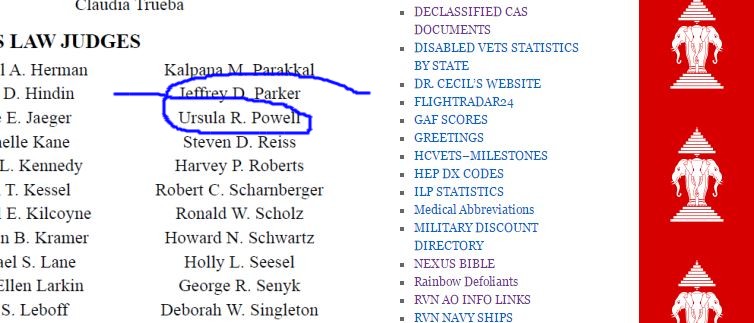
 A Vet on our sister site at Hadit.com has an appeal before VLJ Ursula R. Powell. Judge Ursula is in the habit of signing her decisions U.R. Powell which can cause confusion when you use the VA ‘s searchbar system. VA never heard of of Ursula. Nevertheless she’s mentioned in the BVA’s 2014 Glowing Success Story. Hey, if you’re too lazy to follow the link:
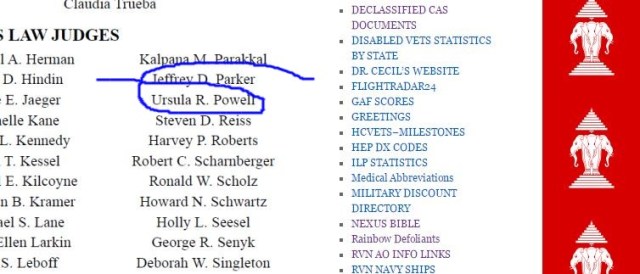
Long story short, the gentleman was reading her newfound decisions (444) and surmised she’s a hanging judge with no love for Veterans. Relax. That’s not news. Any Vet who loses probably feels s/he got the short end of the Punji stick with the brown stuff on it. Fortunately, they aren’t all that way. I’m one for three in the VLJ lotto personally, but the one win was the powerball ticket for my greenhouse and 100% for Porphyria analogous to dialysis. That, in itself, is a tremendous bellweather for others who follow in my path..
The dynamic I see at work from reading a number of decisions follows this particular gem that emanated from the Danial Boone Memorial RO in Louisville, Kentucky. Their local DAV chapter service representative, certified as mentally oriented in all three planes of existence-i.e. free of mental defect- allowed Gomer Pyle, USMC(Vietnam Artilleryman) to file for a higher rating for tinnitus than 10%. DC 6260 is short and sweet. You have two ears. You have one ring. Bilateral minimum is 0% and max is 10%. It’s like a hand grenade. There is no one thousand and four. Certainly, an extraschedular rating for depression secondary to it is for application, but that claim is absent. Any discussion of it is absent. No case has been put forth for a rating higher that 10% based on an extraschedular basis. The only other thing I see in this fustercluck is an equally futile, meritless claim for an earlier effective date for the tinnitus. How can you ask, with a straight face, for that which you never asked for in 1984?
Judge Ursula has him dead to rights. If you had tinnitus in ’84, how come we never heard about it until 2007? VA screwed him by never asking him if his ears rang. DAV, the claims experts, never told him about it even though hearing loss and tinnitus are like mashed potatoes and gravy. Whoever heard of one without the other?
I’m reading a lot of VA regulations because I’m preparing to become a VA claims agent¹. One of them, 38 CFR §14.630-32, discusses filing fraudulent or meritless claims that tie up valuable VA claims resources. This claim is a classic example. DAV has a cadre of “senior expert claims adjudicator representatives” at the BVA who handle all the VSO appeals. They sometimes mix and match using guys from the VFW or AmLeg. They all have one thing in common- no law degree. I think maybe they use ask.com and solicit legal help for about $25/hour on an as-needed basis but that is purely rumor. But….that might explain how this had to get all the way to VLJ “U.R.” Powell’s desk to bring the DAV up to speed on DC 6260.
Johnny Vet already has a 20% for bilateral hearing loss (since 1984) and nobody told him about tinnitus? I want you to let that sink in. No one told him? As in the DAV didn’t ever tell him to file for tinnitus? That’s like free Mardi Gras beads on Fat Tuesday at the VA. So when Gomer goes in for a hearing loss “reassessment” in 2007, he and the VA hearing specialist finally agree that the bodacious ringing noise in his ears for the last 45 years isn’t hearing loss at all-but something called tinnitus.This is an informal or inferred claim. Because it was “discovered” while assessing his hearing in general in June 2007, that is the first knowledge VA had that he was diagnosed with tinnitus. VA, nor DAV, has ever informed him of this entitlement in the 27 years of representing him. Scary, huh? When the VA finds a 10% doggie biscuit and offers it to you free with no strings, it’s easy to figure they felt guilty for funnin’ you all them years they haven’t been paying it-like since 1984. So, who’s to blame? Gomer Pyle for trusting DAV or DAV for having a service representative with the IQ of a pet rock?
Another thing jumps out at us. Gomer’s leagal beagles in Louisville carefully arranged a VLJ Board hearing for him so they could all have a beer summit and iron this out before wasting a lot of VA’s (and Judge Ursula’s) valuable time. For those of you not in the know, a Travel Board hearing is before a live VA Veterans Law Judge. Sometimes you have to wait a year (or more) to get the slot. Here, Gomer and his DAV buddies had specifically requested one in-person rather than the videoconference version which could have been scheduled many, many months earlier. A real face-to face sit down is worth a lot of credibility to a judge, too. That’s why a lot of VA lawyers prefer this when possible. The camera can never capture your earnestness adequately.
So, for Gomer to blow off Judge Ursula and leave her at the judicial altar all alone that morning, one might expect a little animosity-that perhaps Justice Powell might get her undies in a knot. Judge Powell conducts herself very well in spite of the bitchslap.
The Veteran requested a travel Board hearing in his November 2008 substantive appeal. The Veteran received a letter scheduling his hearing for September 2010. The Veteran failed to appear for the hearing. Therefore, as the Veteran has not provided a reason for his failure to appear, the request for a hearing is deemed to have been withdrawn. 38 C.F.R. § 20.704(e) (2011).
So why would Queen Ursula of the “Abandon Faith All Ye Who Enter Here” hall of VLJ justice not be a little brusque with this asinine performance? Well, folks, because she’s a professional. The BVA is more backed up than a shipwrecked sailor with a lifetime supply of canned cheese. If you let this kind of VSO legal help navigate your claim, you are going to incur the ire of a woman who feels she has much weightier things to be adjudicating. I wouldn’t blame her one iota.
CONCLUSIONS OF LAW
3. There is no legal basis for the assignment of a schedular evaluation in excess of 10 percent for bilateral tinnitus. 38 U.S.C.A. §1155; 38 C.F.R. §4.87, Part 4, Diagnostic Code 6260 (2011); Smith v. Nicholson, 451 F.3d 1344 (Fed. Cir. 2006).
I can’t even conceive of doing something like that. Worse, it’s like a booger hanging out of your nose or being one of those Commando jocks (sans underwear) with your pants unzipped and no one telling you about it. Seriously, this made it all the way to the Board of Veterans Appeals after four or five years of ratings back and forth. Shucks, could be they really sucked ol’ Gomer up and also talked him into the DRO review option prior to this fiasco which delayed it another year.
VLJs, with the exception of a few I know personally, are stand up judges but your evidence has to be over the top and better than what the Puzzle Palace clowns generate. Remember, even if you have these bozos dead to rights, the best you get is the “Well, the evidence being pretty much in equipoise, we’re willing to liberally extend the concept of benefit of the doubt on this particular one and grant the claim.”
VA had to sink to that level up at the CAVC in 2013 when the OGC gal said “Well, if you look at this SOC written in 1995, it’s not exactly the model of clarity, now is it? Someone who wrote ‘We received your new evidence with your appeal and we’ll be gettin’ back to you real soon with a new decision after we review it. Hear?’, might mistakenly have thought you’d know they wanted you to drop everything you were doing and file that VA 9 RFN. You can see where the VA raters were confused and didn’t know how to proceed…so from the OGC’s perspective, it appeared for all the world like Grahambo was abandoning the claim.”
No, I don’t see an elevated degree of ire or disgust with Veterans on VLJ Ursula R. Powell’s part. I do see a subtle, angry streak about a mile wide aimed at Zombie VSO reps and their appeals “experts”. That can be said for all VLJs without singling a particular Judge out for his or her conduct. The true test of incompetence or misfeasance would be better researched at the CAVC and the Fed. Circuit. If an inordinate number of her (or any VLJ’s) decisions were reversed or vacated/set aside for error, then possibly yes.
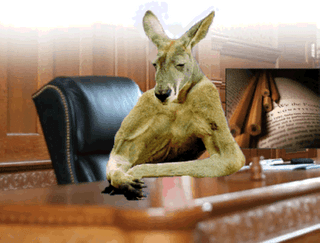
Pardon me counselor. Perhaps you could show me the 20% for tinnitus in DC 6260? I must be blind.
¹ An addendum. I was accredited on 4 August 2016 and accepted to practice at the Court on 11 November 2017. Additionally, Judge Powell granted one of my appeals without much ado in March 2018. I consider her to be very competent and more than fair in her jurisprudence.

 Arliss, the wise old Eleven Bravo Vietnam Vet had six stars on his VSM and was getting on in his years. By now, he was a year-around resident with his high school sweetheart wife in Phoenix. Prodded by his wife, he picked up the phone Wednesday morning early, calling his son Zeb in Nashville to inform him of the impending divorce…







 asknod
 Bethanie Spangenberg
 kcraveiro
 robinhoodesqvetsatty
 Wesley McCauley
