 Sometimes, promised gifts from VA are a long time in coming. Some are rather hollow fulfillments of promised offers. Some are outright scams. The ILP is much the same chimera. It looks so promising from afar in what it offers. Once you get closer, you realize it’s not as advertised according to the salesmen.
ILP, from reading all the statutes and regulations, looks like an offer you can’t refuse. Granted, the price of admission is rather steep. A couple of ratings for tinnitus and hammertoe are not going to get you a slot. First of all, there are only 2,700 openings per year. With a program as ostentatious as this, you’d suspect Vets would be elbowing each other out of the way to get to it. In spite of Bruce McCartney’s and my best efforts to advertise its existence, we only saw 1,426 who got their foot in the door last year. Actually, that is a major decline from the year before. I’m guessing that of the 1,426, the majority got a grab bar or two and an electric can opener.
When I became a concerned Veterans Advocate years ago, I found this program and Bruce. I decided it would be one of the hallmarks of my advocacy so I set out to amass anything and everything I could to help others get there. Obviously, the best way is to be the point man. It’s a steep learning curve but not as lethal as walking point in Qui Nhon at 0darkthiry during Tet in 68. I began with a computer and few other knicknacks. Surprise. Surprise. Surprise. Denied. It was the same for all my friends.
That began the search for what what was necessary to prevail. Et voila! The Administrative Review. Roger that. Get the request out of the hands of the deniers and sent back to DC where they are familiar with the regulations and statute. Sure enough, six months later, I had my computer with all the bells and whistles. They even threw in a guy to teach me Adobe 9 pro and Microsoft Photoshop along with the software. Dragonspeak and lots of other goodies came with it and the largesse now adorns the pages of asknod.
As for the greenhouse, I threw that in as a bridge too far, a desire I felt they would never agree to. I was right. Unfortunately for the Seattle VRE cowboys, they denied it for all the wrong reasons. Using the logic of VRE, they said it wasn’t a vocational goal but rather “avocational” and thus out of bounds. Dumb. Very dumb. That’s how I got the computer-for my avocational needs. You wonder how VRE minds work sometimes.The whole premise of the Independent Living Program is based on you, Mr. severely disabled Vet, never going back to work in a “vocational” pastime. This leaves one alternative from my rather stunted perspective. If you aren’t working, logic says you are going to pursue a hobby to entertain yourself. What you can reasonably expect to do is unfortunately limited by your disabilities-not your imagination. ILP was formulated for just this eventuality. Congress felt bad for handing all us Vietnam Vets the shitty end of the punji stick back in the days right after the Southeast Asia Boundary Dispute so VRE was the tradeoff. A few lucky Vets win the hobby lotto each year and everyone’s a winner.
Sadly, over the years, the IL Program kept getting a haircut by the VRE folks in charge. It was viewed as an expensive trinket Vets were not entitled to. A greenhouse or a woodworking shop before 1996 was the norm. Suddenly, the law was revamped and a chill set in over the entitlement. The Office of General Counsel had to reassert the entitlement’s reach to encompass avocational pursuits all over again in VA OGC Precedent 34-1997. There matters stood for five years until the VRE troops became restless and mounted a new assault in an effort to once and for all eliminate it or make it so difficult to obtain that Veterans would come to view it as a Catch 22 and virtually unattainable for anything of consequence.
Now, to keep the history books straight, keep in mind that at no time has Congress interceded and revamped the controlling statute of 38 USC §3120. That still stands inviolate so all the things promised us in 1982 are still on the table. The problem is getting past the turkeys in charge of the funding. What’s more, the VA Secretary has never changed any of the regulations in 38 CFR that implement §3120 so the program remained much as it was originally promulgated and employed on a day to day basis-that is, until 2001.
VA OGC Precedent 6-2001, while innocuous on its face, introduced a whole new metric to the IL Program. It seemed to concern itself with the legal question of whether certain funds from the Specially Adapted Housing fund (SAH) or the Home Improvement Structural Alterations program (HISA) could be expended for a certain request from a Veteran. The request was for a photo studio which would be an addition to the Veteran’s home. VRE folks argued it was impermissible and asked for guidance. OGC approved the expenditure under the IL Program and added a submarine codicil that it was permissible if it was “necessary and vital” to independence of everyday living. It’s a double-edged sword, though. The OGC also determined every severely disabled Veteran has a right to the outdoors safely and cannot be deprived of that consideration. Et voila. The “greenhouse” codicil if you will.
Suddenly, a new metric was introduced. If a IL request was not absolutely necessary and vital to life, it wasn’t going to be granted. Add in that VRE folk were still mighty disgruntled about that bitchslap over avocational “gifts” in 1997 and suddenly, the IL program went south. It’s never been the same since. The irony is that all these “modifications” to what is, and is not, allowed were done without the approval of Congress. A nuanced reading of 38 USC §3120 and 38 CFR §21.160 is devoid of any of these revelations. Mere mortals who inhabit the halls of power for 20 years have usurped Congress’ edict and begun dictating how the funds will be apportioned. Sadly, ILP is the tail end Charlie in this parade. In order to keep up appearances, VRE sends out a Vocational Rehabilitation Counselor (VRC)to make a needs-based assessment of your situation. Said VRC surveys the house and determines what you might need to gain independence in everyday living but studiously avoids the “avocational” discussion. I have seen more enlightened VRCs offer headphones to plug into a TV (if the TV is equipped to do so) to supplement hearing loss. Most cases are more mundane. A can grabber or electric can opener to cope with peripheral neuropathy.; a grab bar at the toilet or shower to help you rise to the vertical; occasionally a recliner chair with an “eject” function if the VRC is in a good mood. A cordless phone is permissible to help call 911 if you fall down and can’t get up when your spouse is at work and you find yourself alone. Ad nauseum. The sum of all these cheap panaceas fulfills the tenets of what VRE thinks is appropriate for the IL Program. They have become the arbiters of what you will get-not Congress. This is where we found ourselves when I entered the picture.
Bruce had gotten his greenhouse after a four-year battle with the Atlanta RO. They had a whole new measure of respect for what the ILP stood for after that and he had great success advocating for others until recently. VRE, at the local level, is a power unto itself. Nowhere in the VA Table of Organization will you see a VA Officer who reports to no one. Yep. Read that again. Everybody has a boss at VA except the VRE Officer in charge of each RO. He or she alone makes the empirical decisions on who gets what. Guess who loses out in the ILP game? Yeppers. The absolutely, most severely disabled Veterans for whom a program was especially promulgated are fenced out of the very pasture set aside for them. Imagine a corral with no gate. Only at the VA could you have a 180 degree assbackwards result of this magnitude. Keep in mind that there is technically no limit to the amount VRE can expend in providing you with “independence in everyday living”. The devil is in the details and hence the mother of Catch 22s. VRE folk don’t see this as being “adversarial’. It’s all spelled out in the M28 R in clear English. The only problem is the M 28 and its newer successor, the M 28 R, are merely a manual on “how to”. Compare it to the instructions that come with an Ikea bookshelf. Slot peg A into hole B. It is not a controlling regulation or statute. It is merely the machinations of a tired, overpaid VRE dink with a desire for more bonus money. I compare it to a “make work” job. They can’t get rid of ILP so they just hire folks to pretend to award it. In order to do that, they have to have a manual to teach the gomers how to deny. Bingo. Two jobs. One to write the denial technique and one to go out to the Vet’s residence and explain why he isn’t going to get an ILP.
This is what I walked into in 2011. I researched every regulation and followed every link and BVA decision on VRE. It led me to the OGC precedents and far more. After researching the history of 38 USC §3120 and 38 CFR §21.160, it was clear that VRE had arbitrarily made a decision to change their policy and focus strictly on the vocational side of the sheets. All funding for ILP, if not spent in the first nine months of the fiscal year on ILP, automatically reverted back into the “vocational” pot and was no longer available for the last three months. Who decided this? No one was saying. It was just “policy”. This created the habit of denying a ILP until month ten when the question became moot on its face. Problem solved-well-unless someone appealed it to the BVA. Oh shit. Oh dear. Entre moi.
I spent a year trying to get the VRE rangers to issue a NOD to appeal from. The logic was “Put that thought out of your head, boy. ILP is for grab bars. We don’t issue NODs. We deny and you go home emptyhanded.” I wisely opted to skip the administrative review and went for the throat- a full-blown BVA appeal. VRE Seattle “lost” my first Form 9 and closed out the appeal. I showed them the green card and they miraculously ‘found’ the lost VA 9. They then began the “We’re certifying it. Stand by.” excuse for a year in hopes I’d give up. After the first SSOC, I filed a rebuttal and it went unanswered. Again, the hope was that I’d forget and they could send it in the “We never heard from him again” file. I filed the Extraordinary Writ and got the VA 8 issued in February 2015 afterwards. Suddenly, they had nothing left in the tool bag to keep me out of the halls of justice. The BVA Judge saw through the scam and delays and granted the greenhouse but that didn’t daunt these chuckleheads one iota. I have since learned from flies on the wall that a decision was made to grant the greenhouse to keep it out of the CAVC and a panel decision. VRE did not want the ILP advertised far and wide because every Tom, Dick and Harry would be screaming for it in short order.
The Seattle VRE Officer spent four months after the BVA win trying to figure out how to use the M28 R to overrule the BVA Judge’s grant. He finally sought advice -from his superiors in DC. They had to sadly tell him he owed me a greenhouse. That didn’t even faze him in the least. He proceeded to figure out the least amount that could be expended locally and keep the project in his control. Knowing I’d blow an ass gasket and complain, he constructed a plan to avoid the stakeholder process and hand it to me as a fait accompli-take it or leave it. If I refused, in his eyes, the problem was solved. Veteran refuses to play ball. We did all we could. No flies on us. We gave him exactly what he asked for-albeit in May 2011 rather than what he needs in 2016…
That’s the beauty of Extraordinary Writs of Mandamus. You can’t hide your lyin’ eyes, hoss. At some point, they open the books and see who’s been naughty and who’s been nice. This also opens up the whole ILP to inspection and exposes ugly truths that have been afoot for decades. Towards that end, this ILP’s for you, folks. To be truthful, I could buy that $120 K greenhouse out of my pocket. I’d be eating bread and water and have a second mortgage and a Home Equity Line of Credit (HELOC) right off the map to do it but that’s immaterial. The program exists for severely disabled Veterans-the most severely disabled of all. There is no means test or whether it’s necessary and vital. There is no “avocational” test to pass that would disqualify you. All those roadblocks were instituted by mean-spirited SES types who desired more power and felt we are not entitled to such frills. Of course, they, on the other hand, are free to move about the country every three years with housing stipends and $150 K salaries with all manner of “work from the home” subsidies and codicils. Sauce for the goose is not in their lexicon.
Consider this metric. Mr. David Boyd is paid about $114 K a year as a GS 14 in Seattle to head up the VRE. His sidekick Kris Holloway makes about $101 K. The VA has paid them salaries equivalent to $1 million dollars or more over the last five years to deny me a greenhouse I estimated would cost $5,000 in 2011. I was pretty naive back then and would have settled for far less. As I became more knowledgeable (and far more disabled), that figure rose to $130, 000. A BVA appeal, a VLJ’s wages, two Extraordinary Writs that occupied two CAVC judges at God knows how much dinero and here we are in 2016. The greenhouse is still due and owing and no one has lifted a finger to begin production yet.
The VA Secretary has taken the project away from Mr. Boyd and returned it to Washington DC. We expect a response sometime in 2017 judging from prior performance metrics. Maybe 2018.
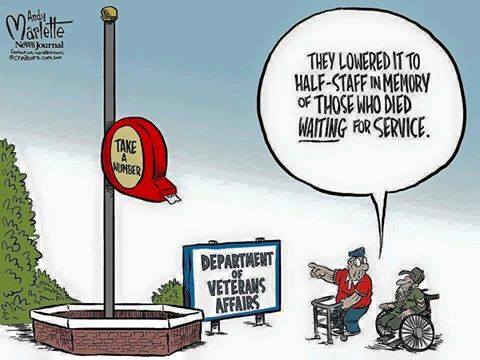
And we wonder why VA is begging for more funding to accomplish their mission? The Gods must be crazy. Share this Veteran’s Story with your friends and neighbors. It ought to give them a whole new appreciation for sick humor. It also supplements the Delay and Deny paradigm we often talk about. I can’t make this stuff up. Really.
Today, I see the CAVC has added my latest update to the ECF docket and I hope Judge Meg Bartley is suitably appalled. Sadly, in all her years at NVLSP, I’m sure she has witnessed far worse. VA’s adversarial posture is thinly masked and poorly camouflaged.

This is the eighth in a series on CAVC #16-2098. To view the next installment click here
https://asknod.org/2016/08/26/cavc-16-0298-the-rise-and-fall-of-another-ex-writ/





















 asknod
 Bethanie Spangenberg
 kcraveiro
 robinhoodesqvetsatty
 Wesley McCauley
