NAVAL INTELLIGENCE

Received from the Oorah contingent (who else?) this morning is an interesting commentary on the relative intelligence of Officers versus Non-Commissioned Officers. Far too often, the commands come down from above in “Make it so, Numbah One!” format. This has to be translated into a comprehensive order that can be implemented intelligently and competently such that the desired outcome actually transpires. This is where the genius if the NCO enters. 

Likewise, when tasked with getting the most bang for the buck, an NCO has to make do with far less than the tools given him or her. Ingenuity abounds in this sector if the NCO has an innovative persona as we see here.

Retirement Bonus
 

   The Navy found they had too many officers and decided to offer an early
Retirement bonus. They promised any officer who volunteered for
Retirement a bonus of $1,000 for every inch measured in a straight line
Between any two points in his body.. The officer got to choose what
those two points would be.
 
   The first officer who accepted asked that he be measured from the top of
his head to the tip of his toes. He was measured at six feet and walked
out with a bonus of $72,000.
 
   The second officer who accepted was a little smarter and asked to be
measured from the tip of his outstretched hands to his toes. He walked
Out with $96,000.
   The third one was a non-commissioned officer, a grizzly old Chief who,
when asked where he would like to be measured replied,
‘From the tip of my weenie to my testicles.’
   It was suggested by the pension man that he might want to reconsider,
explaining about the nice big checks the previous two Officers had
received.

   But the old Chief insisted and they decided to go along with him
providing the measurement was taken by a Medical Officer.
   The Medical Officer arrived and instructed the Chief to ‘drop ’em,’
which he did. The medical officer placed the tape measure on the tip of
the Chief’s weenie and began to work back. “Dear Lord!”, he suddenly
exclaimed,

”Where are your testicles?”

The old Chief calmly replied, ” Vietnam ”.

The inevitable joke always pops up several minutes later. Seems the Army folks always have to contribute their views on the subject of the Navy. Which brings to mind what I encountered when I went to sign up. The recruiter looked me in the eye and said ” Son, you seem to be reasonably intelligent. Why would you want to join the Navy? You’re stuck on a ship with no women (in 1970) and everyone has BO. In the Army, you have to march from here to eternity with a heavy load. The Marines aren’t much better and have lousy food. The best one is the Air Force. You don’t have to sail, march or hike there. They have good food and they fly you to your destination in a real airplane-not one of those shaky rotary wing affairs called a chopper. So, what will it be?

 Womens’ Quarters aboard ships- 2017

Department of the Navy is now assigning females to quarters in a separate private “OFF LIMITS” area on all aircraft carriers. Addressing all boat personnel at Pearl, CINCPAC advised, “female sleeping quarters will be “out-of-bounds” for all males. Anyone caught breaking this rule will be fined $50 the first time.” He continued, “Anyone caught breaking this rule the second time will be fined $150. Being caught a third time will cost you a fine of $500. Are there any questions?”

At this point, a Marine Gunnery Sergeant from the security detail assigned to the ship stood up in the crowd and inquired…

“How much for a season pass?”


Posted in Humor, Vietnam Disease Issues, Vietnam War history | Tagged , , , , , , , , | Leave a comment

Parkinson’s disease and HCV research

 We know that HCV and Parkinson’s Diseases are epidemics in the veteran community.  There is some new research that readers might want to know about.  I’m copying the text of a response to a large study with citations to three other studies.  If you are working on this issue, your librarian should be able to track them down.

Alex has posted about AO, Parkinsons, and Lewy bodies: (Link) which underscores the need to try to keep toxins out of brains and not to let the VA deny their effects.

Hepatitis C virus infection and Parkinson disease: Possible role for interferon

Tsai et al. reported an association between hepatitis C virus (HCV) infection and Parkinson disease (PD) in their study of nearly 50,000 patients with HCV, hepatitis B virus (HBV), or HCV/HBV co-infection from the Taiwan National Health Insurance Research Database (2000-2010). [1] Another recent and comparably large study found a similar association between PD with HCV infection. [2] These studies lacked an analysis of the association between treatment of HCV and development of PD.

We recently published a case report/literature review of 12 patients who developed parkinsonism in the context of interferon therapy, with reversible and progressive cases. [3] Importantly, our review included cases with and without HCV, and suggested the potential for an association between exposure to interferons and development of PD.

The same Taiwanese database has been used to identify 8,747 patients with HCV from 2004 to 2007, of which 919 (10.5%) were treated with interferons for 3 months or more. [4] Tsai et al. potentially have data to perform a much needed analysis of the association between HCV treatment (specifically interferon) and development of PD to clarify whether there is any additive or confounding effect of interferon exposure on the risk for PD.

1. Tsai HH, Liou HH, Muo CH, et al. Hepatitis C virus infection as a risk factor for Parkinson disease. Neurology Epub 2015 Dec 23.

2. Wu WY, Kang KH, Chen SL, et al. Hepatitis C virus infection: a risk factor for Parkinson’s disease. J Viral Hepat 2015;22:784-791.

3. Wangensteen KJ, Krawitt EL, Hamill RW, Boyd JT. Parkinsonism in patients with chronic hepatitis C treated with interferons: Case reports and review of the literature. Clin Neuropharmacol 2016;39:1-5.

4. Chen YC, Hwang SJ, Li CY, Wu CP, Lin LC. A Taiwanese Nationwide Cohort Study Shows Interferon-Based Therapy for Chronic Hepatitis C Reduces the Risk of Chronic Kidney Disease. Medicine (Baltimore) 2015;94:e1334.

Posted in Food for thought, Guest authors, HCV Health, hepatitis, Medical News, Uncategorized | Tagged , | Leave a comment

Can VA chaplains help fill the gap of too few mental health workers?

Most, or perhaps all VA hospitals, employ VA chaplains and have a chapel. This one at the Baltimore VA is an uplifting space.  Chaplains are trained to work with all faiths in addition to their connection to their home denomination laypeople.  A long list of chaplains by state is here (Link);  they are either part-time, full-time, intermittent or fee-based providers.  

One can easily see that most veterans are under-served by VA chaplains but VA is starting to address this (link) with free training for volunteer clergy.  If you have time to read about this, this is a good page to start (link). Webinars are here: (link).

Many chaplains have advanced training in mental health fields and this seems like a whole untapped group of caring people that could help support those thinking about suicide, divorce, addiction or  so many other sad thoughts and problems.   

New spiritual guidelines are needed according to a 2016 OIG report (link).  It deals with these issues:

  • Ensuring every patient’s constitutional right to free exercise of religion
  •  Protecting veterans from the imposition of religious beliefs or activities
  • Allowing holiday displays to be placed in public areas at VHA facilities

This is very important but I do think VA chaplains could do a lot of extra good tasks–now.  Any experiences with VA chaplains to share?

Posted in All about Veterans, Food for the soul, Food for thought, Future Veterans, General Messages, Guest authors, Uncategorized, VA Health Care | 3 Comments

BVA–ANOTHER “CLEAN” JETGUN APPEAL

One thing that will never happen is that a Regional Office will grant a jetgun-based appeal for Hepatitis C (HCV). VA is batting .1000 on that metric. However, in regards to appeals at the BVA, a new breed of Veterans Law Judges (VLJs), such as VLJ David L. Wight here, are becoming increasingly frequent. Not frequent enough by my standards of jurisprudence, but the old 2004 FAST letter is now being read in context and buttressed by the findings of the CDC and other august bodies of medical research. 

Sadly, the reason we have no evidence of cross-contamination via jetgun is that by the time they figured out sanitary protocols and protected the blood supply in 1992, it became increasingly obvious sharing a syringe to do drugs was just as risky as “sharing” a jetgun with about 600 other recruits in a day. Simply put, jetguns were withdrawn from use because the evidence of potential cross-contamination was so compelling that it wasn’t necessary to confirm it by testing to determine the potential. What could possibly be gained in 1993 by purposefully contaminating a jetgun with the HCV virus, or any virus for that matter,  to then gauge the potential for cross-transmission? It was fairly obvious and well-documented by then that Hepatitis B (HBV), a similar DNA-based virus, was only transmitted by blood-to-blood contact. HCV, albeit an RNA-based virus, was still transmitted in like manner-via blood. With that knowledge, it was apparent that the military was going to have to bite the bullet and begin buying disposable syringes and lancets and adopt a one-use policy. That the jetguns remained in use for another six years after insurmountable evidence accrued arguing for withdrawal,  oddly mimics VA’s refusal to begin using an electronic form of record keeping for compensation until they became the last Federal agency in denial on the subject. Do you see a pattern emerging here?

At any rate, here’s a lovely decision that grants HCV due solely to jetguns. We can only hope this vein of thinking becomes mainstream and the accepted premise for viral contraction in the absence of other risks. While I severely doubt it will ever become presumptive, it is heartening to see some realization of the premise beginning to evolve at the BVA. Neanderthal thinking in a judicial setting is counterproductive and openly adversarial to the Veteran.

Bon chance. https://www.va.gov/vetapp16/files6/1648273.txt

Ed. note. Just found this one 3/26/17-https://www.va.gov/vetapp17/files1/1701100.txt

Ed. note #2. Just found this reversal of VLJ  U.R. Powell by Judge Carol Wong Piesch from last July on 4/10/17. Wannabe Judge Powell was forced to retract her defective legal logic and grant the HCV due to jetguns. Note it was done with an attorney.

Ed. Note #3. https://www.va.gov/vetapp17/files1/1704038.txt w/ WA Dept. Of Vet Affairs. 4/12/2017.

It is interesting to note how they (VA doctors) frequently attempt to insert self-reported drug usage manufactured out of whole cloth. Poor Vets spend years trying to erase this kind of fleeting derogatory evidence which besmirches their otherwise honorable service. If it were not unique to VA jurisprudence, it would appear innocent on its face. Nevertheless, when every other appeal regurgitates the same story line of a Vet sporting a two-car garage in his nose housing the financial equivalent of several Maseratis, you begin to suspect there may be a VA doctor or two (or three) with their pants on fire.

Which brings to mind an interesting legal theory. If a Vet testifies that he was in Vietnam but he has no medical and/or service records to substantiate his presence there, his testimony is deemed “incredible” and his credibility is demolished. On the other hand, if a doctor or nurse states (hearsay, mind you) that the Vet tacitly admitted to a predilection for the White Lady, it is incontrovertible evidence that he is/was a raging drug addict and thus the willful misconduct regulation (38 CFR §3.301) is trotted out to deny him. Absent any evidence in the c-file of drug misfeasance in service (other than hearsay), it would seem there is a dichotomy in how VA evidence is evaluated. Shocked. I am shocked that this might enter in to a decision-and at the VA, of all places. That pretty much sums up how our own Agency views us and our service to America-as Walmarket™-shopping trailer trash seeking VA welfare.

P.S. I guess I don’t have to point out the obvious but Vets will note this is the product of using a real VA attorney (Mike Viterna) instead of a VSO.

Posted in BvA HCV decisions, Jetgun BvA Decisions, Jetgun Claims evidence, KP Veterans, Nexus Information, VA Medical Mysteries Explained | Tagged , , , , , , , , , , , , , , | 3 Comments

VA-issued sharps disposal container

Update:  On 11/3/16 (Link) I wrote

A few weeks ago I pricked my finger on my old Marine’s used blood glucose lancet tip.  It hurt. My careless error because I didn’t buy a sharps bin when he recently started testing.

He’s been SVR since late 2004.  By American Red Cross rules, I have been exposed (blood-to-blood) to HCV in the same way an accidental needle stick in a health care setting can occur even though a lot of  “time has gone by.”

Should I get re-tested for HCV again post-stick? I was tested in 2004 and again in 2015, when Medicare made the screening free for all boomers. Again, I was safe.  Will my doctor recommend another test due to this incident when I see her next?

My PCP did test me for HCV again because even though my husband is SVR, the accidental prick is considered an exposure.  Medicare should cover the cost.  Result: no exploitive HCV.

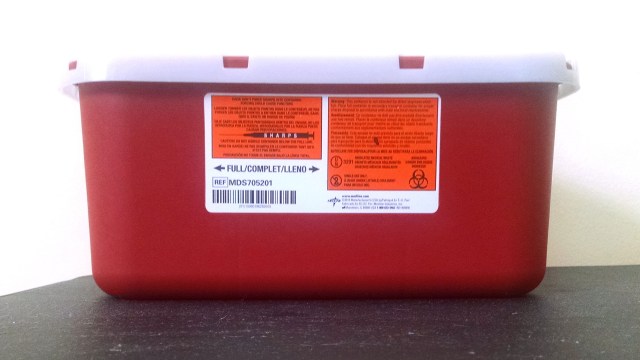
We told my husband’s VA PCP about the incident and asked if he could be issued a sharps container.  Below is a photo of the one they sent us.  The VA should issue these automatically with certain treatments/tests but it’s good to know that they are available at no cost if you ask and have a need.  This size can be purchased for under $10.00 but the VA will ship the refills which is helpful.

Posted in DM II, Food for thought, General Messages, Guest authors, HCV Health, Uncategorized, VA Health Care | 1 Comment

Propublica’s health apps

More valuable resources from Frank–

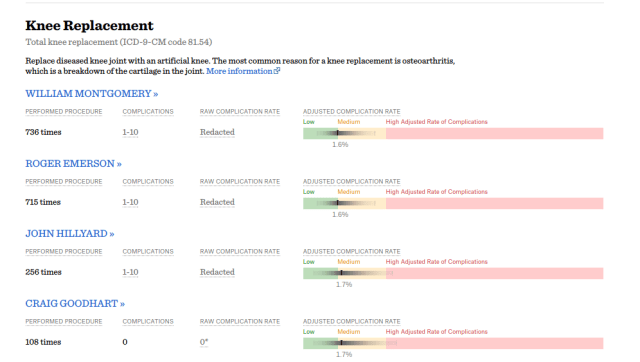
Not all docs/groups are listed in the Vital Signs search tool. At least 20 procedures are needed to be rated.  For surgeons, some may do hundreds of a repair with low complications and others perform fewer repairs with 0 complications.  

https://projects.propublica.org/vital-signs/

Treatment Tracker (Link)

Dollars for Docs (links)

Prescriber Checker (Link)

Surgeon Scorecard (Link) 

Article about surgeon complications.  https://www.propublica.org/article/surgery-risks-patient-safety-surgeon-matters

https://www.propublica.org/article/surgeon-level-risk-editors-note

The data we’re making public today has long been in the hands of the Centers for Medicare and Medicaid Services, the agency that oversees the Medicare program and pays for two in five U.S. hospital stays. CMS and most of the nation’s hospitals have taken the view that it’s better not to calculate or act on this sort of information, in part because it is so controversial. Though no one says it aloud, the attitude has been that the risk of unfairly tarring any doctor trumps all other considerations.

Our reporting suggests that this reluctance to focus on individuals is one reason that patient harm has persisted in the face of considerable effort by the medical establishment. The landmark 1999 study by the Institute of Medicine, “To Err is Human,’’ called on Congress to create a nationwide mandatory reporting system for patient deaths and serious harm so researchers could detect patterns. That has never happened. Surgeon Scorecard is a crucial step in the larger process of spurring accountability for breakdowns in patient care.

click for big image plano tx hospital

Also good:  https://www.medicare.gov/physiciancompare/

Posted in Food for thought, General Messages, Guest authors, Medical News, Veterans Choice card | Tagged | Leave a comment

My Kindle’s

I don’t know what is wrong with my gut but something is and I’m expecting to have a lot of bed time based on recent doctors’ comments.  So I might as well read something useful and Alex’s book makes a lot more sense to me now. And I still need to pull these concepts together.

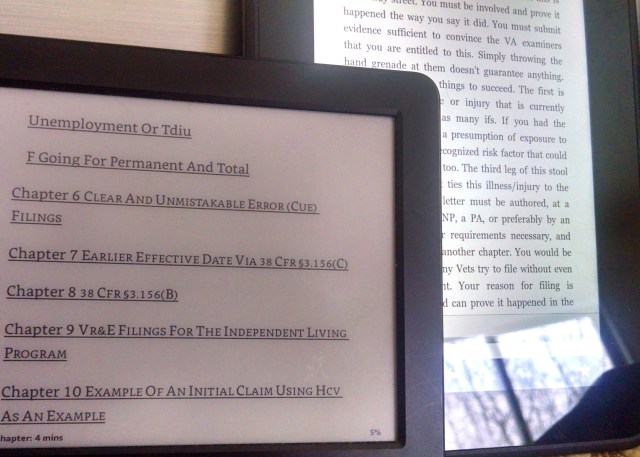
My Kindle Fire HD is colorful and heavy. There are new lighter versions out.  The black and white Kindle e-reader is lightweight but doesn’t have a back light for night reading. The battery lasts a long time.  They are both great values.  You don’t actually need to buy a Kindle device because Amazon has apps for most gadgets and laptops. And Alex has set the price so low for the digital version, it’s silly for veterans not to own it. You just need wi-fi to enjoy a 5-star reviewed book.

Posted in All about Veterans, ASKNOD BOOK, Food for thought, General Messages, Guest authors, research, Tips and Tricks, VA Agents, VA Attorneys | 8 Comments

VETERAN”S TOOL BOX

Tattoo this number to the top of the keyboard for VA claims gratification. Just out on Ron Nesler’s VA Is Lying Facebook site, the accompanying email address is the equivalent of the ‘Call me Bob’ McDonald’s cell phone. Use it sparingly with care. In fact, I’d classify it as a DEFCON 2 alternative and give it fire extinguisher status of “In Case Of Emergency Only!”

veterans@donaldjtrump.com

Bon chance!

Posted in Complaints Department, VA Secretaries, VBMS Tricks | Tagged , , , , , , , , , , | 2 Comments

CAVC–PERCY V SHINSEKI (2009) — WHO OWNS IT?

I have an unusual case of a gentleman who filed to stop a reduction in his rating. At the same time, he had a newly denied claim at the Seattle RO. The gentleman filed his NOD and the presumption of regularity in Sikels v. Shinseki  kicked in. VA was presumed to be competent. The SEARO 346 krewe promptly (in VA time) certified this baby (sans the SOC) along with his reduction appeal with a Form 8 and called FEDEX for a pickup to DC.

Later, Johnny Vet sits for a Board hearing and discusses the whole new secondary (grand mal seizures due to 16 psychotropic drugs for PTSD arguing with each other). He had opted to quit taking them which pissed off the Brain Doctors. VBASEARO got wind of it and proposed to reduce from 100% to 70%. Reduce him they did. He appealed but the failure of the Seattle Gang who couldn’t shoot straight to issue an official SOC on the seizures, created an ownership problem.

The cat was out of the bag. The Board (three back then in 1991) had heard testimony on the seizures and its inextricably intertwined (Harris v. Derwinski)  Harris_90-240 bearing on bent brain syndrome in general and pharmaceutical toxicity in particular. By even permitting Johnbo’s testimony and agreeing to hear it, they accepted that it was properly before them. Concurrently, the Seattle krewe, by ignoring procedure and issuing the VA 8, had also declared the seizures claim ready for ‘one decision, on appeal’ as they say before your BVA hanging.

As an aside, many of you in the readership have seen your claim declared “awaiting certification”-sometimes for 16 months. Nowadays, due to the constipating backlog at the BVA, certification means 4 years. The BVA solved some of this problem by leasing more warehouses to store the paper claims. Thank goodness for the belated electronics transformation. Now they can do it in a six by nine closet. You see,  that actual act of certification could occur in about five minutes. VA rater sticks old paper file in FEDEX box. Tapes it shut. Puts label on it. Sends it to basement to await “certification” and shipping to DC to be docketed at the BVA. BVA folks don’t want to see anything until it’s time to take a gander at it. If it gets lost before the magic certification, it can’t be the BVA’s fault. When you receive a Notice of Certification, it’s more about like finding out it’s going to finally get docketed and assigned a case number. Expect a hearing in about a year or so.

No Bozos

In my Vet’s case, the BVA realized the mistake before washing their hands of it. By rights, any smart attorney would file a waiver of review in the first instance at the RO just to keep it there before the judges. Absent that, a true remand was in order to correct the SOC error. That would have added a year to the appeal but would have avoided the next bozo. So, in the interests of the Veteran, the Veterans Law  Judges semantically stepped on their collective necktie and “referred” it back to Seattle instead of remanding it and continuing to retain control of it. A denial decision  had already been made and a substantive appeal begun (NOD). The only thing amiss was the lack of a SOC and the submittal of a VA Form 1-9. VA, of course, issued the obligatory SOC but demanded a new VA 1-9 to recertify what was by now legally owned and properly certified- complete with docket number- at the BVA. My Vet’s VVA rep. suddenly evaporated for parts unknown and no one ever complained or intervened to get this back on track.

In VA law, a referral from a higher court would be if you filed for DM2 and the gomers at your RO were working the claim. Meanwhile, you have another issue with a VA 9 already signed for a bad back increase from 40% to 60%. When it gets to the BVA, they spot the DM2 claim hasn’t been decided yet and ‘refer’ it back to the RO to issue an up or down decision in the first instance. Go ahead and laugh. It’s a brand new claim with no history and needs a preliminary denial to begin the NOD process. The problem is that the Veterans Law Judge does all of this once- at the end when he announces the decision on the reduction appeal. He has held the seizure claim hostage for 9 months before “referring” it back to the RO.

On the other hand, a legal appeal to a Court in which a judicial error occurred below at the Agency level during the substantive appeals process, requires a “remand” to complete the appeal process to the BVA. Think repair order once construction has begun. Or read this one –https://asknod.org/2012/02/16/everything-you-always-wanted-to-know-about-remands/ Once the BVA hears a matter, or accepts it, and/or takes testimony at a hearing and begins to review it, they have formally accepted the claim and now exert ownership. A remand is merely to gather more info with which to use for a more informed decision, or a true remand to correct an adjudicatory deficiency below. Regardless the cause, the appeal(s) once free of defect, are properly returned to the BVA for the promised “one decision on appeal” as promised in statute. One of the oldest tricks in the book was “forgetting” to include a Vet’s SSI/SSD records in his c-file to the BVA for TDIU consideration. Bingo. Remand. One year (or more) delay.

Mr. M.C. Percy

Percy-2961

Mr. M.C. Percy, with no identifier as to what “M.C.” stands for, suffered much the same as my client. In 1970, Mr. Percy had an unfortuitous  encounter with a hand grenade in the former Republic of South Vietnam. one piece missed Winky by thaaaaaaaat much, thank his lucky stars, but it was that sensitive suprapubic area above Mr. Winky that continued to bother him. The typical rating in 1971 was 0% and Mr. Percy was afforded no different attention. In 1998, they gave him a raise to 30% with an effective date of 94. He must have been playing golf with his DAV rep. and got in good with him by buying his drinks and greens fees. VA doesn’t often cough up four year retro payments to anyone but good ol’ boys and malfeasanating VISN directors.

A year later, in 1999, within the NOD window, Mr. Percy filed a substantive appeal up to the Big House on Vermin Ave. NW. Mr. Percy was subsequently informed after his hearing that his Regional Office had screwed up and they didn’t have authority to talk about an increase because he’d failed to discuss it on the VA 9. Mr. Percy did, however, file about two more VA 9s to try to get it right on what he was appealing. Apparently, there were three other things that were in the same judicial limbo, too- one of which was his effective date for the Winky-area wound.

I have to hand it to Terry L. McElyea, his pro bono attorney, though. Terry’s a  Judge Advocate General (JAG for short) kind of guy for the most part. He’s a Prosecution whiz for the Court of Appeals for Uniformed Servicemen. This whole claim was headed for the denial pile until Terry pointed out that VA justice however imperfect and crude, still affords us a different, friendlier attitude and cannot consider a BVA Veterans Law Judge the equal of a COVA Justice approved by the US Senate. He had to point out the obvious- that Bowles v Russell  127 S. Ct. 2360 (2007) was not on point. Bowles was civil law, not VA Law. Henderson dealt, again with civil law but not at the agency level below. Henderson, thus, was not on point either. Ol’ M.C. was filing at the agency level and appealing to the upper level of the Board of Vets Appeals-still below the federal level. To say Percy’s timing on any VA 9 filings made to the BVA were beyond the suspense date and final defeats the warm, fuzzy admonition in 38 USC §7105…

The filing of a substantive appeal to the Board is not jurisdictional because 38 U.S. C. §7105 explicitly permits relief from prescribed appeal periods with the Agency and permits the Secretary to prescribe regulations to allow a claim even if the appeal period has expired (60-day period prescribed for filing formal appeal with the Board of Veterans’ Appeals “may be extended for a reasonable period on request for good cause shown”). Additionally, the Board may waive or equitably toll its filing requirements. Furthermore, Bowles and Henderson are not applicable to the Appellant’s case because those cases deal with civil cases appealed to federal courts and the Appellant’s case deals with an administrative appeal within the Agency.

38 USC §7105 has to have some built-in slack. VA screws things up so badly so frequently, they’d look bad if they really got nasty with the 60-day SOC suspense date and were dogmatic in enforcing it as being jurisdictional in everyday practice.

Not bad for a JAG, huh? This guy does US military law and he still picked up on this dichotomy between the Agency and the next step up into the Federal level. An Agency has to know its limitations in order to win. This is one more glaring example of why you don’t want your drinking buddy from VFW, who is also your service representative for VA claims, handling something like this.

I finally learned the difference between referred and remanded- even though I knew my Vet was due a remand that should have been returned to the Board after the SOC was issued. Thank you Brad. More importantly, this is a great teaching moment for Vets. Many of you may have suffered this indignity of appealing it up to the BVA and a final remembrance that it seemed something was still amiss but unsure of what. My Vet sniffed it out and asked why he’d won in 2010 with basically the same evidence. Just like any train wreck, you have to go back and reconstruct the accident scene with the c-file. Boy howdy. Can you believe a Marine in 1991 would have the intelligence to ask for a c-file? This boy sure did and it can’t be lost, stolen, accidentally shredded, suffer shrinkage or be misplaced now.

I love forensic claims. The cachet of old claim is more pungent and redolent with VA mistakes than any other. There are three ways you can get back to the past now. 38 CFR §3.156(c) is the best known. Finding Clear and Unmistakable Error (CUE) is a very hard path as many know. But, if you find an unreturned remand to the BVA in your c-file, you discover your old, dead substantive appeal is still alive  and vibrant- de novo once again. With the help of a few law dogs, I can now better understand the semantics of why they got misplaced or waylaid on the claims road. A wrong legal word spelled disaster for twenty six years. Presumption of Delay.


Posted in CAVC Knowledge, CAVC ruling, Important CAVC/COVA Ruling, KP Veterans, Nexus Information, Remanded claims, Tips and Tricks | Tagged , , , , , , , , , , , , | 6 Comments

VA HEALTHCARE-TOO COOL FOR SCHOOL APP?

capture-fedweekJust spotted this one. An excellent App. Will append it to the “VAROs and who’s who above in widgets.

http://www.fedweek.com/armed-forces-news/web-app-aims-yelp-style-reviews-va-facilities/

Here’s the link to the website: http://www.vareview.net/

The downside to this is obvious. It’s a VA site and you have to “join” to submit comments. One doesn’t have to be room temperature IQ to realize an off the cuff remark, no matter how flippant on its face or innocently intended, now has an address.  I’m not a conspiracy freak but I look at past VA history. It seems whistleblowers at VA who call the VA OIG to report their superiors’ mis/malfeasance suddenly become the focus of the investigation themselves.

It’s kinda like when you were a FNG in-country about a week. The first “perimeter breach” at 0200, you light up on full auto. All of a sudden there are more f___ing bullets than you can count humming around you. Nobody wants to play Army with you or sit anywhere near you. You’re a pariah waving a lightsaber with tracers. I hate that when that happens.

capture

Posted in All about Veterans, VA Health Care, VA Medical Mysteries Explained, vA news | Tagged , , , , , , , , | Leave a comment