
Member Robert turned me on to this previously. Now it must be posted. It’s truly amazing that it is on a flat surface. Amazing what the mind can come up with to confound the eye. Almost sounds like, well, Uncle Eric’s famous disappearing VA Backlog.


















Member Robert turned me on to this previously. Now it must be posted. It’s truly amazing that it is on a flat surface. Amazing what the mind can come up with to confound the eye. Almost sounds like, well, Uncle Eric’s famous disappearing VA Backlog.
A recent study of IV drug users infected with HCV in Greece has found that each DU spread the disease to 20 other people. They are called “superspreaders.”
In a BBC article, Charles Gore, chief executive of The Hepatitis C Trust and president of the World Hepatitis Alliance, said: “This study is potentially very important. “It needs to be said, however, that globally hepatitis C is not a drug users’ disease. “Of the 150 million people living with the virus, only about 10 million are people who inject drugs, according to The Lancet. The vast majority of infections are the result of unsafe healthcare and we equally need to target prevention there.”
I’m trying to get a handle on some of the estimates and statistics about humans who inject themselves with illicit drugs, and humans with HCV. Is it possible that the percentage of people who inject themselves with illicit drugs has not have changed very much as a percentage of the population of a country over the last 40 years?
According to today’s U. S. Census U. S. Population Clock, there are U.S. 315,267,926 people living in the United States. The world’s population is 7,063,965,185.
WHO writes: “HCV infections are common worldwide. It is estimated that about 3% of the world’s population have HCV. ”
Using Google calculator, I multiplied 7,063,965,185 x 3% = 211,918,955.
How many people in the world are estimated to be shooting illicit drugs? The Lancet study Gore referenced, analyzed mega-data from 70 countries: “Injecting drug use is an important public health issue around the world: 16 million people injected drugs in 2007 (range 11—21 million).”
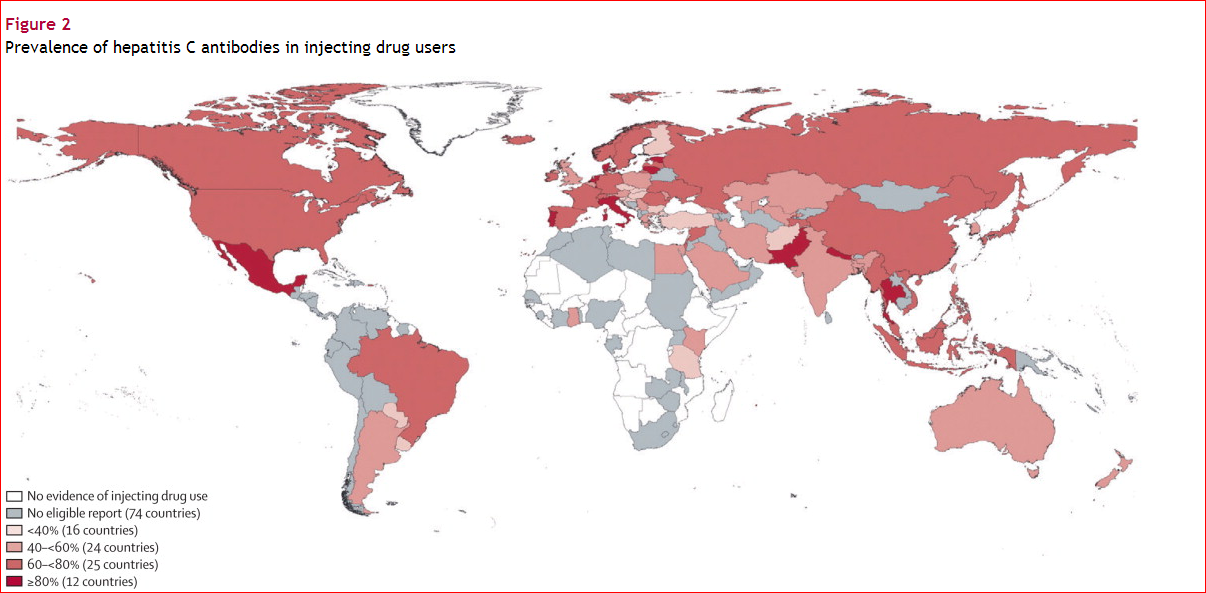
Image from Lancet
They write, “Despite the higher prevalence and transmissibility of viral hepatitis, the disease has received far less global attention than has HIV.” ” After extrapolation to all countries, we estimated that about 10.0 million IDUs (range 6.0—15.2) in 2010 were anti-HCV positive; a midpoint prevalence of 67.0% in IDUs globally).” (Data from all countries was not available.)
The Lancet article is free on Pubmed but requires registration to read on the Lancet website. Lancet. 2011 Aug 13;378(9791):571-83. Jul 27.
ASKNOD shares a photo of member Buckwheat sent in from his Superbowl Party.

I don’t mean that to be humorous. Everything is going up. The delay times in our adjudications. The time to get in to VAMC for a mental health evaluation. The price of gas. And so on. What shouldn’t be, is. Granted, the cost of gas will only kill you in an alliterative context. Waiting for months, when promised days, to see someone about your pretzel brain issues will result in even more problems. That’s in some prequel to the Psychology 101 classes. Law Bob sends me this which pretty much incriminates the VA. They in turn, will blame… yep, trot the straw man out here–Bush. That’s usually followed by the “Funds we will need, yesssssssssssssss.” Or Wimpey’s plaint of “I would gladly rate you next Thursday for a bonus today.”

Everyone’s just in denial. I don’t have a problem with that. I’m going with 2015 and 98% accuracy. I like that Koolaid. Uncle Eric said so. Has he ever been wrong?
This is a moving story and I wish to thank Tom for it. You guys and gals provide me with about 80% of the content that we use to help others. The humor helps because HCV is a brain bender and nobody needs depression. The stories of others’ lives are poignant memories of things we’ve often spent years trying to forget. Anything like this takes my breath away for a few moments. I have to remember to breathe again. This Corpsman was not only smarter but indeed braver that the average bear. To think the SSI Nazis would try to go after his SSDI is unthinkable… or is it?
You’ve witnessed what the VA can do to you-or me-and has in fact-done already to many of us that altered our lives and indeed our fortunes. When we, and people like Roy Benevidez signed up, I’m sure we all didn’t think down the road that we’d have to watch our six-especially with the SSI guys or VA. Many of you who served know what it feels like when VA suddenly, 38 days shy of five years, gives your rating a haircut from 30 to 10%. I’m waiting for the VA to teach them over at SSI how to do CUE.
I petitioned the Air Force, at the urging of member Mike, to up my General Discharge to an Honorable one. My excuse is that the Pathet Lao made me antisocial. In addition, I asked them to issue an updated DD 214 that accurately reflects my true service and medals awarded as well. I never worried about it before. What the hell? Why not set the record straight? Roy had to wait over a decade to get his CMOH. I don’t mind forty years. It just seems like the right thing to do before you punch out.

HCV to pot of boiling water or hot flame: Bring it on. You can’t stop me.
Here’s the flyer: http://www.cdc.gov/hepatitis/HCV/PDFs/HepCIncarcerationFactSheet.pdf
CDC Publication No. 21-1306 entitled Hepatitis C and Incarceration, page 2, states:
Why doesn’t cleaning kill the Hepatitis C virus?
Bleaching, boiling, burning, or using common cleaning fluids, alcohol or peroxide will not clean needles, tools, and other instruments. These methods are not strong enough to kill the Hepatitis C virus. This virus can still spread easily from one person to another.
Click box, zoom, go to page 2.

HCV can’t be killed by burning or boiling
states CDC
One-third (33%) of inmates have HCV. This is a terrible statistic.
Let’s now apply this information to an unpopular medical device we discuss at AskNod, paraphrase and extrapolate. The jet-gun injector (MUNJI) can be referred to as a tool or instrument. Even if the nozzle had been bleached, boiled, burned, or cleaned, between recruits getting vaccinated at boot camp, these methods would not have been strong enough to kill the Hepatitis C virus and it could have still spread easily from one person to another.
So now we know what inmates know (if they’ve read the CDC flyer).
Are the gutless scientists at the CDC going to wait until 33% of the general population gets diagnosed with HCV before this warning is broadcast to everyone?
I shouldn’t be stunned at this information after learning that HCV survives freeze-drying and long storage. But I am. I guess it’s the word easily.
For information about the incarcerated veteran population, I found this Justice Department press release with a link to a 2004 report. I’m afraid they are doomed.
Ed. Note:
Well, Ladies and Gentlemen Vets. It appears that Kiedove has finally submitted the smoking gun for a sure-fire jetgun win. Have your nexus doctor read this and then write your magic thesis. Sadly, we’ve known this for aeons. Trying to get the CDC or someone with an audience has been the roadblock. This might be the the log that breaks the jam.
When I visit various websites for laypersons researching Sexually Transmitted Diseases (STDs), formerly called venereal diseases (VDs), HBV is often listed but not HCV. The general public does not know that HCV is also classified as a STD or Sexually Transmitted Infection (STI).
But it is now listed on the main CDC STD webpage under “viral hepatitis.” Here’s what they write:
Hepatitis C
“Although not common, Hepatitis C virus (HCV) can be transmitted through sexual activity. The factors found to be associated with sexual transmission of HCV are sex with multiple partners, presence of other STDs, or sex with trauma. Case-control studies have reported an association between acquiring HCV infection and exposure to a sex contact with HCV infection or exposure to multiple sex partners. Surveillance data also indicate that 15%–20% of persons reported with acute HCV infection have a history of sexual exposure in the absence of other risk factors.”
There’s a longer discussion in paragraph 4 on this page: http://www.cdc.gov/std/treatment/2010/hepC.htm
What does this mean for veterans who admit that they had sex with sex workers during their service. Is this willful conduct? The answer is “no” even though we’ve read cases on AskNod where veterans have been denied benefits for just this false reason:
This applies:
http://www.law.cornell.edu/cfr/text/38/3.301
(Authority: 38 U.S.C. 501 )38 CFR 3.301 – Line of duty and misconduct.”(1) Venereal disease. The residuals of venereal disease are not to be considered the result of willful misconduct. Consideration of service connection for residuals of venereal disease as having been incurred in service requires that the initial infection must have occurred during active service. Increase in service of manifestations of venereal disease will usually be held due to natural progress unless the facts of record indicate the increase in manifestations was precipitated by trauma or by the conditions of the veteran’s service, in which event service connection may be established by aggravation. Medical principles pertaining to the incubation period and its relation to the course of the disease; i.e., initial or acute manifestation, or period and course of secondary and late residuals manifested, will be considered when time of incurrence of venereal disease prior to or after entry into service is at issue. In the issue of service connection, whether the veteran complied with service regulations and directives for reporting the disease and undergoing treatment is immaterial after November 14, 1972, and the service department characterization of acquisition of the disease as willful misconduct or as not in line of duty will not govern.”
This judge can read, comprehend, and write following the rules:
Residuals of venereal disease are not to be considered the result of willful misconduct. See 38 U.S.C.A. § 105; 38 C.F.R. § 3.301(c)(1) (2005).
The veteran’s claim was greatly helped because he had been treated for another STD. But no one should have to prove that the one STD that they did acquire via sex contact (HCV), needs a second STD to verify sexual contact–just because HCV has a very long latency period!
Today, the terms venereal diseases (VDs) and sexually transmitted diseases (STDs) are synonyms for any any contagious disease acquired during sexual contact but VD used much less now. These 1940 public health posters recall the main VD concerns of that time.


warning to all servicemen that ‘She May Look Clean–But pick-ups, ‘good-time girls’ and prostitutes spread syphilis and gonorrhea.
I apologize. Sometimes someone leaves the gate open and I escape the reservation…
I don’t often resort to poetry but something that shouldn’t have, welled up inside me. I apologize that I was unable to silence it. Actually, Cupcake and I will be doing it alone. My train of thought derails and I cannot absorb the commercials if we have guests. Well, that and they have the tendency to eat all the cheesy chips off the nachos and leave the naked ones.

By now we are all too familiar with VA justice and their misguided attempts at analyzing our evidence with an eye towards a fair and balanced reading. Member Robert, who awaits his winning Lotto ticket, sends in this snippet of humor.
Over the last two decades as my various claims have waxed and waned before the adjudicators, I was always struck by what they did with the evidence-or more precisely, how they extrapolated a denial from sure success. I was unable to fathom this mystery until I fell ill. Once I was able to view the tens of thousands of BVA decisions on these subjects, it became apparent that their repertoire was extremely sparse. All claims were denied using a standard boilerplate terminology. With the advent of the Internet, they were forced to fan out and come up with newer and more refined arguments to support their inevitable denials.
We try to bring those to you in legal form to illustrate how it’s done and the subterfuge employed. To my immense pleasure, what should fall in my lap but an excellent example albeit in media format but nevertheless employing the same technique…
Sound familiar? How about ‘Vet injured numerous times while jumping out of C-130 as a paratrooper. Service connection is denied as there is no link demonstrated between current torn meniscus/ACL injuries and events in service.’ Or more appropriately, ‘HCV service connection is denied as there is no diagnosis of HCV in the Veteran’s SMRs from the 60’s.’

HCV is called a lot of things. We know that Hepatitis C is classified as a communicable disease. It is transmitted when the blood of an infected person enters the blood-stream of another person.
We know that mother-to-child transmission can occur before or shortly after birth (called vertical transmission).
We know that Hepatitis C can be a healthcare-associated infection (HAI). It can live on environmental surfaces and hands so it’s an environmental-associated infection.
We also know that Hepatitis C can be a sexually transmitted disease (STD). First, the good news for many people: An Italian 2004 study of 895 monogamous heterosexual couples, who denied anal intercourse, sex during menstruation and condom use, found the HCV transmission was low or null. “No general recommendations for condom use seem required for individuals in monogamous partnerships with HCV-infected partners.” A small 1994 American study found that “HCV RNA was present in the menstrual blood of all chronically infected patients tested.” But even if the female is the infected person, and the couple has unprotected non-rough sex, they appear to be pretty safe.
Things get risky when a person has unprotected sex with a sex worker.
A 2012 large study of HCV in Vietnam found that 8.7% of commercial sex workers (CSWs; 8.7%, n =87/1000) in certain regions were infected.
Genotype 1 was the most prevalent HCV genotype in our study, although this varied between regions as follows: Ha Noi (54%, n
Analysis of the different risk groups revealed that genotype 1 viruses accounted for a significantly higher proportion of HCV infections in both IDUs (70.1%, n
Discussion
“Sexual transmission of HCV is still relatively rare and, to date, HCV transmission within CSW cohorts in Vietnam has not been well studied. Although the prevalence described in CSWs in this study (8.7%) is higher than estimates from other Asian countries, this is likely confounded by the effect of injecting drug use practices as almost 60% of the HCV positive CSW cohort reported such activity. Evidence exists to support sexual transmission of HCV, although available data suggest the efficiency of transmission by the sexual route is low. Despite this, a number of studies have reported a higher seroprevalence of HCV infection in CSWs compared to the general population.”
However, the authors of the Vietnam study think that there is a low transmission of HCV from sexual intercourse based on a study of middle-aged spouses–a very different demographic from sex workers.
Nod has posted some cases about STDs. In one, a veteran had documentation that he was treated for a STD in service but received SC for HCV after being denied due to willful misconduct. In the award letter, the VA wrote, “…your hepatitis C is due to or the result of high risk sexual activity while in the Army. The examiner stated that sexual intercourse with persons who may be infected with hepatitis C (prostitutes, IV drug users) is a documented risk factor for this infection. The transmission of this infection if (s) often associated with the transmission of other sexually transmitted diseases. Due to the high risk sexually activity documented in your service treatment records, it is likely that your Hepatitis C had its onset and was acquired while you were in the Army.”
My question is, “What if a veteran thinks that his/her main risk factor for HCV was sexual contact with a sex worker during military service and HCV was the only STD they became infected with?” The government knows that military personnel didn’t use condoms as often as they should, having fathered thousands of children in Asia. But what evidence of risky sexual activity can one offer, other than the HCV itself, if you didn’t also get, say, gonorrhea, and the general condition of your liver? In my opinion, the HCV is proof enough. Would the VA say, no you have to have at least 2 STDs HCV AND one more of your choosing.
The CDC doesn’t provide much guidance. They have a very hard time communicating clearly about HCV and sex.
In their recent MMWR Report (8/17/12):
Introduction, paragraph 3.
“Although HCV is inefficiently transmitted through sexual activity, the prevalence of HCV antibodies among persons who report having had ≥20 sex partners is 4.5 times greater compared with the general population (1).”
Why can’t they just spit it out?: “…HCV is sometimes transmitted through sexual activity…”
Background, paragraph 2–they provide hints about oral sex etc..:
“Persons with unapparent percutaneous or mucosal exposures, including those with high-risk sexual behaviors, sexual and household contacts of persons with chronic HCV infection (1%–10%), and persons with sporadic percutaneous exposures (e.g., health-care workers [1%–2%]), had lower rates.”
Meanwhile, an online Medline article about youth with HCV states (section 5): ”
“Adolescents should be educated about the risk of transmission of the infection to their sexual partners.”
WHO classifies adolescents as 10-19 years old. They’re mature enough for the facts. Their parents and grandparents aren’t.
The way our well-paid public health officials have been dealing with the HCV health crisis is crazy.


 asknod
 Bethanie Spangenberg
 kcraveiro
 robinhoodesqvetsatty
 Wesley McCauley
 Veterans Claims Help