BVA– SPECULATION OR BENEFIT OF THE DOUBT?

Milo J Hawley has been a VLJ for as long as I can remember. He is not very forgiving of stupidity, be it the VA or the Veteran. If you arrive in his class without your homework or if its prepared incorrectly, you fail.  No ifs, ands, or buts.

This motor city Vet has a lot going against him. By all rights, he should lose. God looks out for idiots like him as you will see here.

The Veteran’s service treatment records indicate treatment for sexually transmitted disease.  In addition, the record appears to indicate that the Veteran obtained a tattoo while in service.  In addition, the Veteran admits to in-service intranasal cocaine use and intravenous drug use.  

In this case, there are three opinions which indicate that the Veteran’s in-service IV drug use was the likely cause of his hepatitis C.  As noted above, Dr. Campbell stated that the Veteran’s remote history of IV drug abuse and alcoholism resulted in a cirrhotic liver, hepatitis C, and impending liver failure.  Dr. Campbell also noted that the Veteran used IV heroin and many other intravenous drugs during military service.  M. Kretschmer stated that the Veteran admitted to using intravenous heroin and other [il]licit drugs as well as abusing alcohol during his term of duty and that he most likely contracted hepatitis C at that time as he denied other risk factors for contracting the virus.  The May 2009 VA examiner first opined that the Veteran’s hepatitis C was as likely as not acquired during service as sexual activity is likely a mode of transmission of hepatitis C virus and then opined that it was likely that any one or all of the following, sexual activity, IV drug use and cocaine, could have been a transmission of the hepatitis C.

The Board notes that the RO continued the denial based on the May 2009 VA examiner’s opinion noting that the examiner noted that it would be a mere speculation to state one cause of transmission of the hepatitis C as they all could transmit the hepatitis C and it was difficult to delineate which one caused the transmission.  The Board emphasizes that the criteria is whether it is “at least as likely not” that the Veteran’s hepatitis C was the result of the Veteran’s service.  The term “at least as likely as not” means that the weight of medical evidence both for and against a conclusion is so evenly divided that it is as medically sound to find in favor of that conclusion as it is to find against it.  In this case, the May 2009 VA examiner’s opinion in essence is that it is at least as likely as not that the Veteran’s hepatitis C was the result of sexual activity; that it is at least as likely as not that the Veteran’s hepatitis C was the result of IV drug use; and that it at least as likely as not that the Veteran’s hepatitis C was the result of cocaine use. 

Mr. Kretschmer’s opinion was based on an inaccurate factual premise and is not probative.  Although Mr. Kretschmer stated that the Veteran denied other risk factors for contracting the hepatitis C virus, there is evidence of other risk factors including in-service high-risk sexual activity and a tattoo.

In this case, both physicians seem to indicate that the veteran’s cirrhosis was caused by either hepatitis C or alcoholism.  Stated another way, the VA examiner appears to opine that it is at least as likely as not that the veteran’s cirrhosis was caused by hepatitis C, and that it is at least as likely as not the veteran’s cirrhosis was caused by alcoholism.  Thus, the Board finds that the competent medical evidence both for and against a finding that the Veteran’s cirrhosis is related to the hepatitis C is also in a state of equipoise.  Accordingly, reasonable doubt is resolved in favor of the Veteran.  38 U.S.C.A. § 5107(b); 38 C.F.R. § 3.102.

VLJ Hawley has smelled the “speculation coffee’ and wants no part of that. If he subscribes to it, he will be dodging the bullet and passing the buck up to the Court. The BVA has noticed that recently everything speculative headed that way seems to have a rubber band attached to it and they come back faster than they depart. Instead, he does a probative analysis and finds the error is nothing more than good old benefit of the doubt. He doesn’t care if some of the risks are willful misconduct. The important fact is that the good is equal to the bad, so there is no need to don sackcloth and rub ashes on your forehead. Mere speculation does not have to result in an “nondecision”.  You simply pronounce the magic incantation “equipoise” and grant the sucker.

This speculation phenomenon will run its course as we all find a way around it. VA will undoubtedly find a new trick in the next year and that will become the latest rage until it, too, fades away. Recognizing these ploys is easy. Counteracting them without a prolonged delay will always be the challenge.

http://www.va.gov/vetapp11/Files3/1124905.txt


Posted in BvA HCV decisions | Tagged , , , | Leave a comment

BVA– SP-SP-SPECULATIVE, YOUR HONOR!

downloadSenator Harry Byrd of West Virginia used to inveigh in the Senate when filibustering with a well-known rejoinder-“WRONG! WRONG! WRONG!” (capitalized merely to enunciate his vigor voicing it). Where are you now when we need you, Harry?

This horrible piece of legal work made its way to the BVA this year. It was advanced on the docket because the poor widow is undoubtedly past her medical prime. I doubt she’s a mail order fluffer from Russia or the Philippines. The VFW has done a credible job here or the VLJ has. I suspect the latter as you will see.

I recently posted a 2010 CAVC case (Jones v. Shinseki) where the appellant was getting the sharp end of the Punji stick. It was remanded based on a lot of things, but one in particular is the new default denial starting to become the latest way to chuck these decisions in the circular file. VA has the “examiner” tear their hair out and say they really tried and tried but couldn’t in good conscience grant SC, because to do so would be speculative. This makes for good theater at the RO, but wears thin at the BVA. If it gets up to the CAVC, the whole house of cards comes tumbling down and the RO has to admit defeat and actually come up with a yea or nay rather than check the box marked “don’t know”.

VA examiners do this for a living. Most are not doctors, but that’s why we have IMOs and IMEs . Private Doctors are not so equivocal as to scratch their heads and profess ignorance on how to decide it.  Without doing the Mel Gibson Conspiracy shtick, I think something is afoot here and I don’t like it. Ten years ago it was the plaint “It appears that the hepatitis the claimant suffered in Vietnam was Hep. A”. We can now test for that and determine if it was A or B so that window of denial was erased. If you had B, then there is a better than even chance you picked up its little brother C at the same time.  VA would dispute it but that is common medical theory for the SEA theater in the 60s and 70s.

In Jones, the Court enunciated an important precept:

The appellant raises a new question, however, with which this Court deals today.  How should the Court treat a situation in which an examiner’s opinion is unclear or silent as to whether all information that reasonably bears on a medical analysis has been gathered or the reasoning behind the inconclusive opinion is absent?  Stated another way, how thoroughly must an examiner develop and describe the information gathered and explain the essential medical reasoning before the Board may rely on his or her representation that an opinion cannot be rendered “without resort to mere speculation”?  This phrase must not become a mantra that short circuits the careful consideration to which each claimant’s case is entitled. Jones supra. (emphasis mine).

The reader can ascertain where I’m going with this. The BVA VLJ was just as perceptive. The RO is like an inept, bumbling prosecutor who can’t find the right file. Then, when located, enunciates a theory as insane as alien abduction. Here, the examiner tried the old  ETOH ploy. Yup. Two beers a day. There you go. A raging alcoholic. It’s a wonder he didn’t die sooner. Hold the phone. The testimony was 1 (one, uno) sixpack a week= 6 beers/week. Now it’s 1-2 per day for an aggregate total of 14/week? In VAland a “pack” of beer is subjective. The terms “rack” or “case” apparently are not in their vernacular.

The appellant disputes the RO’s suggestion that the Veteran was at risk for developing hepatocellular carcinoma due to cirrhosis from alcohol consumption (one pack of beer weekly, one or two beers daily).  She points out that, although cirrhosis is a factor leading to such cancer, it is a consequence of chronic hepatitis C and might not develop into liver cancer.  The appellant believes that it is just as likely that the inservice hepatitis led to the Veteran’s cancer.


http://www.va.gov/vetapp11/Files1/1101957.txt

Four medical professionals have discussed the cause of the Veteran’s death and/or possible relationship between the Veteran’s liver cancer and in-service hepatitis.  In August 2007, a VA examiner/non-physician, reviewed the claims file and concluded that she could not resolve the issue of whether the two were related without resort to mere speculation.  She based this conclusion on the following findings: (1) it is too difficult to determine whether the Veteran’s in-service hepatitis was of C type; (2) although there was no test for hepatitis C when the Veteran was serving on active duty and no medical professional noted hepatitis A or B during that time, the symptoms the Veteran exhibited during service were more typical of infectious hepatitis A or B; (3) liver enzymes were normal prior to 2007; (4) the Veteran had no risk factors for hepatitis C virus and therefore was not tested prior to his cancer diagnosis; (5) the Veteran had cirrhosis on a computer tomography scan in February 2007 and revealed drinking a pack of beer weekly; and (6) cirrhosis often develops with chronic hepatitis C infection and is a major risk factor for developing hepatocellular carcinoma.  

 This is where the poor examiner at the Huntington VARO is forced to swallow her pride and spout the VA party line.  Were she to tell the truth and say it was undoubtedly something to do with that Purple Heart and combat wounds, she would have been looking for new employment outside government. The reader will notice that even though this examiner professes to be well-versed in this process, there is no mention of testing in 07 to determine if he was positive for HAV or HBV antibodies? This is so elementary a test, they just do it automatically when they run the HCV PCR test. Somebody is not being completely forthcoming with all her medical abilities to opine.

Three months before, good old Ramesh Shah, M.D. had no problems with a speculative quandary:

In May 2007, Ramesh K. Shah, M.D., submitted a prescription indicating that the Veteran had been diagnosed with hepatocellular carcinoma in February 2007 and had underlying hepatitis C.  He opined that the liver cancer was probably due to the underlying hepatitis C.

One of VA’s  finest, a physician/ examiner no less, was  stymied to the point of speculation yet again three years later. These poor folks in Huntington must have a hell of a time making a commitment to marriage if opining on HCV gives them such conniption fits…

In March 2010, a VA examiner/physician, concluded that he could not resolve the issue of whether the Veteran’s in-service hepatitis contributed to the cause of his death without resort to mere speculation.  He based this conclusion on the following findings: (1) it would be sheer speculation to label the Veteran’s in-service hepatitis as type C in the absence of test results showing such type (not then available) and with documentation of non-specific symptoms and liver enzymes; (2) the Veteran did not have classic risk factors for hepatitis C; (3) from 2000 to 2006, the Veteran had normal liver enzymes and there was no episodic pattern of aminotransferase elevation; (4) there were various causes that contributed to the Veteran’s terminal phase, including other types of carcinoma, with a possibility of a metastatic cancer to the liver with a primary site of the intestines or lungs (hepatocellular carcinoma favored, but not definitively established, as primary site); and (5) the Veteran had cirrhosis, which is also a risk factor for developing hepatocellular carcinoma, and a history of alcohol consumption, which can cause cirrhosis.  The examiner explained that he could not conclude with certainty, and could not discard fully as a probability that the Veteran’s initial episode of non-specific hepatitis in service was hepatitis C and that the Veteran was a chronic carrier for almost four decades before developing hepatocellular carcinoma, which led to his death.


Well, there you go. No classic symptoms of HCV. What, pray tell, might those be? As near as I can tell, everyone presents in a different manner. There is no “classic” textbook demeanor one can cite to. Apparently this doctor is aware of one and our room temperature candidate failed the test. What happened to Groves v. Peake (2008)? At this point, our esteemed VLJ got tired of all these West Virginian bozos and opted for his own medical whizbang. Smart move.

In October 2010, upon the Board’s request, a private gastroenterologist reviewed the Veteran’s claims file and concluded that, although he could not state definitively that the Veteran had acute hepatitis C in service, that was the most likely clinical scenario.  He also concluded that the hepatitis C contributed to the Veteran’s chronic liver disease and death.  He based these conclusions on the following findings: (1) risk factors for hepatitis C infection include intravenous drug use, blood transfusions, high-risk sexual activities and body art/tattoos; (2) Vietnam veterans are at a significantly higher risk of such infection than the average population; (3) hepatitis A and B were unlikely based on serologic evidence; (4) hepatitis C is one of the most common causes of liver disease; (5) acute hepatitis C infections are most often asymptomatic, but account for approximately 20 percent of acute hepatitis cases in America; (6) over 80 percent of individuals exposed to hepatitis C progress to chronic disease, one third of which have normal liver tests; (7) one study with 10 to 20 years of follow-up with individuals with chronic hepatitis show progression to cirrhosis in 50 percent of the cases (other studies show lower rates); (8) hepatitis C accounts for one-third of all cases of hepatocellular carcinoma in America and this type of carcinoma always occurs in the setting of cirrhosis; (9) progression from initial infection of hepatitis C to cirrhosis to hepatocellular carcinoma takes 20 to 30 years; and (9) tests for detection of hepatitis C were not available until the early 1990s.    


Hmm. The man said “TA-DAAA!” No mention of beer and resultant hyaline cirrhosis due to same. The speculative cobwebs have been wiped away and a diagnosis has been found to clear the air of indecision. Now that wasn’t so hard. Perhaps this gentleman could replace the two boobs up in Huntington and VA could save some money. In addition, one rarely sees this degree of honesty exhibited in the cloistered VA system:

In this case, the Board assigns the VA examiners’ opinions the least evidentiary weight.  The two opinions are inconclusive, in some respects conflict with medical literature the appellant submitted in support of this appeal and do not respond to the appellant’s well-reasoned assertions. 

To the contrary, the private gastroenterologist’s opinion which favors the claim is based on a review of the claims file, including the medical literature the appellant submitted, supported by rationale and phrased in a manner that allows the Board to understand the probability of a relationship between the Veteran’s active service and death.

Much ado about nothing as they say. The folks in Huntington just don’t get out much and are medically challenged. We should pass the hat and buy them a newer edition of Cecil, Book of Medicine or a new Dorland’s illustrated.  Perhaps they need to attend more of those Hawaiian Tutorial Task Force get-togethers for some up to date instructionals on HCV.

Posted in BvA HCV decisions, HCV Risks (documented), VA Medical Mysteries Explained | Tagged , , , , , , , , , , , , , , , , , , , , , | 1 Comment

BVA– 3 Judge Panel

This is an example of what happens when you have a Board hearing, the claim gets remanded and somehow you end up with another judge looking at stuff or doing a travel Board hearing at your RO. You end up with the evidence spread out over two VLJs. In order to adjudicate it properly, they have to revert to the old method and have a three judge panel to make it legal. Hence, we have the following decision with 3 VLJs. You don’t see this very frequently. It’s more common when filing a MFR over an old decision. Our friend loses here for a number of reason. His VSO just isn’t up to speed for this big a production. They rarely are. I am constantly amazed at how many arrive in D.C. with little or no preparation. The process is so basic Homer Simpson’s monkey (Mojo) could learn it. Why does it escape VSOs so frequently?

http://www.va.gov/vetapp11/Files1/1105512.txt

Posted in General Messages, Uncategorized | Tagged , | Leave a comment

BVA– Waco Tobacco

Leave it to those funny guys down at the Whacko, Texas VARO smoking their left-handed tobacco. Here, His Honor Ronald W. Scholz, a seasoned VLJ, has divulged that the emperor has a twin brother and they are both naked as a jaybird. He may have known prior to this, but I have never seen any Judge or the AOJ let on that DC 7345 (HBV, AIH, etc. to exclude HCV) is identical to DC 7354 (HCV only) . Anyone can read it and see, but the comparison has never been so lucidly pointed out with a big ”So tell me how does it make any difference whether you just go ahead and rate him on the HBV? If the symptoms of both are identical and the ratings criteria are as well, who cares where one ends and the other begins? Rate him on the HBV or explain why you can’t and then send it back to us and we’ll do it.”

We get some really off the wall stuff from the religiously challenged city of Waco. You do remember the BATF shooting up that church and then the FBI burning it down a while back?  Whacky religion …Waco…Wait. I think I feel something here…

At any rate, this remand finally focuses on something that few consider. The VA watched as HCV claims started to increase when everyone from the Vietnamese “conflict” started to present like a pregnant woman with 4 cm dilation. They finally reached 10 cm.  on July 1, 2001 and DC 7354 was born.

The VA started to notice an uptick about 1992 when Vets started coming in with acute symptoms and no risk factors. Worse, testing showed it to be the new version of hep.- Non A, Non B (NANBH). As was their wont, they ignored it for a few years and then started to notice “bidness was pickin’ up “as they say at the VAMC. Consider these figures from the BVA files.

1992)======= 395 dispositions ( includes remands)

1993)======= 315 “                   “                                 “

1994)======= 451

1995)======= 450

1996)======= 649

1997)======= 841

1998)======= 811

1999)======= 824

2000)======= 865

It peaked at 1432 in 2009 and has held stable there.  BVA’s search engine is antiquated, so it’s difficult to sort out the different flavors and sub group them. Nothing remarkable would happen to the statistics even if I did.

If I were a business man selling hep. test kits to the VHA, I would have been building a bigger factory about then. VA opted for something far better than trying to figure out what was up.  They started a new Diagnostic Code to weed out the drug addicts and group them under a different number. Bingo! A lot less HBV claims! What they didn’t foresee was that someone, sometime, was eventually going to put 2 and 2 together and come up with Pedojet.  Think back to 1964 and consider this. The Army was now drafting individuals. Some were drug addicts and when sent through the line with the rest, they were contaminating the guns. Obviously it would be almost impossible, short of a Cray Supercomputer, to crunch the data and find all the infected souls and group them by Basic Training squadrons or platoons etc.  Thus was bred the beginnings of ultimate deniability. Do no study for fear of finding out the truth. Nobody has ever been infected with one so we will hear no more about that.

Truth always surfaces like a five day old body in a lake. Look no further than the AO cover up and subsequent debacle. If a Department of the government is tasked with overseeing the health and welfare of a component of our citizenry, common sense dictates they would represent us in a defensive posture rather than defend their actions against us. This little BVA ditty says as much.  Write Ron a letter and thank him for pointing out the obvious to Fort Wacko.

Honorable Ronald  W. Scholz

c/o Board of Veterans Appeals (027)

810 Vermont Ave. NW

Washington, D.C 20420

http://www.va.gov/vetapp11/Files1/1109238.txt

Posted in BvA HCV decisions | Tagged , , | Leave a comment

DICK TRACY 101

When filing a claim for benefits, there are certain things that can unduly influence your success. These may seem mundane and of no import, but they will have an impact larger than you can imagine. First time filers fill out a Form 21-526 that records as much information as can be amassed in order to find your records and enter you into this gargantuan system. Subsequent filings will be done on the venerable Form 21-4138. Of course, if you’re a maverick like me, you shun the bridle and do it yourself on the Standard Form 8 ½ X 11 (white). Nowhere is it cast in stone that you use their paper.

Regardless of which method employed, one thing will stand you in good stead. A brief, concise summary of what you are filing for and why you think it is related to your military service is axiomatic. Where most Vets overlook a golden opportunity is to interject the most primordial reason for the disease that can be ascertained medically. Most initial filings with the VA are a peremptory affair with the majority of the claims documentation following later. This reason is twofold. First, the VSO or the VA stands a better than even chance of losing it and secondly, that is how it has been done for aeons.  The VA motto, shared by their VSO lackeys is “If it’s broke don’t fix it”.

Under this scenario, you file and a month or more later VA will send you the standard intro with a “send us what you have and tell us if we need to go fishing for more.”  This is all well and fine but there is one small detail many overlook. Much further down the road when the claims file reaches the ratings personnel, the first piece of paper on top will be the original filing document that set this process in motion. As such, it will be read and reread more times than any other document in your entire file. It will have more French fry fingerprint grease and catsup stains on it than any other document.

VA examiners, as they are referred to in BVA decisions, have just so much attention span. This is true for all of us, but when you do this for a living, your eyes tend to glaze over after about 3 or four pages and good comprehension of important evidence is often missed or simply misinterpreted. I have looked at successful claims I have helped with and see one commonality. The rationale in the great majority of them was plagiarized almost verbatim from what the Vet filed and the phrase or rationale was derived from that first document.

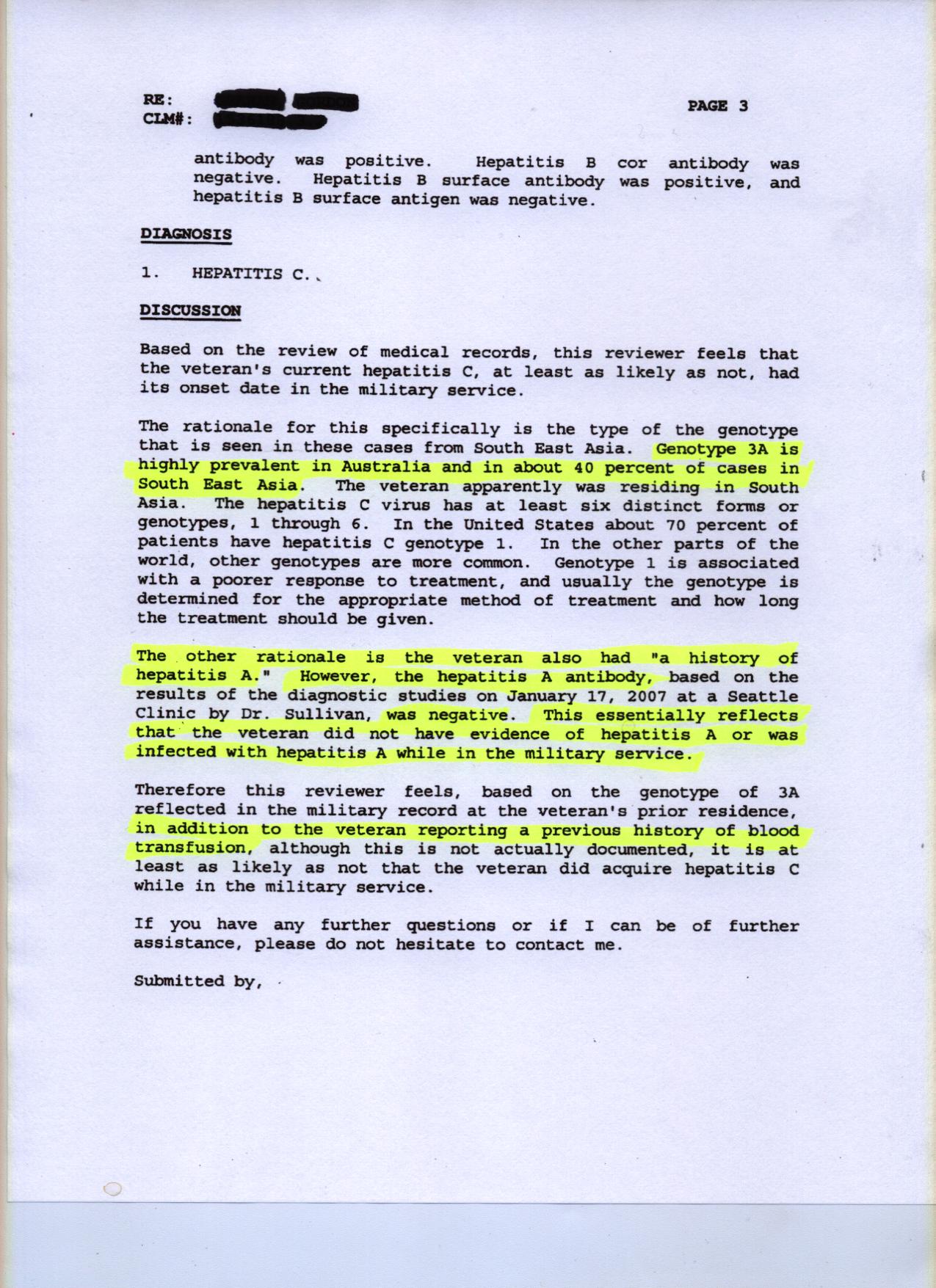
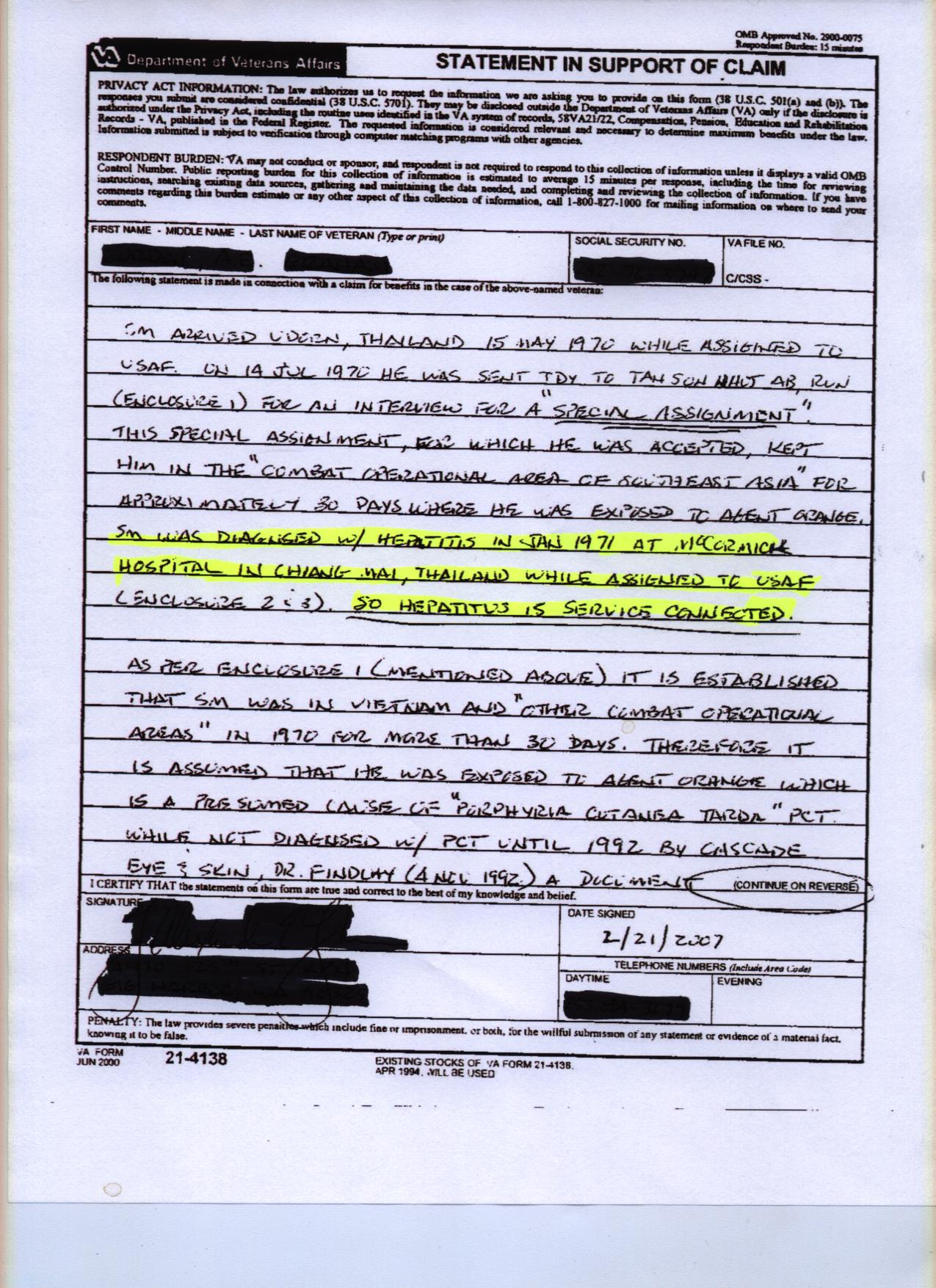
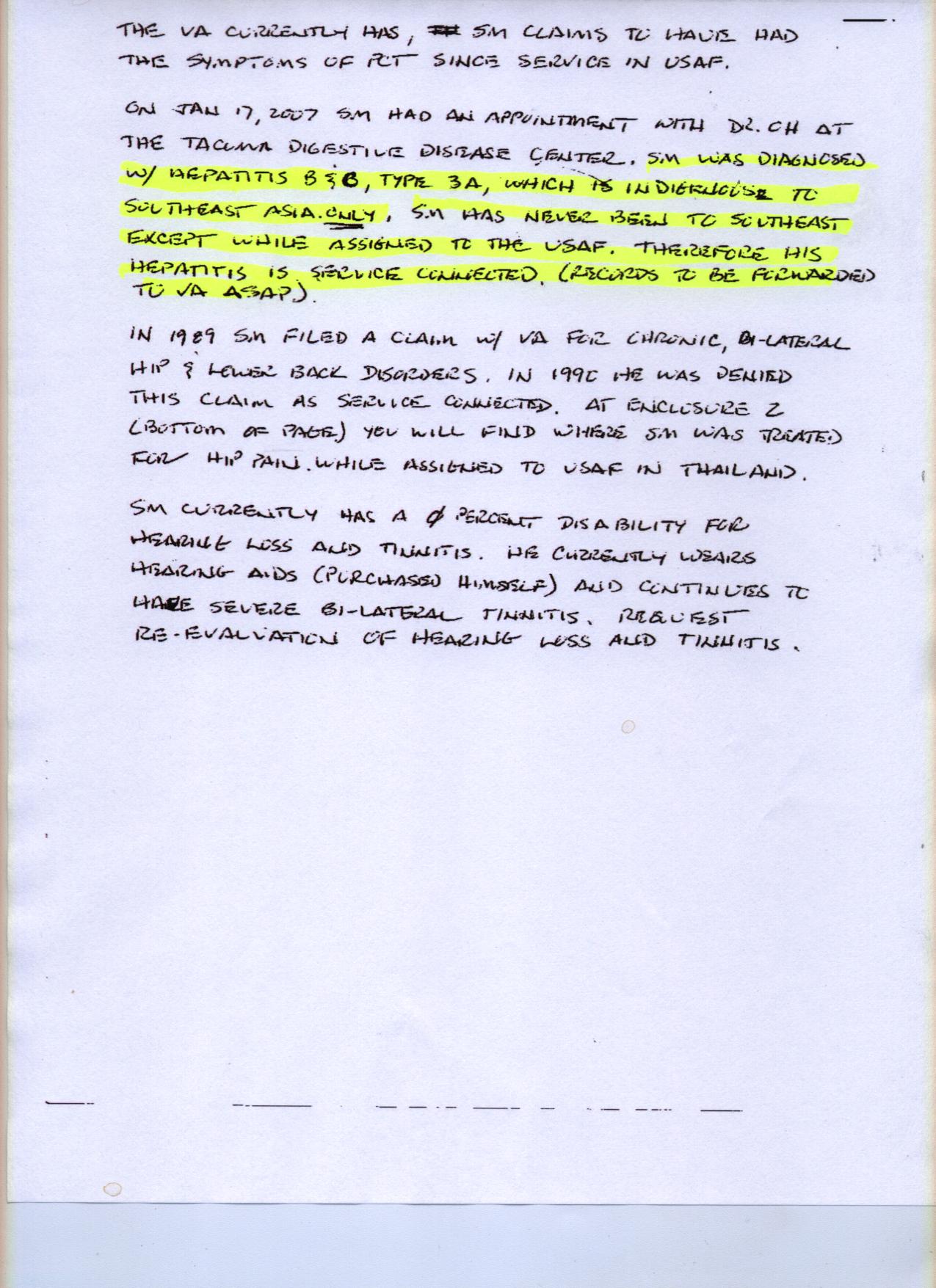
Case in point.  I filed, or should say, technically refiled to reopen my HCV/PCT in 2007.  Still ignorant of the ways of VSOs, I was doing this with the MOPH representing me. On my initial 21-4138, the rep. and I laid out all the reasons why I felt this was SC. One thing I insisted he enter on my sheet was the fact that my HCV genotype was 3A, dominant only in SEA at the time of my service there. Granted, I had hepatitis in service, but no one ever determined what flavor it was. I honestly believed it was HAV back then. It kicked my ass and I was sicker than a dog for months. Nevertheless, I survived and went on to recuperate after 6 weeks as an inpatient and several months of light duty. When I was diagnosed with PCT in 1992, the doctor ran the tests and determined I had been infected with HBV. He didn’t test me for HCV because it was still relatively unknown.

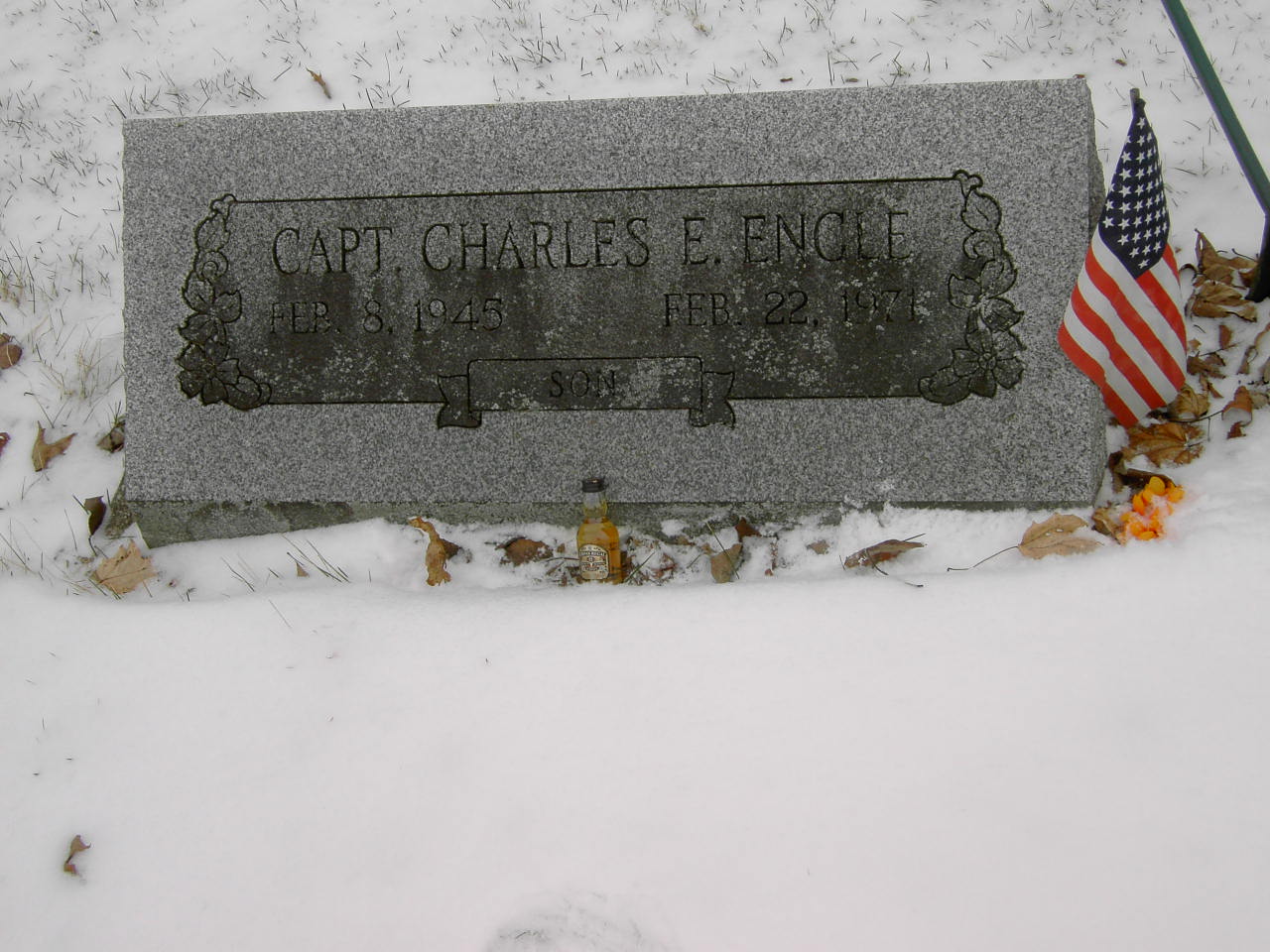
During the run up to what I figured would be a denial, the rater called me at home and asked for more information about my risks and whether I could document my transfusion from the GSW. It took me several days to remember the name of the pilot I was flying with. Believe me when I say it tasked my brain. I could see the gentleman in my mind’s eye, but couldn’t put a name to him to save my life.  While driving to a job site to check on my crew (I was still working a few hours a day), I turned onto Englewood Drive and bingo-Charles “Chuck” Engle, Slats (slang for a 1st. Lieutenant) jumped up and it all came back to me.  Forty years of admittedly repressed memories. Being a newbie to the computer, I asked my wife how to find him or show me how. Fifteen keystrokes and a google search later up popped the link that would guarantee my claim’s success…

http://www.virtualwall.org/de/EngleCE01a.htm

I was still in the hospital when Chuck augured in on the 22nd of February, 1971. I never returned to that assignment and thus never knew he caught the golden BB. This really put a fork in any potential buddy letters as you can imagine. Try as I might I couldn’t put a last name to our crew chief Randy. No one wore uniforms up country so that name tag over one’s right pocket was absent from my memory’s chords.

All I had for evidence was some civilian medical records that documented my hep.  89 days after being wounded, a faded scar where the bullet transversed my upper thigh and a raging case of HCV out of control.  Things looked pretty dim. VA wasn’t going to buy my version of events without some tall evidence. The hep records were useful, but VA was still in the “HBV isn’t the same as HCV” mode then. If you didn’t have evidence of HCV in 1970 in your records, then you were screwed. Trying to point out that HCV hadn’t been “invented” until 1989 falls on deaf ears-especially when they aren’t medical ears. VA ignored my nexus letter from my doctor and sent me to a QTC exam. I suppose that would have happened anyway as it’s SOP. The doctor who performed the C&P was an old Chinawoman. I couldn’t understand a word she said so she had her assistant translate. She listened to everything I said and finally asked me to drop my trousers. She carefully measured the GSW and photographed it extensively. That was January of 2008- almost a year from filing.

VA called again in March and asked if there was anything I could think of that might help prove this and also asked when I was going to send in any private medical records in my possession(???).  I couldn’t add any more new, but did send in all the ones I submitted to my VSO a year earlier which were promptly lost. I was stumped and so were they. This is when they sent out for an IMO and also where the story returns to why I won.

The QTC doctor doing the IMO looked over the whole pile of evidence which was pretty skinny. He correctly pointed out that while I claimed a transfusion, there was nothing to document it other than an obvious GSW scar. However, he seized on two things that were right on the top of the pile in the 4138. Hepatitis in service (documented now) and the genotype. Like all Dick Tracy types, he simply abrogated this evidence for himself and acted as though he had just cut the Gordian knot. Yea, verily, Genotype 3a is of Southeast Asian origin and the hepatitis in service wasn’t HAV, but HBV. Since it was HBV which is blood borne, it was as least as likely as not that I had contracted the C at the same time from the transfusion that was undocumented.  I’m sure at that point he felt he had just solved the most complex medical quandary of all time. My private doctor had opined as much in his nexus a year earlier.

The moral of this is simple. You can put the evidence in front of VA examiners but you cannot make them digest it. They live in the M-21 world which demands clear, easy to decipher evidence contained in military medical records. Nexus letters mean nothing unless penned by their own personnel. Doctors, like lawyers, have a keener mind and invoke inductive as well as deductive thought processes to arrive at diagnoses. While I am fond of making fun of the mental midgets who work at the VAROs across the country, I understand their limitations. They are a product of what they are taught and permitted to do. Hillary Clinton wrote a charming novel about how it takes a village to change a light bulb or some such drivel. Similarly, it takes a VARO to arrive at a decision on your claim. The fact that it is in error 70% of the time is immaterial in their mind. They have done their job and it is up to others to sweep up the broken glass if they erred. One small, insignificant entry in and of itself at the very beginning of my claim is what made the difference in my case. Keep this in mind when you file. Condense the initial filing into something short so as not to lose the attention of the examiner. Keep it simple enough that a person of sub par intelligence can assimilate it. And most importantly, enshrine it at the beginning of the process on your initial filing where even a dolt can stumble over it- thus repeatedly stubbing his mental toe in the process. Where, as here, if they still manage to ignore it, your chances are not completely dashed. Should it require a substantive appeal, rest assured that someone with a three-digit IQ will eventually recognize it for its significance. My abiding hope for all of you is to avoid that by utilizing some of these ploys.

If you are filing based on a jetgun risk theory, enunciate the fact that just because there are no documented cases of HCV transmission via the guns, that is not definitive evidence that it has never occurred. Absence of evidence is never incontrovertible proof that something doesn’t happen. Explaining this to the VA is much like discussing the shape of the Earth with a devoted member of the Flat Earth Society. Keep that in mind.

Below are the 2/23/07 refile for Hep./PCT and the QTC IMO that put this in the bag.

Posted in AO, BvA HCV decisions, Tips and Tricks | Tagged , , , | Leave a comment

BVA–BABY YOU CAN DRIVE MY CLAIM

Baby you can drive my claim

Yes I know it sounds insane

And Baby, I trust you

Seeing as I was born and raised in the Tidewater area ofVirginia, it’s only natural for me to spot Roanoke VARO and be interested. This is the original stomping grounds of Capt. John Smith of Fort Jamestown fame. Hell, you could legitimately call Jamestown the original Fort Fumble.  After you read this remand, you’ll undoubtedly agree.

This old boy got the 10% ice cream cone in 1982 with an effective date of 10/13/81. He had HBV diagnosed in service and was rated on DC 7345.  In 1985 the ice cream evaporated and he was holding an empty cone. Apparently he didn’t appeal, or if he did, it isn’t mentioned.  What’s the difference? He would have lost because the HBV symptoms abated.

Fast forward to 2002 with an interim Dx of HCV in 1999.  Capt. John files for increase of his service–connected HBV because he isn’t feeling too hot and his doctor is worried. The VA prognosticators rightfully diagnose that HBV does not equal the recently diagnosed HCV and deny the request based on the fact that he wasn’t rated for HCV. Incidentally, the new Diagnostic Code rating for HCV (7354) was introduced less than a year before on July 1st, 2001. Capt. Hep seems to be just behind the eightball here and really slow on the uptake.  Or… his VSO isn’t on his speed dial. I find this incongruous because his rep. is AmLeg and they have pretty good well drink Happy Hour specials regularly. They should have been on a first name basis and playing on the same slow pitch team by now. What happened?

Fast forward over the commercials again to 2006. Our time-challenged Veteran, who is really starting to get sick, now files for HCV and the fun begins. Remember how I always tell you potential filers to beware of what you claim and how you couch it in English?  Those wascally wabbits down at the Veterans Service Center drank too much carrot juice and construed his claim to be for an increase for his HCV. They somehow spaced out on the fact that there was no HCV rating in the file. Ne Problemo, Capitano. They therefore granted him a 10% scoop for “chronic hep.” and his effective date was deemed Feb. 28th, 2006, his most recent date of filing. Everything would have gone well, but Capt. Crunch filed a NOD for a higher rating. Ruh-oh, Rorge, said Astro.

Three years later on appeal, the esteemed Derek R. Brown, legendary VLJ, and his able munchkins spotted this anomaly almost immediately. What most Vets don’t understand is that BVA decisions are not issued piecemeal. They save it all up until they are completely finished and then release it simultaneously. That means this thing sat like a bump on a log for a year or more when it could have been legitimately remanded back to the VARO chowderheads at the Roanoke Puzzle Palace. Lord, give us the strength to endure until they finish their labors.


     In considering the merits of the claim for increase, there appears to be some confusion as to what type of hepatitis the Veteran is service-connected for.  For example, in an addendum request to the November 2008 VA examiner, it was noted that VA provided information that the Veteran has hepatitis C for which he has been service-connected.  Additionally, in a September 2008 letter, the RO set forth the rating criteria for Diagnostic Code 7345 (chronic liver disease without cirrhosis (including hepatitis B, chronic active hepatitis, autoimmune hepatitis, hemochromatosis, drug-induced hepatitis, etc., but excluding bile duct disorders and hepatitis C)) and Diagnostic Code 7354 (hepatitis C (or non-A, non-B hepatitis)). 


On review of the various rating decisions, it is clear that the question of entitlement to service connection hepatitis C has never been the subject of a formal rating decision.  In an effort to properly evaluate the residuals of service-connected hepatitis B, the Board finds that the claim of entitlement to service connection for hepatitis C  must be adjudicated.  The Board acknowledges that Diagnostic Codes 7345 and 7354 are very similar.  Notwithstanding, consideration of residuals related to hepatitis C, if service-connected, could possibly affect the overall evaluation for chronic hepatitis.  As such, the Board considers the issues inextricably intertwined and the evaluation for service-connected hepatitis B is deferred pending the outcome of this issue. 


This decision is dated 03/30/2011. It takes a month from this date to reach the stenographer’s pool. It takes another month to be typed, proofread, and mailed. It will take several more months to box up the C-file and send it 95 miles from D.C. to Roanokopolis. With any luck the Pony Express showed up by September. And then what?

The claim will spend 16 months in development and rating before they decide. If Pocahontas’ friend is still breathing, he will be delighted to get the manila envelope. I won’t guess the outcome, just the timeline.  About January 2013, seven years after filing, he will know. If his endeavour flops, he will be refilling a new NOD, etc. and returning to see Judge Brown again, assuming the aging Judge hasn’t retired.

Again, I reiterate my plaint: “Where’s his VSO? Who’s in charge of this clusterconstruction? You Vets do realize, I hope, that your VSO reps. are allowed to wander in and out of VAROs at will and find out the where/how/ why/ when of your claim any time they want. If this thing was headed down the wrong track, the VSO should have derailed it in its infancy. Isn’t that why you gave them your POA? This is where a well-versed law dog would be invaluable for the Vet who is  DIY challenged. Unfortunately, Congress has set it up so that only we or a VSO can file. A Grateful Nation bestows its respect on its defenders. In a word, brilliant.

Perhaps we should just automatically throw in MDD and/or dysthemia because if we aren’t bummed out when we start, we sure as hell will be after years of adjudications and denials.

http://www.va.gov/vetapp11/Files2/1110405.txt

Posted in BvA HCV decisions, Uncategorized | Tagged , , , , | 2 Comments

Stolen Valor Act- Pandora”s Box?

Finally. The Supreme Court has agreed to hear the case about the Stolen Valor Act. Readers may recall that an enterprising 43 year old named Xavier Alvarez of Claremont, California informed potential voters that he was the recipient of the CMOH in 1987. A quick check by some enterprising sleuth revealed no such thing. In fact, further investigation uncovered the fact that he’d never even served in the Marines as he claimed. This provoked a legal action by the U.S. government that culminated in the 9th Federal Circuit Court of Jokes to declare it was permissible under some tortured reasoning associated with the First Amendment. Prosecutors wisely decided to take this up to the Supremes.

Some of you may feel this is a waste of time and resources. Others are too busy playing thumb tag with their friends via their new IP4s. I suppose time marches on, seasons change and mores evolve into more “compassionate” rationalizations. When is a lie a “lie”? If it only hurts someone else? Defamation of character is an example of this. It is actionable in a court of law and celebrities regularly employ it when the Inquirer exposes some juicy peccadillo regarding their behaviour.

When a person aspires to public office or wants to create a positive persona for a position in his community, he or she regularly lists their qualifications. These are then used as a yardstick to measure their worth. Lying about your military service or your awards and medals gives you an unfair advantage over your competitors. If believed, it implies you are of superb character and a cut above Joe Blow Citizen who didn’t feel that call to arms. As you can see, this creates an unfair advantage. How the 9th Fed. Circus can come down on the side of misstruth and deception and defend it with the Bill of Rights will escape me forever. Some may say I am a dinosaur in a new world. The same ones may say I am not empathizing with Mr. Alvarez because he was abused as a child and is a member of the Hispanic minority. He is truth challenged but he has “issues” that permit this behaviour.

This is a slippery slope and the government recognizes such. What would this provoke if left standing? Jez, where would I start? I used to be Davy Jones of the Monkees, but I changed my name to achieve anonymity because the paparazzi continually make my life miserable? Did I mention I was the founder of the Mensa Society? Our President regularly consults with me privately about Veterans Affairs? Come on. If left standing, anyone can say anything about themselves, be it military or otherwise. It gives a whole new meaning to the Army’s tagline “Be all you can be”.A whole new industry will have to arise just to determine who is telling the truth about themselves. While this will help the President’s poll numbers by lowering the unemployment percentages, it forebodes a host of new ills. Truth, as an integral part of our psyche, will become subjective or simply optional.

I think I would prefer to be the dinosaur or is that apatosaur now? Did I mention that I strongly resemble Davy Jones? It’s true. People stop me on the street all the time and say “Hey. I remember you.” Why would I lie about a thing like that?

Posted in General Messages, Uncategorized | Leave a comment

BVA–Muskogee Jetguns

When I spot a jetgun win at the BVA, I really dissect it from every different angle. They are still rare, but yield a plethora of valuable information for others. Sometimes something as minor as a physician’s note in the file, an absentminded remark by a VA examiner or an intuitive judge will be the dernière crie on the subject.  The decision below was an amalgam of several of these.

From the marijuana-free city ofMuskogee, we are treated to a win for Vetkind. The fact that he was represented by the DAV can be looked at as either a plaudit for them or a testimonial to one individual who has done his homework and impressed the VLJ. The man had a video conference with his wife at his side. This is a positive thing. It implies she stands by her man. I guess it could equally imply she was a conniving welfare cheat and wanted a shot at Monty’s Cookie Jar, but as you watch this develop, you will see my first supposition is more likely.

The Court has spoken on the private physician treating rule. They held that this opinion is to be given no more weight that anyone else’s- including the fractured reasoning of the VA examiner. This case partially contradicts that. His private doctor has been treating him for over 15 years and is well-acquainted with his illness. He has been the Vet’s caregiver to include a liver transplant in 2004. Having been around the block with him, the doctor’s observations about a risky lifestyle would be apparent after this amount of time. The lack of a “history” combined with little or nothing in the way of risk factors other than four sexual encounters and jetguns weighs heavily in his favor. The VA is prepared to poke a hole in this, but cannot find a purchase. The boy is simply as slick as a pig at the County fair contest. Examiner after examiner tries to inject doubt or lack of evidence in an attempt to create “negative evidence”-all to no avail.

With regard to hepatitis C risk factors, the Veteran has consistently denied IV drug use or the receipt of any blood transfusions prior to 1992.  The Veteran reported having had four sexual partners in his lifetime, none of which have been diagnosed with hepatitis C.  The Veteran is not a combat Veteran; he was not a military corpsman or medical worker; and his post-service occupation was as a postal worker, so there is no occupational exposure.  Finally, the Veteran denied having any tattoos or body piercing.  As noted, the Veteran contends that he contracted hepatitis C as a result of exposure due to the air gun used to inoculate the Veteran when he started active duty service.


Witness the fact that the Vet doesn’t prevaricate. He sticks with his contention that it was jetguns from start to finish. He doesn’t meander off target and mumble about sharing razors and toothbrushes. His story is monolithic and unchanging. Vets would benefit by taking notice of this. When you file, you will be asked (even though you have no medical training) to opine on the etiology of your disease. If you choose to contribute a theory, keep it the same and never vary. Don’t add to it later in hopes that the “spray and pray” technique will hit some resonant chord. Once you become equivocal your credibility is irreparably compromised. You will be accused of being a “poor historian”. You can also say you don’t have a clue, but that isn’t advised. They may say you don’t have a viable reason to attribute it to service.

Vets will take notice that in jetgun claims, the VA will fight tooth and nail to deny. This case is no exception.  The accepted wisdom in Caluza and Hickson was that you had to have a nexus letter. Later they started adding even more verbal baggage about having reviewed the service medical records. When that requirement started to become well-known, they moved the goalposts yet again and said we had to have a “probative” analysis that discussed the pros and cons of all the risks and why the one claimed was most likely the culprit to the exclusion of all others. This evolved yet again into a discussion in recent years about how “speculative” a nexus was or wasn’t. As of 2011, we have graduated to the point where arriving with a nexus from your private treating physician is almost as useful as tits on a boar hog.  They will still deploy their examiners in the “circle the wagons” plausible defense. I’m sure you’re familiar with that one-the 2004 FAST letter that said “Yeah. We let one slip in under the wire, but that’s it. There’s no proof jetguns do this.”

In an August 2007 VA examination, a VA examiner stated that transmission of hepatitis C with air gun injectors is possible in theory, but noted a lack of scientific evidence to document the transmission.  He then stated, in essence, that because the Veteran had no other risk factors for hepatitis C, he would be unable to give an opinion about the etiology of the Veteran’s hepatitis C without resorting to mere speculation.

So, after scratching their asses and picking their noses, they decided to renexus three years later:

Given the speculative nature of the August 2007 VA examiner’s opinion, the Veteran was afforded another VA examination in July 2010.  The July 2010 VA examiner reviewed the entirety of the Veteran’s record as well as research regarding the likelihood of hepatitis C transmission through an air gun.  The examiner noted that the Veteran did not have any of the other risk factors and that transmission of hepatitis C with an air gun is biologically plausible, however he opined that as there is no scientific evidence that a transmission of hepatitis C from an air gun has ever occurred, the Veteran’s hepatitis C is less likely than not causally or etiologically related to the Veteran’s service or the inoculations received therein. 

Lay statements submitted on the Veteran’s behalf attest to the fact that the Veteran did receive inoculations during service via an air gun.  The Board acknowledges the various statements in support provided by the Veteran’s fellow servicemen.  Each letter verifies that the Veteran did receive his inoculations by an air gun injection.  Although, the Board notes that none provide evidence that anyone else was infected with the hepatitis C virus as a result of the inoculations by air gun injection that they received.

The Board acknowledges that the Veteran also provided internet research to support his contention that he could have contracted hepatitis C from an air gun.  The information provided stated that there is scientific proof that hepatitis B can be contracted through the use of the air gun.  The July 2010 examiner responded to the information by noting that hepatitis B virus is heartier and more readily transmitted than hepatitis C and that while there is at least one reported case of hepatitis B being transmitted by an air gun injection, thus far, there have been no case reports of HCV being transmitted by an air gun transmission.

Mr. Muskogee here has a really well-reasoned nexus from no less than his doctor of 15 years and the VLJ sits up and takes notice. If Mr. M was a reprobate, the doctor would never go to the floor for him. Most doctors have high moral standards. Most doctors, mind you. The ones at the VA apparently can be suborned, but we won’t discuss that today. Of more import is the obvious re-examination of the evidence (rebuttal) by the July 2010 examiner that trots out the old “HBV is heartier that HCV” nonsense. Notice this surfaces after it goes up to D.C. when the Vet can no longer rebut it? If they believe you can get HCV with only one exposure to IVDU (with or without a shared needle), why is it suddenly unproven science that you could possibly pick it up from a jetgun that 47 others whom you first met three days ago recently used? The VA loves to bandy about the word “speculative” right up until the Vet employs it against them. At that point the argument reverts to the term “plausible but unproven”. Where is the scientific study that conclusively proves the transmission via IVDU 100% of the time by the admittedly “less hardy” HCV?  Who’s the fool, fool? I submit the whole process is speculative and the medical professional who can keep the straightest face comes out the most probative.

The Board notes that the record contains a positive nexus opinion, a negative nexus opinion and a speculative opinion.  In this regard the Board refers to the previously noted positive nexus provided in the April 2007 letter from the Veteran’s private treating physician which stated that the Veteran’s hepatitis C is as likely as not caused by the air gun injector, given the absence of any other risk factor; the negative nexus opinion provided by the July 2010 VA examiner stating that although a relationship is plausible, the Veteran’s hepatitis C is less likely than not causally or etiologically related to service, including the inoculations, because there is no scientific evidence that supports transmission of hepatitis C by air gun; and the speculative opinion provided by the August 2007 VA examiner.

So the score is:

1) Yep. It was the guns.

2) Nope. It’s plausible, but we don’t buy it.

And last but not least

3) Beats the shit out of me. It would be too speculative for me to say he got it in the service,  and I was paid well to say this.

The VLJ, S. L. Kennedy, deductively reasoned this one out as being a rocks/ paper/scissors decision. Throw out the wet paper and the dull scissors and you are left with a rock solid nexus. Game, set and match.

While it can be said that you are precluded from using these decisions in an effort to prove your case, you can plagiarize to your heart’s content from them. That’s why I post them.

Posted in BvA HCV decisions, Jetgun BvA Decisions | Tagged , , , , | Leave a comment

CAVC– Jones v. Shinseki 2010 + BVA Case

Jones v. Shinseki examines what to do when, after numerous tries, the VA examiners are stymied as to the cause of your disease or whether it is service-related. This is usually summed up somewhere in your denial. It will say that after much construing, prognosticating, opining and interpreting, the poor fellows are unable (or unwilling) to grant your claim under the umbrella of any attempt being speculative. Invoking the word has been successful in the past. Here, Mr. Michael H. Jones, the appellant, appeals the practice of denial based on being unable to figure it out.

Funny how this problem rarely arises where Hep. is concerned.  Seems the Boys at the VARO have it all figured out before you get there and simply fill in the blanks with your name, rank and airspeed.  Jones set forth a rationale that supports this denial via speculation. They used McLendon v. Nicholson (2006) to hang their hat on but it wasn’t completely on point for this argument:


 Of particular significance to the matters at hand, the McLendon Court stated that “when a nexus between a current disability and an in-service event is ‘indicated,’ there must be a medical opinion that provides some  nonspeculative determination as to the  degree of likelihood  that a disability was caused by an in-service disease or incident to constitute sufficient medical evidence on which the Board can render a decision with regard to nexus.”  Id. at 85 (emphasis added).  The Court also noted that medical evidence that is too speculative to establish nexus is also insufficient to establish a lack of nexus; McLendon v. Nicholson (2006) (emphasis mine).

Mr. Jones’ defense put forth a different proposition. His major contention was that the VA should not prevail simply because they could not make an informed nexus statement. He advocated for as many attempts as necessary until the jury wasn’t deadlocked and hung.


The appellant raises a new question, however, with which this Court deals today.  How should the Court treat a situation in which an examiner’s opinion is unclear or silent as to whether all information that reasonably bears on a medical analysis has been gathered or the reasoning behind the inconclusive opinion is absent?  Stated another way, how thoroughly must an examiner develop and describe the information gathered and explain the essential medical reasoning before the Board may rely on his or her representation that an opinion cannot be rendered “without resort to mere speculation”?  This phrase must not become a mantra that short circuits the careful consideration to which each claimant’s case is entitled. Jones supra. (emphasis mine).

This is what makes this case so interesting to Vets seeking SC for Hep. We all know when the jetgun theory is laid on the table, the examiners sharpen their pencils and start doodling the word “speculation” and “plausible”.  They might as well be interchangeable terms.

This passage is what disturbs us as litigants:

While VA has a duty to assist the veteran by providing a medical examination in certain situations, that duty does not extend to requiring a VA physician to render an opinion beyond what may reasonably be concluded from the procurable medical evidence.  Notwithstanding the duty to assist, it remains the claimant’s responsibility to submit evidence to support his claim.   See 38 U.S.C. § 5107(a); see also Skoczen v. Shinseki, 564 F.3d 1319, 1328 (Fed. Cir. 2009) (interpreting section 5107 and stating that the duty to assist requires VA to bear the “primary responsibility of obtaining the evidence it reasonably can to substantiate a veteran’s claim for benefits”). Jones supra

So the Court has simply put off for another day any cutting edge precedence which might be useful to our situation.  His remand will be based on poor wording and an incomplete verbal assassination.  Chances are the VASEC will feel emboldened enough to deny yet again. They’ll give him the tinnitus. That’s a throwaway issue for 10%. Oddly, the hearing, even if Mike won, will be worth 0% until he’s deaf as a post in one ear and well on his way in the other.  But any decision the BVA renders de novo will be non-speculative this time – I guarantee it. As for the SMC K (erectile disfunction), my guess is it’ll go to an IMO at QTC and he’ll get a good nexus. One thing is for certain. This gentleman is going to be eligible for Social Security, if he isn’t already, years before he sees a meaningful resolution to all this.

http://www.uscourts.cavc.gov/documents/Jones_07-3060_published_opinion_3-25-2010.pdf

And here is the beginning of the fallout from this non-decision. The BVA is already citing it before it has been resolved.  Say all after Jones, over?

http://www.va.gov/vetapp11/Files1/1107350.txt


In this case, the September 2007 VA examiner’s opinion was of the type specifically noted by the Court in Jones, where the record yielded multiple possible etiologies with none more likely than not the cause of the Veteran’s hepatitis.  Moreover, the Board finds it significant that the IV drug use and 1993 blood transfusion were both post-service events.


The Board notes that the Veteran emphasized in both his September 2005 statement, and at his May 2010 hearing, that he only used clean needles for his IV drug use.  In other words, he did not share these needles with anyone else.  However, he did not provide any evidence how that would affect his case, as IV drug use itself is the VA recognized risk factor without reference to shared needles.  Moreover, the September 2007 VA examiner was presumed to be aware of this fact as it was documented in the September 2005 statement that was presumably reviewed along with the other evidence contained in the VA claims folder.

This is where the Vet has to be on his toes. Simply stating that you didn’t share your hardware doesn’t cut it now. Remember about 40 or 50 posts ago where I admonished the reader to be careful about VA’s propensity to come up with new ways to deny? I rest my case. We will spend another year of two before something like this finally gets a hearing before a Court judge or Judges.  Seeing it here now is useful so you can close that avenue of denial before you get there. Ex parte justice has a propensity for getting away from you. Trying to repair an error is time-consuming and requires a lot of paper and postage. Once the BVA has spoken, the only avenue is a NOA, not a NOD. More time is wasted and resolution is pushed out several more years when this occurs. Knowing full well, that what you do not include in your claim will be seized upon as the causative factor, its almost axiomatic that you become more anally retentive than they are. I know that’s almost impossible like attaining the speed of light, but you will have to learn how.

Our teaching moment is obvious. Simply stating a lay fact does not influence a VA examiner’s assessment of risk in this. You have to be specific and explain why to them- as in: “Because I didn’t share needles, the risk of contracting hepatitis from this vector was avoided. And to keep the record straight, I did it once or twice and never did it to the point of addiction. It was isolated and infrequent and it had no deleterious effects on me.” Then shut your friggin’ pie hole. Better yet. Write it all down and avoid having to do it in front of a judge unless you can honestly look him in the eye and convey your credibility and sincerity.

Posted in BvA HCV decisions, Important CAVC/COVA Ruling | Tagged , , , | 3 Comments

FROM THE FOOTLOCKER

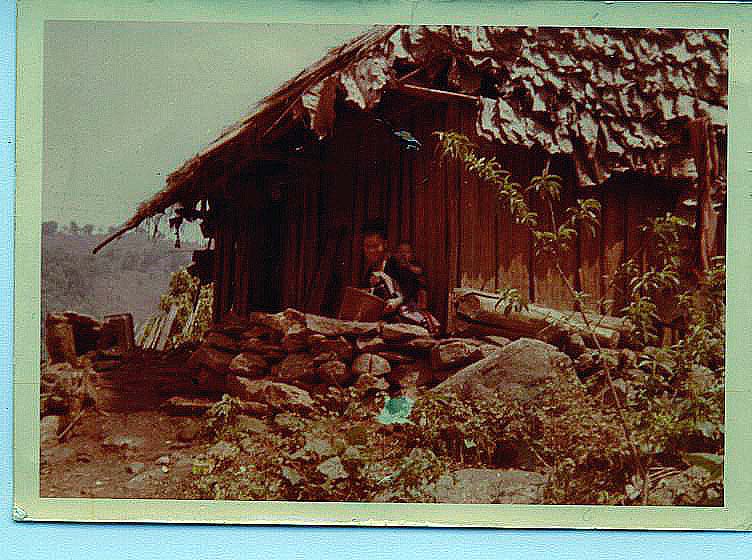
Always in search of oldies that may help Vets accomplish a claim, I constantly run across weird things I saved from SEA and old flight maps. The ones we had were leftovers from when the French controlled the Indochinese peninsula (Laos, Cambodia and what is now all of Vietnam).  I can’t believe I have some of this. My wife says I’m a packrat and I’m beginning to believe her.  All I remember bringing back was a bunch of guns.

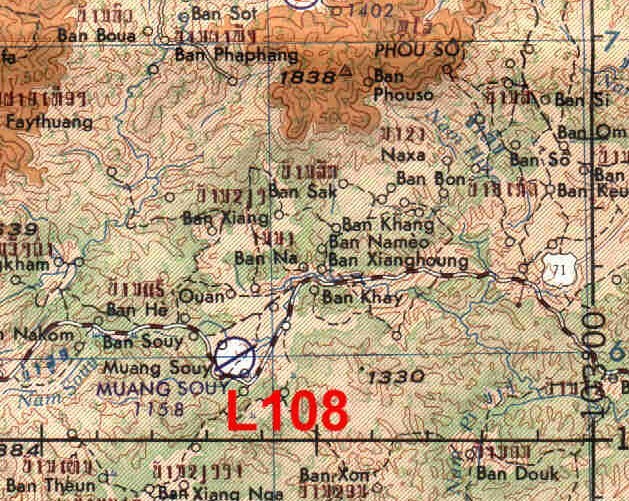
The white circle is the operating location and the line tells you which way the runway aligns. Muong Soui’s paralleled Route 7 just to the south.  Route 7 goes from Hanoi to Vientiane. Still does. Route 71 branches off to the north to Luang Prabang  (L-54).  Moung Soui is in the northwest corner of the famed Plane of Jars.

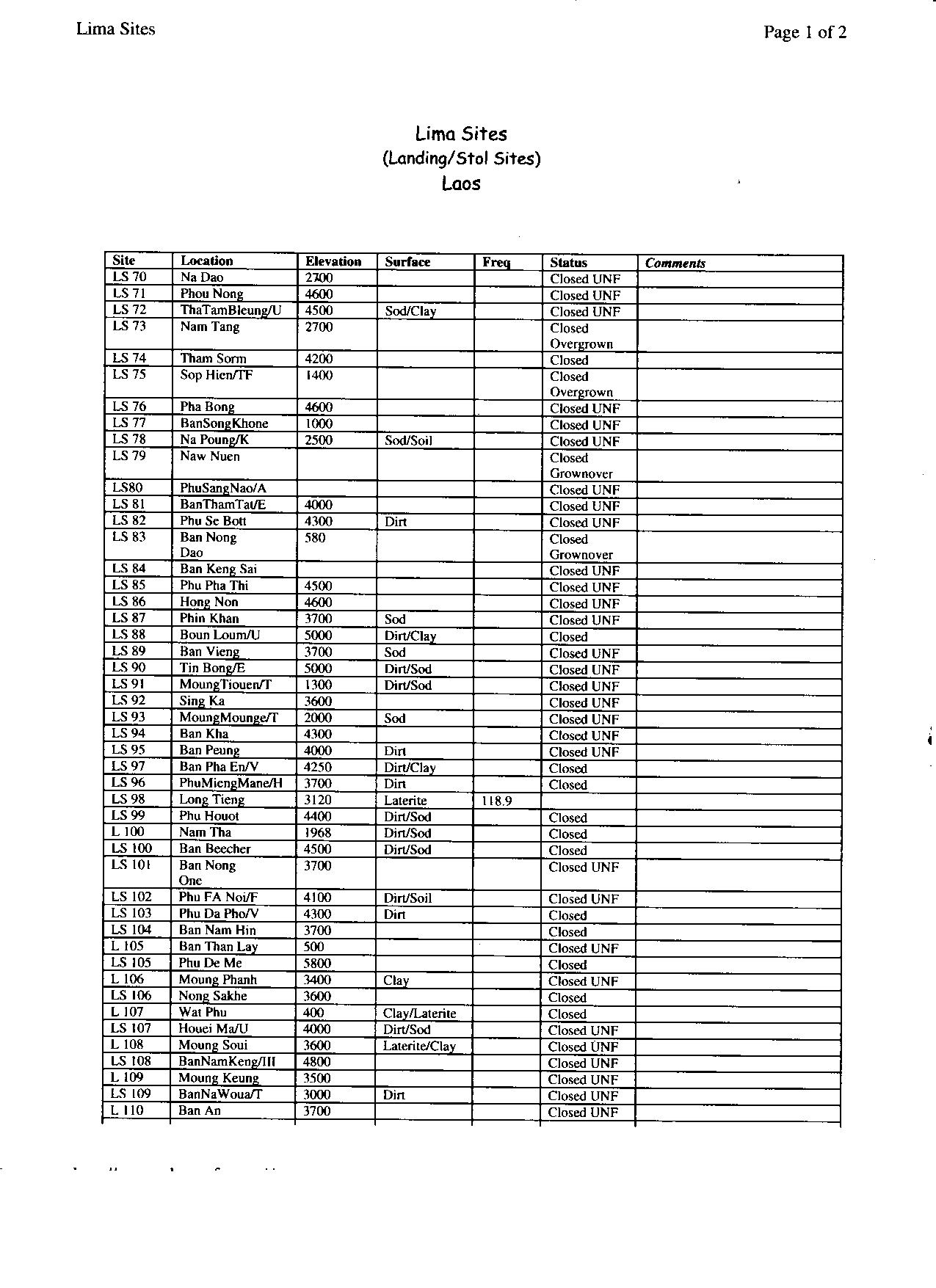
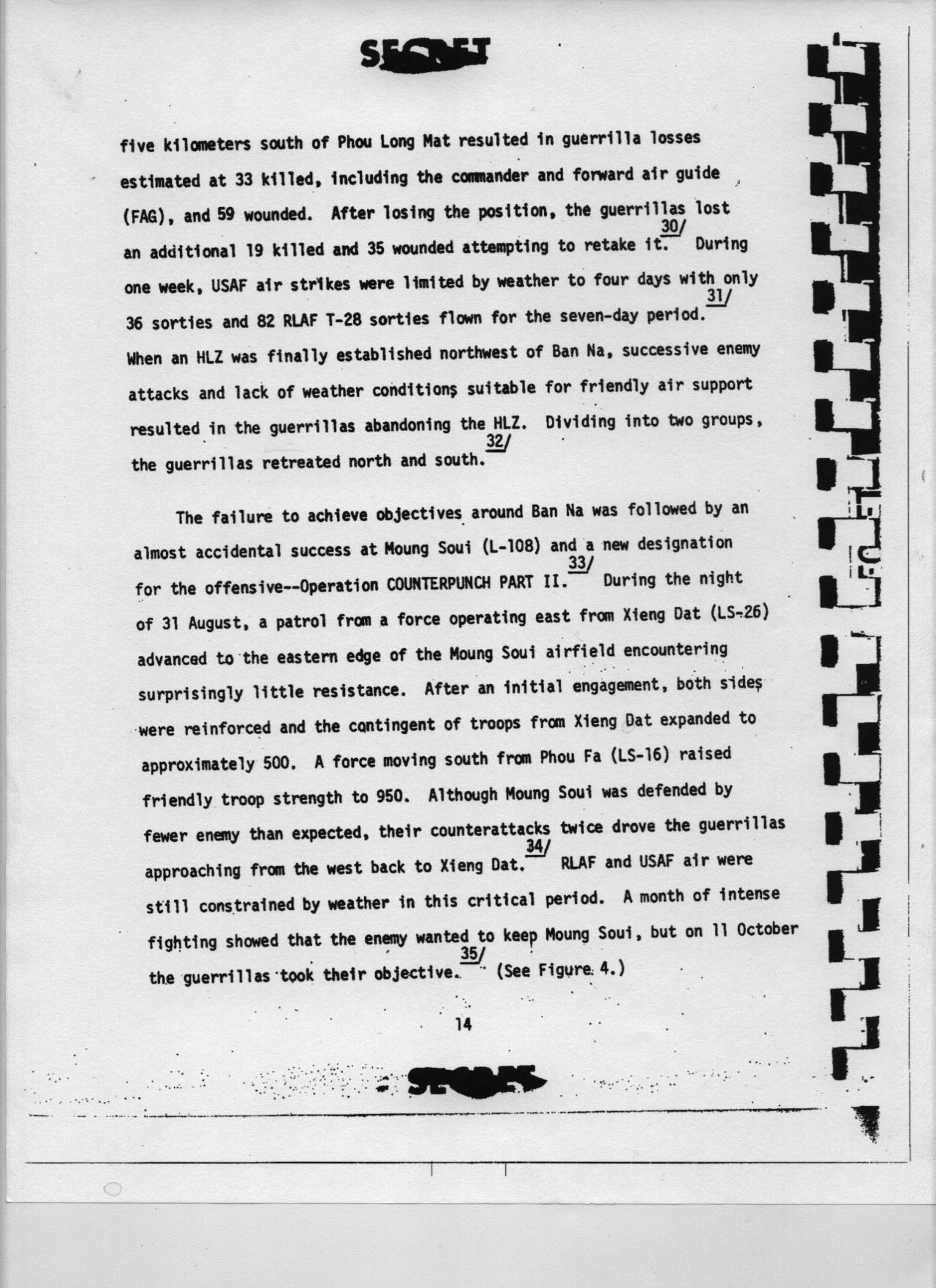
 L-108 traded hands quite frequently. We owned it during the monsoon ( August to January) and lost it every winter. My brain is starting to go. I think UNF stood for Unknown Nationality of Forces or else it was Unsafe for Navigable Flight.  We never paid too much attention to that column.

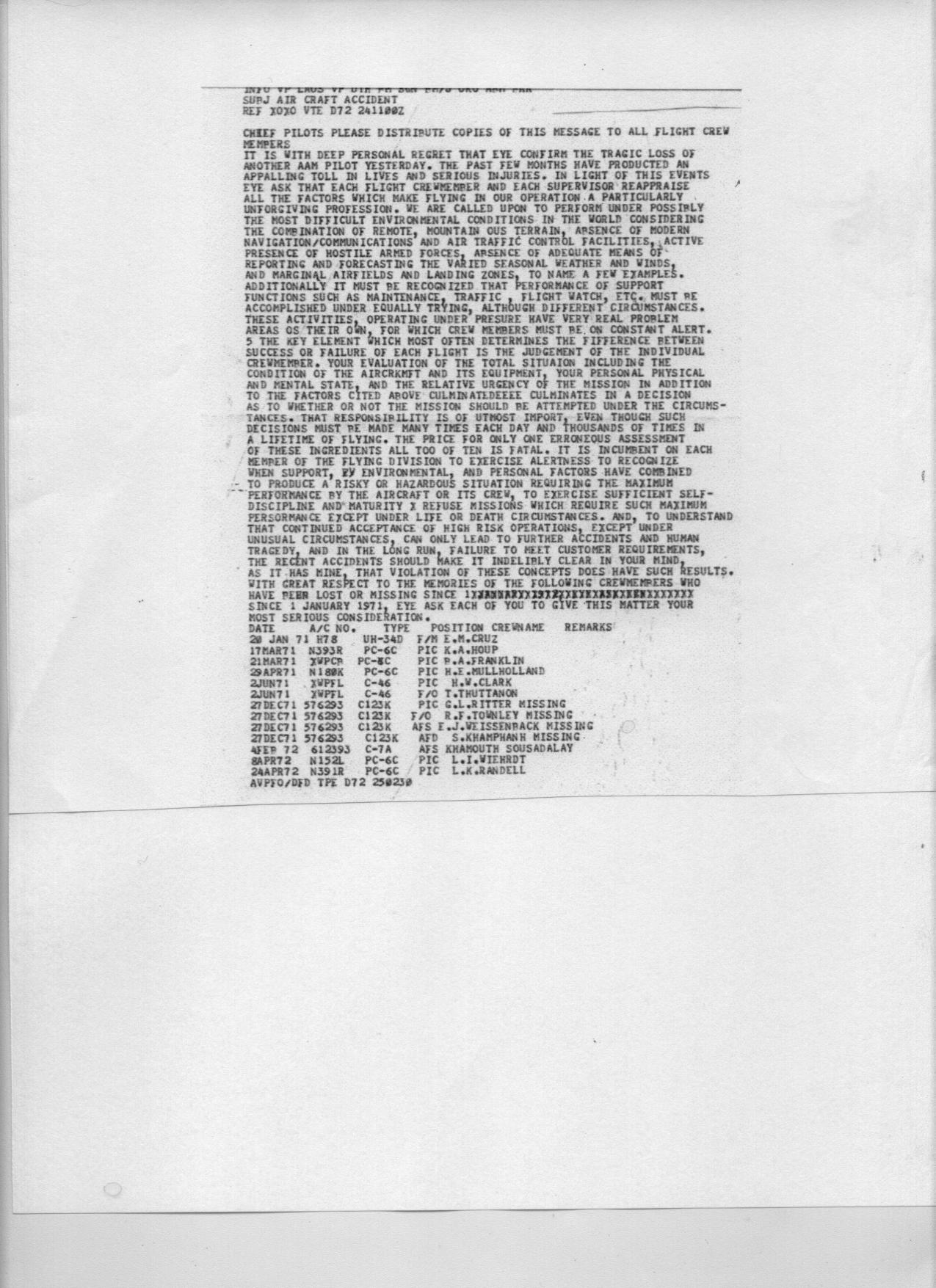
Flying is a hazardous business as you can see.

Lima Site 20 Alpha-Long Tieng. This was home from 7/70 to 11/70. We called the Karst limestone hills at the end of the runway the titty karsts. We also referred to them as the vertical speed breaks. Runway was Laterite 1100 feet. 3120 ASL, Approach and Departure freq. was 119.1 mhz. The only major base with a unidirectional runway. A C-123 hit it in 69. The reason you don’t see any weeds around the runway is because the Hmong children used bleach bottle scoops and poured AO undiluted all over the approach and the parking aprons.  That would explain why I have PCT. I bet there’s still nothing growing there. I’d also bet every one of those kids are dead, too.

Posted in From the footlocker, General Messages, Humor, Uncategorized | Tagged , | Leave a comment