BVA– Remand to Nashville Cats

BVA—Remand

NashvilleCats

While I compliment the  VLJ on his candid observation that the Nashville Cats at the Nashville VARO aren’t playin’ as clean as country water, the cause is lost. Judge Michael E. Kilcoyne has been around the BVA for quite some time. He has seen innumerable cases come up the ladder. As hopeless as this seems, he is still going to insist that the VARO give the poor Vet a blindfold before the firing squad cocks and locks.

It’s almost unconscionable in this day and age that an organization as august as the DVA purports to be would kick Sgt. John Doe to the curb without performing due diligence on his claim.  This stinks. He’s obviously filed his “Fetch!” forms (VA Form 21-4142 – Authorization and Consent to Release Information to the Department of Veterans Affairs (VA) ) with them as it says as much. His Tennessee DVA (the VSO) doesn’t appear to be into the Lovin’ Spoonful because they sure aren’t on the same page. In fact, about the only one on the same page with him is Hizzoner Kilcoyne who is several hundred miles away.

Another one who seems to be overly helpful is his wife. I got out the magnifying glass to see if the prefix “ex-“ had escaped me, but alas, it just wasn’t there.  This is worse than a bad hair day:

Furthermore, as mentioned supra, the Veteran has reported engaging in various hepatitis C risk-related activities during service, and the Veteran’s spouse has reported discovering the Veteran’s illicit drug use approximately six months after his discharge from service.

A word to the wise. While I abhor the idea of lying to the VA, there is really nothing a spouse is going to be able to contribute to your claim that is beneficial.  Camp followers went out of style after the War of Northern Aggression (that’s the “Civil War” for all of you from Chicago).  Here, it was fatal. I commend his spouse for her honesty. She must have been briefed by the VSO on how helpful this would be for his claim. Has anyone a better hypothesis? Feel free to contribute. This is a forum.  I feel she could have submitted a statement on his ills and how the disease impacted his life. Assuming she was like my spouse, I doubt she would have purposefully sabotaged the process and thus deprived them both of a potentially compensable grant of SC. I fear we’ll never know.

One of the things that makes this  beyond the pale is that the VARO is in Nashville and they were too lazy to even send over to the hospital (which is less than 18 miles away) to get his medrecs. How lame is that? No one I’ve met who has been subjected to the VA “experience” has ever had a cheerful chipmunk attitude about it. I guess you have to draw the line somewhere. Disobeying the law and pissing off the VLJ is not going to win you friends anywhere but at the VARO. What’s worse is that there’s no complaint form that will ever punish the miscreants or reprimand them for committing such an obvious error. Wasted time? No big. We’re gonna be here for the next 15 years waiting for the golden parachute. We’re indemnified. Like, what are you going to do? Sue us?

This will wend its way back to the venerable VLJ in due time- probably about 16 to 18 months from now- with another Dear Sgt. John letter attached. It will dutifully be noted that there is still no medical nexus forthcoming other than the one thoughtfully and meticulously prepared by those sweet, utterly efficient little VA raters on their busy little hamster wheels cranking out justice for all. All his damning medical records documenting numerous mentions of a former life of sin and degradation will now be collated, color tabbed and part and parcel of his C-file . There will also be highlighted portions wherein he has turned over the new leaf after service with the help of wife and church. Amen.

The VLJ will then intone a mournful soliloquy about willful misconduct and how it cannot be rewarded. The Judge will finally pronounce Extreme Unction and wash his hands ceremoniously. The inevitable is so foregone as to be anticlimactic. Nevertheless, the music must be allowed to finish before the dancers can retire from the floor. At some point after this is over, the SO will pipe up and say something dumb like “Who would’ve figured? Are you buying?”

Peter of Menalteed fame has a wonderful suggestion for all this claptrap. Why not have an impartial jury of seven composed of say, two VA poobahs to bring the correct rules and regulations to the table; a third, an impartial lawyer well-versed in the same discipline, to keep an eye on the poobahs and prevent mission creep; and lastly, two unversed civilians and two military personnel to approximate the term “of his peers” with no ax to grind. Hand them the evidence and everyone can play Pontius Pilate using their thumbs to affirm or deny. This should separate the ribbon clerks from the poker players. They can remand for more evidence as necessary as many times as they want-just as they do now. This can be done in person in small cities everywhere. It will be synonymous with regular jury duty and you’ll be exercising your rights and duties as only a loyal American can. What could be more perfect? I suppose this might upset the jobs applecart at the VAROs , but what the hey? We can retrain them on the concept of Innocent until proven guilty instead of the obverse.  Yep. Pretty soon they’ll be saying things like “Stinky, dude! What a totally new concept! Imagine treating a Vet’s testimony as being potentially credible instead of merely “contentions? Is that tubular or what?”

I admonish Vets not to hold their breath as it makes those little black spots in the corners of one’s vision such as when you stand up too rapidly. In time, grasshopper. Just think.  Twenty years ago they were looking at us and saying “Hep. C? There is no such thing and you sure as hell didn’t get it from no toilet seat in the service, sonny. Now move on.”

Ladies and gentlemen Vets: I give you former Sgt. John Doe of Saint Petersburg, Florida where all veterans go to file. He then moved back to Nashville.

http://www.va.gov/vetapp11/Files1/1109751.txt

Onwards through the Fog. Vote For Oat Willie in ’12.

Posted in BvA HCV decisions, Frivolous Filings | Tagged , , , , | 3 Comments

TEACH A MAN TO FISH

Give a man a fish and you feed him for a day.

Teach him to fish and you feed him for life.

I don’t know who said this. It isn’t germane to my discussion here. The thought is, though. Yesterday, I had the pleasure of lunch with one of our members and his wife. As we are few and far between, this occurs rarely. In fact, this is only the second time it has occurred. “Members” of HCVets are a loose, unaligned bunch. Due to this disease process, we have an ugly habit of passing away before we have an opportunity to develop long-term relationships with one another, too.

Peter (Menalteed) and his charming wife traveled a great distance to buy my wife and me lunch, as I said. He is the epitome of perseverance. I have had several members tell me via the internet that they followed my prescription for pursuing their claims and it worked. Peter was no different. He actually read everything I had posted here and followed the program to a “t”. The payoff is vindication for all of us who aspire to help others. Nothing brings me greater joy than helping one of you attain that which is rightfully yours. The fact that the VA erects such an impenetrable barrier to service connection is no accident. They have limited assets and loads of time.  Finding a path through this jungle seems to be the problem.

Recently Peter and WGM (Bill) succeeded in accomplishing this at the VARO level without having to appeal to D.C. This doesn’t mean that the VA has changed its modus operandi. It reflects a dogged, intense preparation which caught their respective VARO examiners off guard and compelled them to throw in the towel. They are not accustomed to Vets arriving with this kind of evidence and the requisite letters connecting their diseases to service. VSOs seem to overlook this little requirement on a regular basis. Peter did this all by himself and he’s 68.  In addition, he’s stage 4 on his second liver and undergoing chemotherapy.  Look no farther than Miriam Webster’s seminal tome on the English vocabulary under “perseverance”. There undoubtedly will be a picture of him under the word.  This gentleman, with astute assistance from his wife (who is a nurse), assembled a bulletproof claim for cirrhosis, HCV and a host of secondaries including DM2 and coronary artery disease. He has now won them all. Having a sawbones in your corner is a prerequisite but the impetus required to pull all this off when you are knocking at death’s door is stupefying.

I have often cajoled Vets into greater efforts to win when it seems they have hit the wall. Peter, on the other hand, did virtually all this with little or no input from me.  He simply read what I posted and acted on it.  It is one thing to advocate a path of attack, propose backup measures and assemble evidence you think you will never need.  Likewise, when denied, some lose hope or become despondent. Peter exhibited none of these mental maladies. He simply soldiered on and put one foot in front of the other. The results will stand his wife in good stead when he is gone vis a vis DIC. By covering every possible contingency, VA will not be able to try their sleight of hand tricks and say “Well, that’s all well and fine that he was connected for the HCV/cirrhosis, but our esteemed experts have determined he died from a heart condition”. Fine. Let them say that. Peter has covered that base so it is a moot point. In fact, Peter has covered a plethora of bases. The word “checkmate” comes to mind. VA is going to have writer’s cramp before they finish penning all his ratings. I strongly suspect he will have somewhere in excess of 180% in ratings- more than enough to qualify for the SMC “S” he so richly deserves.

You have to ask, of course- what was the risk factor? Hold on to your hats. Jetguns.  With nothing more than several pounds of medical literature, a buddy letter from a fellow recruit about the sanitary practices of pecker checkers and several nexus letters, VARO Seattle examiners granted his claim with little more than a whimper. They did send out for a QTC IMO on whether all the secondaries he filed for were legitimate. They were-and QTC said as much in VAspeak.

If you Vets out there keep this up, I won’t have any time to write funny posts like Agent B and the new Libyan medal.  I consider that grossly unfair. All my time will be consumed writing congratulatory letters to successful Vets on their prowess at bearding the VA lion in his own den. Where does that leave me?  Well, there is the danger of obesity. With Vets showing their appreciation by buying me meals at fine restaurants, I endanger my own health.  Damn it, I say.  It pains me to think I must set aside my concerns over my health for the greater good of helping all of you. You task me, ladies and gentlemen. Your success(es) are earned. Providing you with the assets to do so is less than half the battle. Peter is ample proof of that.

Posted in General Messages, Tips and Tricks | Tagged , , , | 4 Comments

VA — TRICK OR TREAT

On October 31st, 1990, the VA instituted the concept of willful misconduct. Prior to this the measurement was nominally Line of Duty (LOD). If you did something stupid like driving drunk and really messing yourself up, that was not LOD. However, the two Specialist First Class buddies who were twice as toasted as you were passengers and were LOD because they were unwitting hitchhikers of sorts. Confused? You needn’t be.  If you were not responsible for an accident (unforeseen), then you were LOD. If you were doing something you knew was stupid and managed to cause yourself great harm, then you had to repay Uncle Sam by staying in the service longer to compensate for the lost time. AWOL was assessed this way as well. We’ll address desertion in another post.


With the advent of drug usage and abuse, the problems gradually multiplied one hundredfold. The military method finally percolated down to the VA on Halloween, 1990.  If you came down with cirrhosis of the liver from too much Tanqueray prior to that Halloween, you could claim it as SC. All you had to document was one detox while in service to prove your case and pow! SC. Too cool for school. VA finally put their foot down and closed this loophole. 20-year junkies from Nam were filing and getting SC. This had to stop. So henceforth from that All Hallowed’s Eve of 90, the practice came to a halt. Everyone before was good to go but all those after…weren’t. This, of course was the new 38 CFR § 3.301. Allow me:


(a) Line of duty. Direct service connection may be granted only when a disability or cause of death was incurred or aggravated in line of duty, and not the result of the veteran’s own willful misconduct or, for claims filed after October 31, 1990, the result of his or her abuse of alcohol or drugs.

(b) Willful misconduct. Disability pension is not payable for any condition due to the veteran’s own willful misconduct.

(c) Specific applications; willful misconduct. For the purpose of determining entitlement to service-connected and nonservice-connected benefits the definitions in §§ 3.1 (m) and (n) of this part apply except as modified within paragraphs (c)(1) through (c)(3) of this section. The provisions of paragraphs (c)(2) and (c)(3) of this section are subject to the provisions of § 3.302 of this part where applicable.

(1) Venereal disease. The residuals of venereal disease are not to be considered the result of willful misconduct. Consideration of service connection for residuals of venereal disease as having been incurred in service requires that the initial infection must have occurred during active service. Increase in service of manifestations of venereal disease will usually be held due to natural progress unless the facts of record indicate the increase in manifestations was precipitated by trauma or by the conditions of the veteran’s service, in which event service connection may be established by aggravation. Medical principles pertaining to the incubation period and its relation to the course of the disease; i.e., initial or acute manifestation, or period and course of secondary and late residuals manifested, will be considered when time of incurrence of venereal disease prior to or after entry into service is at issue. In the issue of service connection, whether the veteran complied with service regulations and directives for reporting the disease and undergoing treatment is immaterial after November 14, 1972, and the service department characterization of acquisition of the disease as willful misconduct or as not in line of duty will not govern.

(2) The simple drinking of alcoholic beverage is not of itself willful misconduct. The deliberate drinking of a known poisonous substance or under conditions which would raise a presumption to that effect will be considered willful misconduct. If, in the drinking of a beverage to enjoy its intoxicating effects, intoxication results proximately and immediately in disability or death, the disability or death will be considered the result of the person’s willful misconduct. Organic diseases and disabilities which are a secondary result of the chronic use of alcohol as a beverage, whether out of compulsion or otherwise, will not be considered of willful misconduct origin. (See §§ 21.104321.5041, and 21.7051 of this title regarding the disabling effects of chronic alcoholism for the purpose of extending delimiting periods under education or rehabilitation programs.)

(3) Drug usage. The isolated and infrequent use of drugs by itself will not be considered willful misconduct; however, the progressive and frequent use of drugs to the point of addiction will be considered willful misconduct. Where drugs are used to enjoy or experience their effects and the effects result proximately and immediately in disability or death, such disability or death will be considered the result of the person’s willful misconduct. Organic diseases and disabilities which are a secondary result of the chronic use of drugs and infections coinciding with the injection of drugs will not be considered of willful misconduct origin. (See paragraph (d) of this section regarding service connection where disability or death is a result of abuse of drugs.) Where drugs are used for therapeutic purposes or where use of drugs or addiction thereto, results from a service-connected disability, it will not be considered of misconduct origin.

(d) Line of duty; abuse of alcohol or drugs. An injury or disease incurred during active military, naval, or air service shall not be deemed to have been incurred in line of duty if such injury or disease was a result of the abuse of alcohol or drugs by the person on whose service benefits are claimed. For the purpose of this paragraph, alcohol abuse means the use of alcoholic beverages over time, or such excessive use at any one time, sufficient to cause disability to or death of the user; drug abuse means the use of illegal drugs (including prescription drugs that are illegally or illicitly obtained), the intentional use of prescription or non-prescription drugs for a purpose other than the medically intended use, or the use of substances other than alcohol to enjoy their intoxicating effects.


So, what does that say about all this business being legal before 10/31/90? I’m not that moral so I won’t conjecture. What I will point out is something that most Vets are unaware of- the old escape clause. This is part of the Santa clause.  Read again more slowly…

(2) The simple drinking of alcoholic beverage is not of itself willful misconduct.

(3) Drug usage. The isolated and infrequent use of drugs by itself will not be considered willful misconduct;

Oftimes, what a regulation permits is hidden in what is forbidden by it. Sometimes in plain sight. This has been there all along and I have only seen one VLJ parse it exactly the same.  § 3.301(c)(3) comprehends that some idiot may want to “experience” the rush of heroin, speed or whatever.  This rare occurrence should not condemn the poor boy to perdition and denial via willful misconduct if it was a one of a kind lark or even several over 3 years.  Under these unique circumstances, you can pass the mirror test and advance to a claim. On the other hand, if you have been clean for only six months and you’re 63, forget it.

The humor I find in regulations like this has to be that they even allowed alcoholic lifers to file for hyaline cirrhosis due to ETOH abuse before this was enacted.  I think drug addiction is sad. I fear it may be harder to break the addiction than booze. That’s why I come down hard on alcoholics. I think I may have been one once.  Nevertheless, there you have it. Trick or Treat from the happy folks at VA.  Their Motto? We will grant no claim before its time (time is such a subjective concept).

Posted in Introduction-Read these first, Tips and Tricks | Tagged , , | Leave a comment

BVA–PEER PRESSURE

I am always amazed at the entries in the excuse book for how a Vet got infected with HCV. I say excuse in the sense of a disenfranchised Vet- i.e. one who has been denied and will never attain SC for it. We here at AskNod thought we had heard them all. My all-time favorite was  the one where the stateside Vet had been infected by returning Vietnam Vets because he drank from the same water tanks as them. Eating contaminated feces was another wild tale. This one is not inherently incredible, but lacks something besides the fact that we all know it’s against the law to do this and get remuneration. My daddy said “Excuses are for entertainment purposes only. They serve no useful purpose beyond that other than to convert oxygen into carbon dioxide.”

With that, I leave you to contemplate the idea that one’s superiors would consciously attempt to coerce you into drug abuse on a fairly regular basis…

In this case, in statements and testimony, the appellant contends that his hepatitis infections were caused by his use of intravenous drugs (heroin and cocaine) beginning during his period of initial active duty for training in the Army National Guard.  He explains that, immediately after his basic training, higher ranked personnel introduced him to heroin and cocaine, and that he felt peer pressure to partake.  He contends that the Medical Board findings concerning a history of intravenous narcotics use that began at age 16 (prior to service) were a lie. The appellant testified that he attended detoxification three times during that first period of training, and that he continued using illicit drugs until 2009.  He testified that he was first diagnosed with hepatitis in 1994 or 1998.

http://www.va.gov/vetapp11/Files1/1101518.txt

Take about one hundred of these filings out of the system and I’m willing to bet jurisprudence would accelerate like those defrag programs they sell called speedupmypc.com

Posted in BvA HCV decisions, Frivolous Filings | Tagged , , | Leave a comment

LOOKING FOR CUE IN BVA PLACES

Looking For CUE


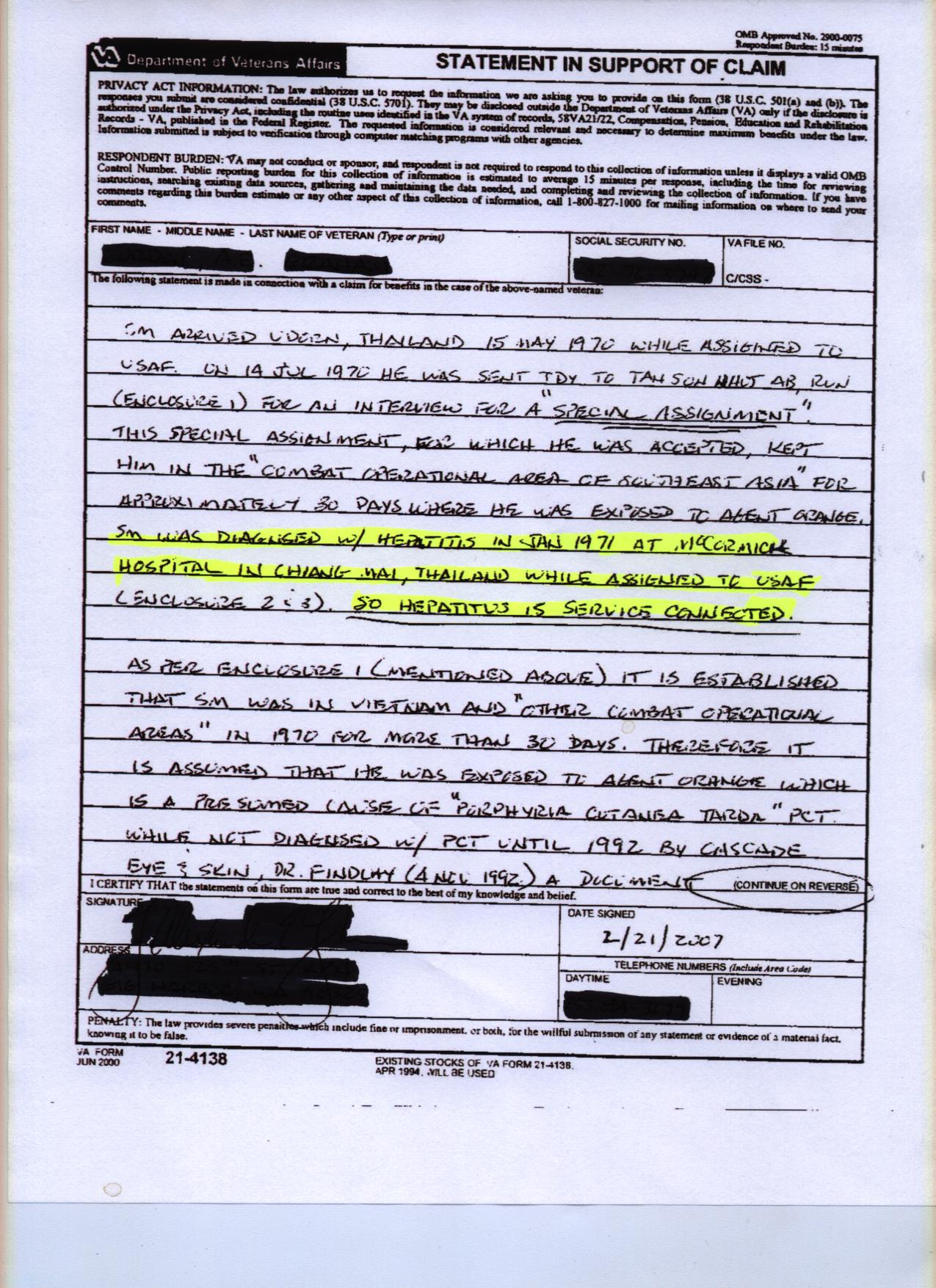
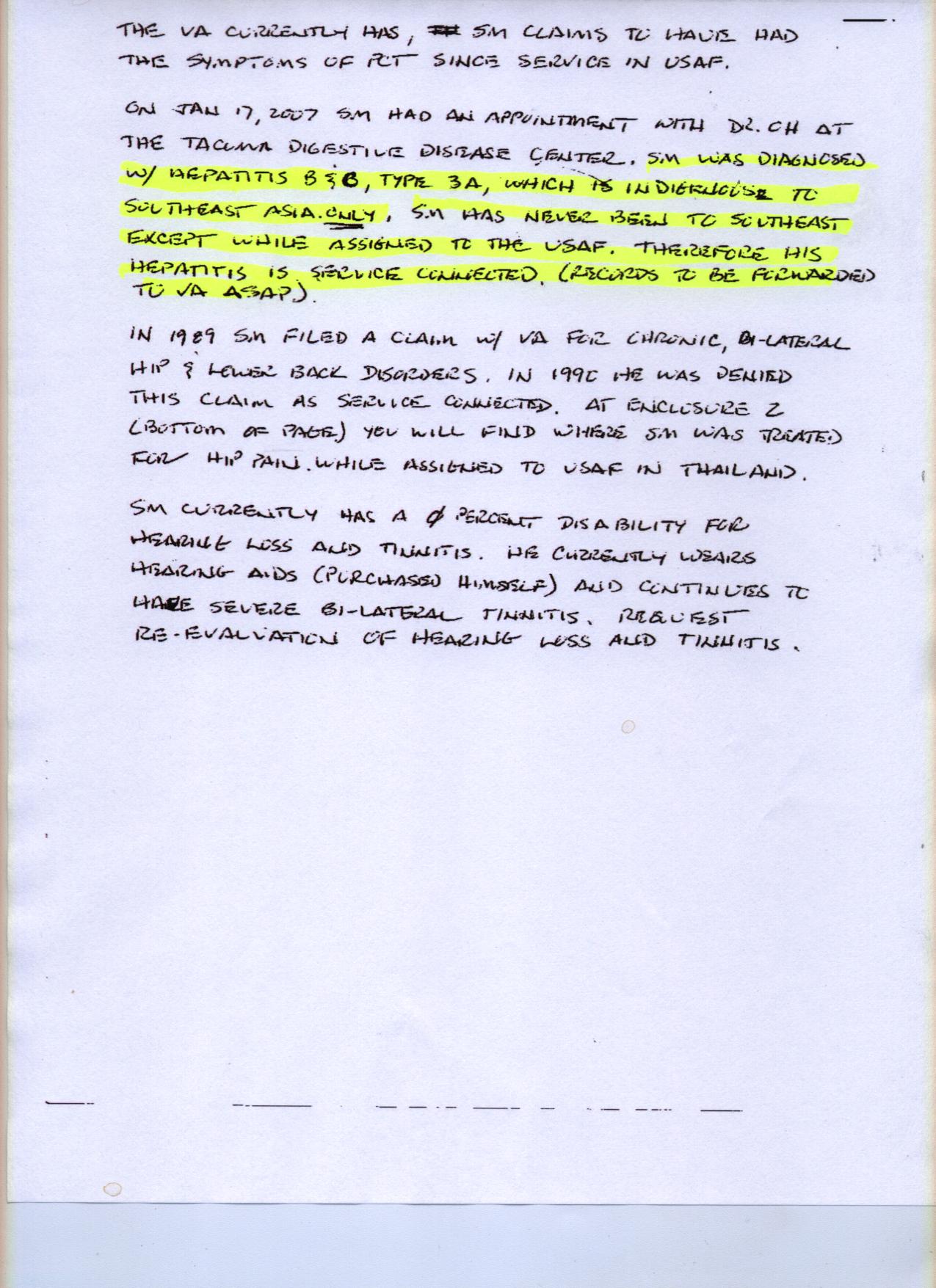
I have posted examples of CUE (Clear and Unmistakable Error) on several occasions but have never posted decisions where the reader can look for CUE in a BVA decision and discern it. I have chosen my first battle with the VA in 1989. I didn’t know anything about this process and trusted the DAV to do this for me. I fault no one but myself in retrospect, but feel I was represented by Huey, DUI and Louey.

The COVA, the forerunner to the CAVC was empanelled about one month after I filed. They were just hanging their sheepskins when I lost. They moved to new digs four months after they were ensconced in their first offices. My claim arrived in D.C.  early in 1991 and my docket date was March 5th, 1992. This was truly the dawn of time for the Court. If I had known about them, I could have appealed. My service officer never told me. I suspect he was so wet behind the ears he honestly didn’t know either. He didn’t go to D.C. personally. Some chowderhead higher up who lives there did the honors.   What I think of him doesn’t bear repeating. He tried to play doctor. Then he tried to do the benefit of the doubt argument. All for naught it seemed.

The beauty of our cloistered legal system is the fact that we can go back and correct deficiencies, glaring errors that were prejudicial, and judgments that were clearly and unambiguously defective.  In order to accomplish this, you, the Veteran, have to know what to look for. Just having the shopping list of what constitutes CUE isn’t enough. Being able to see it is harder. They don’t type their errors in red. One other thing they don’t do is call you up 22 years later and apologize with a back check in their hands. If this is going to happen, you have to be the active participant.

Fugo v. Brown held that you could not come into court shouting just CUE. It required that you show what you thought was CUE, why you believed it to be so, and why it manifestly changed the outcome.  We won’t go into all the facets here. What we want to examine is how you can spot it. If you have any decisions from way back when like this one, get them out, pour an iced tea and keep a pad of paper and a pen handy.

http://www.index.va.gov/search/va/bva_search.jsp?QT=+Citation%3A+BVA+92-04999&SQ=vetapp92&RPP=100&LC=0&ET=&UA=Search

In 1992 there were 20 sections of 3 judges each for a total of 60. Mostly, but not always, the same three engaged in a certain geographical area of theU.S.  They sat as two occasionally, which was legal, but never as one. That is what happened here. One of the members was required to be a medical doctor and was allowed to make decisions of a medical nature to keep things moving right along. This all changed with the COVA. They ruled that was no longer an option in 1991 several times. The BVA doesn’t listen very well or else they didn’t get the fax/email on it.  They continued to make this mistake right on up until things got so backlogged that they opted to do this with one judge and retired all the doctor judges. The error is almost unheard of now. You will find it in early ones however.

As you can see, I filed for four items. Ron whatizbutt from DAV said I was going to knock them dead at the VARO. When that phrase was pronounced “no longer operable”, he told me not to worry. We were going to D.C. for some real justice. He decided at the last moment to try to make them see reason here in Seattle at a DRO hearing and review. That dragged it out for almost all of 1990 and I finally got the F-9 filed in early 1991.  To be honest, I forgot about it until Ron called me all breathless in late March of 1992 and told me we had WON! Not exactly. I had won 0% for hearing and 0% for tinnitus. That’s an ice cream cone with two scoops of air. My VARO shared that with me in June, 1992 just on the off chance I hadn’t figured it out by myself.

The big one for my back/hips was tossed. Ron never said “Dude, let’s motor on up to the Big House.” Nobody from DAV said boo. I was led to believe I had fought the good fight and lost. If I ever came up with any new and material evidence I could refile anew and start over.

While I waited for justice in 2007/2008, I ate a steady diet of BVA and then CAVC decisions. Every time I ran across a cite, I followed it. Why did that Vet win and this one lose? Imagine my joy when I found the term CUE. Here was a way to go back in time and right this injustice. Well, not exactly. I had to find the error. I came up with a long laundry list of defects, but each in and of itself, could not manifestly change the outcome. They were procedural. You are called the moving party if you wish to upset the decision. As the movant, you have to find the perfect error- the one that caused you to lose. It has to be  seminal-that it produced an outcome determinative decision.  The error had to be such that others can point to it and say “Jez, who’s the idiot that authored that?”

I read my decision from top to bottom several hundred times with  a yellow highliter pen. I’d then go to the CAVC archives and read all those antique rulings. Finally I found it staring me right in the face. Two of them, no less.

If you read the above, you will notice I protested vociferously at every turn that my records were incomplete. Hell, I even retrieved a small portion at great expense from a rural hospital at the ass end of nowhere inThailand.  VA still refused to obtain the complete file. This violated a big precedent about 3 months old-Shafrath v. Derwinski. The Court had already said this was a bozo no-no several times before, but Roger Shafrath will always have his name in lights for as long as the CAVC holds sway on this precedent:

Although the veteran contends that the service medical records are incomplete, we are satisfied that these medical records, which include the veteran’s service entrance examination, treatment records throughout service, and his service separation examination, provide a fair basis for determining the issues on appeal.

The VA loves to move the goalposts and has done so over the years. Caffrey v. Brown in 1994 purported to overthrow failure to assist as a CUE defect. Caffrey only deals with private medical records, not official service medical records. If you tell the VA where they are, the address and what to look for, they are legally required to fetch them.  If they cannot come up with them, they have to have an excuse from their parents as to why.

One year before, the Court decided Colvin on March 8th, 1991. This again was a reminder that playing doctor, even if you were a doctor, was not according to Hoyle when you did it sitting as a judge. Lo and behold, right smack dab at the end of my back claim was the Ben Casey moment:

Based on the record, it appears likely that the  “pain” referred to was the left hip pain documented in the service medical records rather than back pain.

So, having discovered errors that would have manifestly changed the outcome of your decision, you have to dodge minefield number 2. If you send in your neatly typed CUE claim, you have to be very specific as to what you want these gentlemen to do with it. Simply asking for a revision can have unintended consequences. There are two kinds of revisions and one isn’t appealable.

A motion for revision under CUE is a redo of a prior claim. It is not a new claim, a reopening of an old one or a request for an increase. This is a battle where the VA is going to try to defend its good name. None of the rules for regular claims exist here.  This is a knife fight in a dark alley. There exists no room for error or misunderstandings.  Either you’re right or they are.

A Motion For Reconsideration (MFR) is a different genus and species. If VA entertains your request accidentally to be an MFR, a lot of things may happen. I have told readers to be wary when submitting claims because VA often plays dumb and does the “Gee, we never learned phonics so we tried to sound this out and we construed it to be a MFR”.  Here’s the long and short of MFRs.

If your BVA decision was more recent (after 1994), you had one judge. Any MFR motion entertained must be in multiples of two judges after that. Therefore you would have a three judge panel of VLJs hearing your Motion. In my case above, they would add two judges and come up with four. That is not an odd number and could conceivably result in a tie. That means I would have to have a panel of five VLJs. They do not have to grant it (the motion) and they don’t have to tell you why. To add insult to injury, you cannot appeal a decision not to hear a MFR to the CAVC. This is one of those lose-lose venues and the BVA knows it. If they agree to hear it, chances are you lost already before they start. If you are turned down, you can never bring this back to litigation. You’re done. Period.

When you file, you should use language that precludes the GS-0 from doing the MFR Macarena.  A firm disclaimer that this filing is to be construed only as a Motion for Revision must be prominent in the first paragraph. This will protect you when and if you have to go up to Indiana Ave. NW. You think I’m joking? VA is famous for handshakes that are worthless. When I filed for PCT as a residual of Hepatitis, it was “construed” to mean I was filing strictly for residuals of hepatitis and the PCT was from AO. Do not give them any corral room. Make it a cattle chute from start to finish. A) You screwed up; B) Here’s why; C) The law said this back then; D) You did that; E) Please mail my check to1234 Yellow Brick Road Oz, Kansas. 60609 – and be quick about it.

VA will resort to semantics. They will claim it’s your entire fault. They may be so bold as to say it is not unequivocally an outcome-determinative error.  Your saving grace in all this is the CAVC. When they did Gilbert v. Derwinski, they vocalized a wonderful legal principle for Vetkind:

A “[m]aterial fact is one upon which [the] outcome of litigation depends.” Black’s Law Dictionary, 881 (5th ed. 1979). Under § 4061(a)(4), in order for a finding of material fact made by the BVA to be set aside, this Court must conclude that the finding is “clearly erroneous.” The Supreme Court has defined the “clearly erroneous” standard as follows: “A finding is ‘clearly erroneous’ when although there is evidence to support it, the reviewing court on the entire evidence is left with the definite and firm conviction that a mistake has been committed.” United States v.United States Gypsum Co., 333 U.S.364, 395 (1948). Gilbert v. Derwinski(1990)

This is where you can cut a notch in the butt of your .45. If you have done your homework and you have made your case, you will prevail. CUE is fraught with pitfalls, so it behooves you to consider legal representation when you enter this den of iniquity. The VA Secretary is not going to consider you a kind, soulful, disenfranchised Vet who deserves a fair shake. If the BVA was a knife fight, then this is akin to gladiatorial combat in the Coliseum. Only one of you will prevail and the VASEC is determined not to be “it”.

Research your work. Research it again. Do not do what some try and attempt to read things into a regulation and “construe” it to be in your favor. You must find errors that are so egregious that everyone can point to as such. You need to have Court precedence to back up your contentions. Often, failure to cite to the Court decision will allow the BVA bozos to attempt to blow smoke up your alimentary canal.  Getting it all down on paper before you have to go up the ladder is paramount. VA knows this and won’t turn into a Chatty Cathy doll and tell you. If you do not get specific at the BVA, you cannot go up to the Court and say “Oh, yeah. And you know what else they did? Get this. They forgot Colvin v. Derwinski.” If you didn’t mention it in the BVA motion, that’s all she wrote and VA will win.

This is not for amateurs. BVA loves to deal with Vets one on one like this because they usually win.  Show them that you did your homework when you get around to pitching a bitch. One last admonition- keep your wallet in your front pocket and sit in a corner facing out whenever seated at a VARO.


Posted in General Messages, Tips and Tricks, Uncategorized | Tagged , | Leave a comment

BVA–A Well-Reasoned Jet Gun Win

Over the years we have noticed a small coterie of very successful lawyers who take on Hep. cases and win them with seeming ease. Virginia Girard-Brady is one. Here, she demonstrates that even in a pool full of VA law sharks, she can emerge unscathed with victory in her grasp.

The client she chose to represent has a checkered past to put it mildly. He has some down time at the Texas Home for Wayward Vets, a possible, although undocumented, drug history and testimony that changes over time. He has one thing he needs though-jet gun immunizations while in service. Because the VA examiner left the door ajar, the VLJ has pushed it open wider:

However, the October 2008 VA examiner further stated that a
relationship between the Veteran's hepatitis C and air gun
injections in service cannot be excluded without resorting to
speculation.  Such clinical statements lend toward an
interpretation that it is biologically plausible that the
Veteran's hepatitis C was transmitted in service by air gun

As a class of Veterans, we seem to be getting more traction on this. Four years ago I would not have even suggested listing it as a risk factor. Now, I wouldn’t consider filing a claim without throwing that in. If one looks at the history of VA hep. claims, they can see a gradual maturing of the process. The practice of denying simply because your medrecs didn’t metion HCV in service in 1970 is being debunked by courts who have finally come to realize that it was impossible to test for it then. This was a long time in coming. It almost always involved a doctor pointing it out to an uninformed VLJ. While there is no substitute for the gold standard of a qualified nexus letter, having a good law dog at your side and a smart judge can often go a long way towards achieving a win.

http://www.va.gov/vetapp11/Files1/1101581.txt

I don’t know when or if VA will ever do a study on HCV and jetguns. It seems more remote every day as if they just wish we’d all hurry up and die before they have to litigate in earnest or worse- admit culpability for this sorry mess.

Agent Orange claims began to surface as early as 1982 with the culmination of the 1984 Nehmer settlement (Nehmer 1). VA did their ostrich imitation for another 7 years before being called to task in 1991 (Nehmer 2). Patricia Lupole of HCVets and her merry band have been waving the jetgun allegations under the VA’s nose far longer with limited success. This decision is vindication for her work. These victories are far too infrequent and  the consensus is that the VA still is in denial. Rome certainly wasn’t burned down in a day and we can’t expect a landslide acceptance of this overnight either. The mere fact that Vets are winning these claims without having to lean on other risks to buttress their contentions bodes well for the future of the process. And yes, having Ms. Girard-Brady in your corner is a mighty big plus as well.

I’m not advertizing here, but if you have a claim for hepatitis, this is the one you want. She can be reached by viewing this site:

http://local.yahoo.com/info-17899398-girardbrady-virginia-a-abs-legal-service-lawrence

No one’s perfect at law, but the sun does seem to rise over her shoulder.

Posted in BvA HCV decisions, Jetgun BvA Decisions, Tips and Tricks | Tagged , , , | Leave a comment

DRO– Bait & Switch Ploy

Here is an interesting contretemps. You finally get rated for, let’s say, DM2 and they give you 10%.  What would you think if you applied for PN secondary to the DM2 and they whacked your DM down to 0% and gave you bilateral for all four extremities for 40%? Pretty screwy? You bet.

Back in 2008, I finally got rated for hep and PCT. They gave me 10% for the PCT based on DC 7815 -scars for 10%. I filed a NOD for an earlier effective date and also asked for a rating for my monthly phlebotomies at 40%. As there is only one mention of phlebotomies in the entire Diagnostic Code under DC 7704 (Polycythemia Vera), VA is obligated to use it under 38 CFR § 4.20 (analogous ratings). No ifs, ands or buts about it. However, it doesn’t conflict with DC 7815 so the strictures of §4.14 (pyramiding) do not apply.

I was reading back over my March 2010 rating and noticed that they had 86’d my 10% and substituted the 40% in its stead. No mention of why. No “Sorry Mr. Nod but you only get 40%.” Nothing.  Just a fait accompli and a denial for an EED.

So, being the little so and so that I am. I filed CUE today for removing my 10% illegally. VA calls that an outcome based decision and I reminded them of that. Oddly, when they gave me the original 10% for scarring, they said it comprehended my phlebotomies like I was a turnip Wagoner and wouldn’t know the difference. Sorry, Charlie, but DC 7815 doesn’t mention bloodletting.

We will see how well this is received.  Considering they refused to even entertain my argument about an EED to 94, my guess is they’ll want to fight me tooth and nail all the way to the mortuary. It has resonance with me because I am going to be (hopefully) rated back to 1994 for the Hep and the PCT. Obviously, another 10% on top of 40%/10%/10% would be nice. That guarantees I’ll be at 60%. I wouldn’t trust them not to shortsheet me on the hepatitis back then at 0%. VA loves to hand out Crackerjacks boxes with no toy inside and tell you you’re a winner.  Don’t fall for it if they try something similar on you. This is a classic VA bait and switch ploy.

Posted in General Messages, Tips and Tricks | Tagged , | Leave a comment

Fed. Cir.–Bond v. Shinseki 2011

Obtaining justice for Vets or watching others do the same is what keeps me alive. There are several lawyers who are unarguably adept at this. Two from Kansas of all places, are the masters of the VA judicial universe. I refer to Kenneth M. Carpenter (no relation to Karen) and Virginia A. Girard-Brady. Those hyphenations really throw me. Was she a Girard or Brady before she married? Who gets first billing on this deal?

In the Fed. Cir. decision below, the Kenmeister shows his judicial acumen and argues successfully to overrule the CAVC-no small feat. The VA has always played fast and loose with 38 CFR. The regulations are continuously bent to conform to rulings that they were never designed to encompass. The hackneyed argument that “We’ve always done it this way” is getting less and less traction higher up.  What’s more, the tortured theory that even if the regulation didn’t quite go that far, the Vet was not disenfranchised and justice was kinda, sorta done doesn’t cut it on appeal to the Fed. Cir.  It usually doesn’t at the CAVC , What happened?

The government first responds that this case falls outside of our jurisdiction because, in its view, “what Mr. Bond really challenges here is the Veterans Court’s factual determination that he did not submit new and material evidence pertaining to his initial October 1996 claim within the one-year appeal period or the Veterans Court’s application of § 3.156(b) to the facts of this case.”3 Appellee’s  Br.  10.    We disagree.    Mr.  Bond’s argument is that the Veterans Court misinterpreted § 3.156(b) when it endorsed the RO’s failure to consider whether his submission contained new and material evidence because, in his view, the regulation requires such consideration.  Whether § 3.156(b) requires the VA to determine if a submission filed during the appeal period constitutes new and material evidence relating to a pending claim is a legal question divorced from the facts of this case.  We, accordingly, have jurisdiction over Mr. Bond’s appeal.  See 38 U.S.C. § 7292. With respect to the merits, the government argues that, because the “plain language” of the cover letter attached to Mr. Bond’s February 1998 submission stated that he was “request[ing] an increase in percentage rating for [his] service connected [PTSD],” the RO and Veterans Court properly treated the submission as a new claim, rather than new and material evidence relating to his October 1996 claim.  Appellee’s Br. 23.  According to the government, where a claimant requests an increased rating in correspondence attached to newly submitted evidence, the RO need not consider whether the underlying submission constitutes new and material evidence relating to an existing claim, regardless of the nature of the evidence submitted and its relationship to any pending claims.  We reject the notion that such a statement made in connection with the submission of evidence discharges the RO of its duty, under § 3.156(b), to actually evaluate the evidence submitted and determine whether it is new and material to an old claim. Bond v. Shinseki  Fed. Cir. 3d(2011) (emphasis mine)

Richard D. Bond (no relation to James) appeals a long saga of jurisprudence gone awry for years.  Mr. Bond’s odyssey began on October 8th, 1996 when he filed for bent brain syndrome. Amazingly, seven months later the VARO granted him a 30% rating on May 6th, 1997. As we all know, that meant he had one (1, uno, un, ichi, nung) year from May 6th, 1997 to appeal if he found a defect in VA’s decision. This he did in February, 1998 (nine months later) but he couched it in rather tortured English by saying “I respectfully request an increase for my presently connected pretzel brain disease.” (paraphrased).  Most importantly, he submitted new and material medical evidence with it that could support a higher rating.

VA in their own inimitable way, managed to “construe” this to be a reopening of his old claim even though it clearly fell within the confines of 38 CFR  §3.156(b). There is a big difference. If he had won, the effective date for a higher rating would have been his October 96 filing date. A reopening would be for the new filing date with the possibility of one year retro. He lost and appealed. Dates are critical here. They denied him on July 8th , 1998 for the increase. That meant he had to file a NOD or some form of “Excuse me?” within a year. He did. He filed on July 7th, 1999 with one day to spare, asked for reconsideration and submitted yet more evidence. The VARO was in high efficiency mode that month. On July 15th, just eight days later, they denied yet again.  I know the reader is going to say “Huh? How’d they do that so fast?”

And here we begin the chase in earnest. The VA now suddenly “interpreted” the Motion for Reconsideration as a NOD  and issued a Statement of the Case in December of 1999. Mr. Bond promptly filed his Form 9 in February of 2000. This part is easy so far. He’s only three years into it.

Undaunted and lacking any knowledge of what VA was up to, he filed yet again for increase in September of that year. VA denied again in October of 99 just before they sent the SOC out in December. Confused? I was. I had to go outside and do the stick drawing in the dirt and play with  our new kitten.

Again, in February of 2000, Mr. Bond had idle time on his hands and filed for TDIU. He was a very prolific author. VA realized this guy was like a bad penny and wasn’t going quietly into the night without a big fight. A late Christmas present arrived on December 29th, 2000. They decided suddenly to up his PTSD to 70% and gave him his requested TDIU- effective July 1999. Without knowing, I’m going to guess old Kenneth was involved in this by now. It has his fingerprints all over it. VA caves in and Kenny says back the boat back up to the dock, Gilligan. All the money isn’t on board yet.

As before, with only 8 days before the appeal time would run out, Messieurs Bond & Carpenter filed a NOD over the IU and the 70% rating effective date. One year later (January 2003), VA got around to issuing a SOC on this. The BVA decision came out September 2004 and partially agreed with Rich. One thing they didn’t cotton to was give him an EED all the way back to 96 which was what the poor boy was shooting for. No such luck. They did go so far as to do the informal claim rule and give him an EED (and 70%) one day shy of his 1997 30% rating date. Most guys would be content with that and our tale would end here. But Mr. Bond had a wild hair up his ass and had IU on his mind.  So, off to the big house on Indiana Ave. NW and an NOA over the IU and 70% from 96. The Court remanded for consideration of an informal claim for IU at the same time as the new 97 EED of 70%. What they didn’t do, which was fatal to their decision, was catch the 38 CFR  §3.156(b) error discussed above.  In Latinspeask, this made everything they did from here on out void ab initio. In DickandJanespeak, this means it doesn’t count. To sum it all up, the remand came back like a boomerang from the BVA after they declined to disturb their earlier decision. The Court likewise agreed with the BVA and  Kenny and Rich strapped on their boogie shoes for the Fed. Cir.

Trust the Feds to really give this the hairy eyeball. The poor Vet has 15 years into this. It just didn’t have to happen. §3.156(b) is very clear. There are other regulations and VAOPGCPRECs (9-97) that say this in DickandJanespeak so there was no ambiguity.   Here, he was still in the process of a Fenderson rating. What could be more natural than for him to request a higher %. Mr. Bond, I suspect, was probably cognizant of it. In fact, everyone who had any training in this field seemed to overlook or misinterpret the clear meaning and fail to do the finger test. You know- take your right hand and hold out all five fingers and count.  June 6th , (1997), July 6th, August 6th,  September 6th, , October 6th.  Proceed to your left hand and finish- November 6th, December 6th, January 6th, and lastly February 1997. Nine months is three (3, tres, trois, san, sahm) months less than a year. Why did this have to occupy fifteen years, untold hundreds of thousands of dineros of and God only knows how many trees for pulp to put it on paper?  Homer Simpson’s monkey Mojo could do this in between beer runs to the refer. Wilbur could have gotten Mr. Ed to do it on the first take.  We are not measuring neutrinos vs. the speed of light.  Here is the meat of the ruling. I find it speaks volumes:

Section 3.156(b) provides that “[n]ew and material evidence received prior to the expiration of the” period for appealing a decision “will be considered as having been filed in connection with the [pending] claim.”  38 C.F.R. § 3.156(b) (emphases added).  Thus, the question for purposes of the regulation is whether the evidence submitted is, in fact, new and material—not whether the claimant characterizes it as such.  Because § 3.156(b) requires that the VA treat new and material evidence as if it was filed in connection with the pending claim, the VA must assess any evidence submitted during the relevant period and make a determination as to whether it constitutes new and material evidence relating to the old claim.

This obligation persists even where, as here, the RO has concluded that the submission in question also supports a new claim for an increased rating, for neither law – nor logic – dictates that evidence supporting a new claim cannot also constitute new and material evidence relating to a pending claim.  The Veterans Court, thus,erred when it rejected Mr. Bond’s argument that the Board failed to consider whether he submitted new and material evidence on the basis that “the RO treated [Mr. Bond’s February 1998] submission as an increased rating claim.” Bond supra.

The case doesn’t end here. It has been remanded back to the CAVC who will wash its hands like Pontius Pilate and  remand it back to the BVA. The BVA will say “Not it!” and it will eventually matriculate back to the RO whence it originated for some chucklehead GS-0 to figure out if the evidence submitted  in February of 1997 was indeed new and material,  and if so, whether it warranted a rating in excess of 30%. Poor Mr. Bond. I hope the reader understands that it will be August/September of next year before the C-file even sees the light of day at his local Veterans Service Center. Add a year for them to construe what it is they are supposed to be construing and get it wrong. Then it will have to wend its way back up the ladder to the BVA for another massage. It may end up back at the big house if they (BVA) decide the Fed. Cir. dissed them.

Let’s do the math here. Mr. Bond enlisted in the Marines in 1965 and exited in 1968- a standard three year enlistment. He wasn’t drafted but even money says he was 18 when he joined. I make him out to be 64ish by now depending on his birthday. I bet he will easily be over 67 before this is concluded.  A grateful nation shows it appreciation once again. VA’s logo should read “Justice Delayed is Not Justice Denied. Trust Us.”

P.S. I filed in 1994 and they walked away from mine without finishing it after I filed the NOD and new evidence. It’s now 2011 and mine is with the VLJ.  17 years in the wings waiting for them to do their job. Obviously, Mr. Bond and I are not anomalies in the system.  If you were wondering: 3 is numerical , tres is Spanish, trois is French, San is Japanese and sahm is Laotian.

Posted in Fed. Cir. & Supreme Ct. | Tagged , | Leave a comment

38 CFR §4.14–The Dreaded Pyramiding Regulation

I had a phone call from a member who lives near us last night (Peter aka Menalteed). He was having trouble navigating this new site looking for an old post that discusses the inequities of DC 7354  (HCV) and DC 7312 (Cirrhosis).  For our readers, it was located on page 16 of the listing of all posts as well as being in the BVA decisions category. I relabeled it with the term “pyramiding quandary” in the title to make it easier to locate. it involved this case:

http://www.va.gov/vetapp10/Files1/1002416.txt

One of our original members from Salt Lick City, RobD, has run up on this rock and had extreme difficulty getting off it. Rob filed for hep C and cirrhosis simultaneously and- wonder of wonders- lost. VA used their voodoo ratings techniques to rationalize this. Hmmm, Navy medic in training at Balboa Hospital (San Diego) working in the hospital laundry. Claimant says he was cut by scalpels left in gowns, poked by needles inadvertently wrapped up in sheets from surgery, etc. VA counters with their Gee, we don’t see any of this in his medrecs. Seems he would report for sick call and get treatment for an itsy bitsy 26 ga. hole in his palm, right? On appeal, Rob presented a letter from his former wife who testified he came home absolutely blood-spattered and lacerated nightly. This worked quite well as the ex-wife certainly didn’t have a dog in the fight and all the dependents are way over 18 now. The BVA saw it his way and he won-sort of. It was remanded back to SLC for a rating. This is where VA’s perfidy always emerges. They gave him a whopping 10% on the hep and 0 on the cirrhosis. Keep in mind Rob is Stage 4, Grade 2 with a compensated liver on the verge of going decompensated. He’s been out of commission for work for a number of years. VA knows this. They have his Vista Records. Apparently they’re pretty hard core in Salt Lick. He’s been fighting them now for 2 years trying to overcome the incongruous policy of two Diagnostic Codes in conflict with one another.

Begin by  looking at the Hep. C code, 7354.

With serologic evidence of hepatitis C infection and the following signs and symptoms due to hepatitis C infection:

Near-constant debilitating symptoms (such as fatigue, malaise, nausea, vomiting, anorexia, arthralgia, and right upper quadrant pain)—–100

Daily fatigue, malaise, and anorexia, with substantial weight loss (or other indication of malnutrition), and hepatomegaly, or; incapacitating episodes (with symptoms such as fatigue, malaise, nausea, vomiting, anorexia, arthralgia, and right upper quadrant pain) having a total duration of at least six weeks during the past 12-month period, but not occurring constantly————-60

Daily fatigue, malaise, and anorexia, with minor weight loss and hepatomegaly, or; incapacitating episodes (with symptoms such as fatigue, malaise, nausea, vomiting, anorexia, arthralgia, and right upper quadrant pain) having a total duration of at least four weeks, but less than six weeks, during the past 12-month period———-40

Daily fatigue, malaise, and anorexia (without weight loss or hepatomegaly), requiring dietary restriction or continuous medication, or; incapacitating episodes (with symptoms such as fatigue, malaise, nausea, vomiting, anorexia, arthralgia, and right upper quadrant pain) having a total duration of at least two weeks, but less than four weeks, during the past 12-month period———20

Intermittent fatigue, malaise, and anorexia, or; incapacitating episodes (with symptoms such as fatigue, malaise, nausea, vomiting, anorexia, arthralgia, and right upper quadrant pain) having a total duration of at least one week, but less than two weeks, during the past 12-month period———10

Everything seems above board until you get to the bottom and notice this little codicil:

Note (1): Evaluate sequelae, such as cirrhosis or malignancy of the liver, under an appropriate diagnostic code, but do not use the same signs and symptoms as the basis for evaluation under DC 7354 and under a diagnostic code for sequelae. (See §4.14 .).

Sequelae (plural of sequelus, sequala, sequelum if you’re into Latin) is VAspeak for symptoms. As we are all educated, we can readily ascertain what we need to qualify for each of the different ratings percentages. The litany of symptoms is relatively the same throughout the DC  and the increase in percentage occurs in conjunction with how debilitating the disease is. This is expressed as to how much time is lost to “debilitating symptoms”. Hence, a loss of 7 days a year (one week) over 12 months  equals 10%; two weeks up to four as 20%; four weeks up to six as 40%; six weeks but not occurring  constantly as 60% and lastly near constant debilitating symptoms as 100%. As an aside, getting that 100% also entails having a shiny letter from you doctor saying your symptoms are, indeed “near constant and debilitating” as well as an Rx for bed rest. I’m serious. He has to actually write it down exactly that way- “I have prescribed bed rest for the patient as needed for fatigue and malaise”. Only in America, Veterans, and only for these Diagnostic Codes (7345 & 7354).

Now, let’s examine DC 7312, the code dealing with cirrhosis. This is ugly. I am getting ready to enter this phase soon and I dread it.

7312  Cirrhosis of the liver, primary biliary cirrhosis, or cirrhotic phase of sclerosing cholangitis:

> Generalized weakness, substantial weight loss, and persistent jaundice, or; with one of the following refractory to treatment: ascites, hepatic encephalopathy, hemorrhage from varices or portal gastropathy (erosive gastritis)——–100%

> History of two or more episodes of ascites, hepatic encephalopathy, or hemorrhage from varices or portal gastropathy (erosive gastritis), but with periods of remission between attacks———70%

> History of one episode of ascites, hepatic encephalopathy, or hemorrhage from varices or portal gastropathy (erosive gastritis)———-50%

> Portal hypertension and splenomegaly, with weakness, anorexia, abdominal pain, malaise, and at least minor weight loss——–30%

> Symptoms such as weakness, anorexia, abdominal pain, and malaise———–10%

Note: For evaluation under diagnostic code 7312, documentation of cirrhosis (by biopsy or imaging) and abnormal liver function tests must be present.

VA, unbeknownst to many Veterans, has the option of changing the code you are rated under if your symptoms more closely approximate the one they want it to unless you’ve had the rating for over 5 years. That’s under §4.20. Also, if you were rated under the pre-2001 hepatitis code (DC 7345 claimed as Infectious hepatitis), VA cannot legally change you over to the new DC 7354 just because you have C instead of B. VA is not allowed to substitute this to your disadvantage. They are required to grant the one most beneficial to you.  Beware  the trick of changing you over for an increase and then calling you in for a new C&P with the idea of reducing you under the new code. As you can see, when you get down to the 30% rating in 7312, there is an overlap of symptoms with those listed in DC 7354- to wit, anorexia, abdominal pain and especially malaise.

Those of us familiar with the system have noticed over the years the propensity of VA to use this against the Veteran when he or she legitimately files for both simultaneously. VSOs do this in the blink of an eye without any aforethought. Gee, Vet has HCV and has already advanced to cirrhosis by proven biopsy. Let’s go for the max. Claim everything and see what sticks. It seems prudent to do so in light of VA’s past peccadilloes. Wrong-and here is why.

Your hep. C is the progenitor of all this. It is the guilty party. You mustn’t lose sight of that. Using the old M-16 spray and pray technique in hopes of hitting something in the treeline didn’t work in Nam and it is equally ineffective here. Aim your fire. Ignore the cirrhosis and focus on the culprit. Get your rating for this established as high as you can using your medical records to substantiate your case. Only then, if you dare, should you tackle the cirrhosis issue. Filing for both will generally result in a 20-40% rating for the hep and a 10% for the cirrhosis so the rater doesn’t run afoul of the §4.14 conundrum. They will ignore evidence of ascites because they cannot cross the cattle guard of the anorexia/ malaise erected at 30%. Should they do so, they’ll  violate the precepts of §4.14 . That’s a bozo no-no in VA examinerland and one they are mindful of. Or perhaps worse. They opt to give you 50% for the cirrhosis and 10% for the hepatitis. Lose-lose predicament.

If you legitimately are incapacitated by HCV to the point of being unable to work, and indeed suffer some of the ailments listed in  DC 7312, you will immediately notice that you will get a lower rating for them than what you might receive (i.e. 60%) under DC 7354.  Face it, you have to be knocking on Death’s door to get 100% for 7312. Why go there?

DC 7354 was enacted in July of 2001 when VA finally recognized the HCV tsunami  washing ashore. We would like to think they were obliging us and making it easier to obtain SC. Since we don’t subscribe to the Tooth Fairy Newsletter and our membership in the Flat Earth Society has lapsed, we have come to doubt the VA’s sincerity in the new DC. One will also note one salient difference between DC 7354 and it’s predecessor, DC 7345 which it was drawn from. DC 7345 encompasses the following:

Chronic liver disease without cirrhosis (including hepatitis B, chronic active hepatitis, autoimmune hepatitis, hemochromatosis, drug-induced hepatitis, etc., but excluding bile duct disorders and hepatitis C) (emphasis mine). DC 7354 is subtly different:

Hepatitis C (or non-A, non-B hepatitis).

With serologic evidence of hepatitis C infection and the following signs and symptoms due to hepatitis C infection:

The Reader will note the dichotomy instantly. DC 7354 doesn’t specifically exclude cirrhosis in the header. VA has never been accused of being stupid or overlooking an opportunity to abridge our ratings percentages in Part 4. They are either eternal optimists in thinking our symptoms are not nearly as debilitating as they seem, or incorrigibly inclined to be parsimonious. We are therefore left with the assumption by deduction that they contemplated cirrhosis in their writing of the new DC. Knowing that, it behooves Veterans to take full advantage of  DC 7354 and claim all their maladies emanate from HCV-related causes. If a dispute arises, you can always point to the above. Nowhere is it written that you have to go down the more arduous cirrhosis path to attain an inferior rating %.  Quite the contrary, in fact. You got there via the HCV path and that is where your rating ultimately should be decided. The cirrhosis rating is just icing on the cupcake.

Posted in BvA HCV decisions, General Messages, Introduction-Read these first | Tagged , , | Leave a comment

BVA– Process of Elimination

Here’s a recent decision that involves a novel approach. I’m sure the Veteran thought he was much better educated than his SO and therefore this approach was a winner. I would have loved to have been a fly on the wall at the AmLeg bar to hear his rationale.

“See. Bob. This is how it’ll play out. I’m not filling out the RFQ sheet. No way. That’s for chumps. No, the way to win this is to tell ’em that I didn’t  do any of that crap and to get off their asses and look in my file. The jet guns are the problem and when they realize that, it’s Corvette time, baby. I’ve already got a blue one picked out and they’re holding it for me.”

Process of elimination has never worked in scientific or legal settings. Real proof is the answer and that is accomplished with real evidence. Read on…


The Veteran essentially is trying to etiologically link his 
Hepatitis C infection to his military service by process of 
elimination, rather than by also having evidence affirmatively 
establishing this claimed correlation.  The Board is mindful of 
the argument he has presented, including in his statements 
submitted in support of his claim, specifically his VA Form 9 
denying any exposure to the above-mentioned risk factors, as to 
why his hepatitis C is related to his military service, if for no 
other reason, by logical deduction.  But he in effect is trying 
to legitimize this alleged correlation by merely theorizing there 
is no other possible cause, without instead offering any 
supporting evidence positively establishing this required 
linkage.
http://www.va.gov/vetapp11/Files1/1104734.txt
Posted in BvA HCV decisions, Frivolous Filings | Tagged , , | Leave a comment