Ladies and Gentlemen, I proudly present to you the class of 2013-an eclectic bunch to be sure.
Stretch (left, below) was elected class valedictorian and Chubby was voted most likely to be eaten first.
Ladies and Gentlemen, I proudly present to you the class of 2013-an eclectic bunch to be sure.
Stretch (left, below) was elected class valedictorian and Chubby was voted most likely to be eaten first.
I found this over at Hadit.com., a sister site for Veterans help posted by 71M. He deserves a big thank you from us for ferreting out these things. This is how we learn to win.
Member and four-tour dustoff medic (68-72) Bruce sends me this poignant reminder of May 1973. I had been home from Vietnam one year and was struggling to make ends meet as a cab driver in Lancaster, California. While not terribly fond of politics in general or Nixon in particular, I nevertheless cheered the release of the POWs- some who were family friends from my youth.
Fortunately for us, warfare has evolved sufficiently that Search and Rescue does not leave quite so many scattered about on the battlefield. It is my fondest hope that Laos or the Democratic Republic of Vietnam, Jane Fonda’s adopted country, would step up to the plate and relinquish the information on pilots still held from that theatre. To date, we have only one repatriated from Laos in spite of all that augered in there. We know categorically that many survived punching out as they were observed alive on the ground or were in contact by survival radio shortly thereafter. Their absence with no explanation is the heart of the MIA conundrum and why I will never hold out an olive branch to zipperheads until all have been accounted for. Similarly, I will never just say “Let bygones be bygones” and welcome Jungle Jane back into the fold of civilized human beings. She hasn’t earned it nor will she ever.
This video should make shivers run down your back. “Welcome home” does not begin to communicate the emotion owed by America to her troops who served there and were captured. We have never seen such atrocious behavior accorded prisoners of war in recent history with the exception of the Japanese in World War II. Even North Korea was more accommodating albeit not by much.
The humble nature of these POWs is unique. They are proud to be Americans and not apologists. They kept their faith in spite of the bleak prospects of incarceration and torture. They continue to this day to be thankful to a President who, though in no way responsible for beginning hostilities, did not shrink from what what was necessary to bring them home alive without turning it into the typical political Dog and Pony show. I don’t know about you all but it makes me very proud to have fought with them. And that’s all I’m going to say about that.
I hope I haven’t made any gross errors in this post. Please fact check everything because I am a layperson trying to figure this out like everyone else.
KEY FACT FROM THE VA ACA WEBSITE THAT IS HIDDEN IN THE FAQ:
I am enrolled in a VA health care program. Would I be eligible for assistance to pay health insurance premiums on the Marketplace if I choose to purchase health care outside of VA?
Since VA care meets the standard for health care coverage, you wouldn’t be eligible for assistance to lower your cost of health insurance premiums if you chose to purchase additional health care coverage outside of VA. However, you may still purchase private health insurance on or off the Marketplace to complement your VA health care coverage.
My assumption: The term “assistance” refers to a potential tax subsidy. If so, buying additional health care coverage will be very expensive as we will see a few paragraphs down.
Since over 80% of veterans who apply for disability benefits are denied, let’s look at the situation for Non-Service Connected (NSC) and 0% SC veterans with regard to co-pays. The first number to know about is the $80,000 limit on gross income and assets to avoid co-pays.
What kind of property is considered an asset? Although there’s very little guidance for this accounting concept, if you don’t report your secret assets, five years prison time is one penalty. However, make no mistake about this: your retirement fund and your spouse’s retirement fund are assets! Add both IRAs together. Add up the value of your cash, rare coin, stamp, or fire arms collections, vintage wine, stocks and bonds, your fishing cabin, canoe, boat, ATM, snow mobiles, motorcycles etc… (Your car, house, house lot, and furniture–things you use everyday–are excluded.) To determine your net worth, deduct liens and mortgages. Is the other side of your duplex an asset? Yes. A riding lawn mower used in the summer? Who knows? An outbuilding like a shed? Hmmm..maybe. If your house is sitting on acreage, beware!
Section VII – Previous Calendar Year Net Worth. Your net worth is the market value of all the interest and rights you have in any kind of property. However net worth does not include your single-family residence and a reasonable lot area surrounding it. It also does not include the personal things you use every day like your vehicle, clothing and furniture.
2012 Gross Income is used in 2013 to determine status for VA cost-free care. Here is the figure for a veteran with 1 dependent: $39,304 or less. (You can exempt $907 in medical expenses.) This means that the veteran and spouse can own no more than $41,603 in retirement funds (and/or other assets) together to keep under the $80,000 income and asset limit.
Post UPDATE (10/7/13 I’ve found a VA online calculator called Health Benefit Explorer that you can use to plug in your own numbers and zip code. There may be some leeway depending on where you live and other rules I haven’t found: http://hbexplorer.vacloud.us/
Now, some veterans aren’t required to fill out Form 10-10 EZ Financial disclosure sections IV-VII but they won’t enroll new applicants who don’t! Two examples: You were at Camp Lejeune for 30 days or you served in Vietnam within certain dates. Why bother paying for ink to print this list when veterans disqualify themselves for care by not filling out the financial disclosures!

The last paragraph is nonsensical. If you’re not going to provide financial information, and you’re in one of these groups, don’t bother applying for VA health care. Click image to read over the whole form.
The figure of $39,304 for a family size of 2 translates to a Federal Poverty Level of about 251%. The VA considers this the threshold income before crossing into “high income” veteran status. I use $39,000 in the following example to see what a veteran & spouse would pay for Obamacare. I’m using the Kaiser Subsidy Calculator (which calculates a Silver Plan). For a hypothetical non-smoking couple in Charleston, West Virginia (zip 25301), it appears as if this veteran (64) and spouse (62) would pay about 8.09% of their income for a Silver Plan or $263.00 a month ($3,156 a year). But oddly, if only 1 person is covered, again using the Kaiser Subsidy Calculator, the premium is the same! The government subsidy for this zip code would be about $12,749 for 2 or $4,625 for the one younger person.
If a veteran keeps the VA AND signs up for Obamacare, the veteran’s portion of the premium will be the retail cost . The un-subsidized premium for 2 is $15,905. A subsidy for 1 is $4,625. My best guess is that the cost for a couple to keep the VA and sign up for insurance in the exchange marketplace, the premium could be as high as $11,280 annually ( $15,905 – $4625 =$11,280). The Kaiser calculator doesn’t allow this scenario but this option would not be affordable for most people earning $39,000! (If the couple are both veterans, keep the VA and buy private insurance, there will be no tax subsidy for either.)
Therefore Congress is forcing veterans to choose between the two alternatives even though VA health care is not health insurance but a health benefit. I think this is a disgrace because veterans have earned this benefit which they may not be able to use. Why? Because Congress doesn’t want to give veterans tax subsidies for private insurance like other Americans.
Certain politicians in Congress are hysterical about granting health care subsidies to anyone (except themselves). The VA is trembling too because they don’t know if they’ll be overwhelmed with new patients or the opposite, see an exodus. Some veterans may be willing to trade the VA for a tax subsidy and the opportunity for flexible, convenient, private health care–without threats of prison terms for mistakes made on their 10-10 EZs. Some will join, probably young uninsured veterans, for the sake of simplicity.
And if a veteran needs a lot of medication and care, the VA would be more attractive than a Silver Plan. However if the veteran’s spouse (62) is in very good health, she could opt for a Bronze minimal plan for $164.00 a month as a bridge policy to Medicare. Uninsured spouses are probably crossing off the days on their calendars to Oct. 1 when they can shop for a plan, and in 2014, get health care coverage despite pre-existing conditions. But veterans should be furious when they realize that they’ll still be paying “retail” if they want to see a private specialist and keep their VA benefits. That’s my current understanding of the situation. I welcome your input and information and check out the multi-state Kaiser subsidy calculator.
Ed. note: Is this too cool for school or what. Kiedove is crunching unbelievably large quantities of numbers and data for us here. Devotion to duty is on overtime. I commend her. Two attagirls and a warm Asknod thank you are overdue.
I’m left with more questions after looking into this but here goes. Short-term care is defined as 90-100 days or under. Medicare Part A (Hospital) stops paying for care at SNFs at day 101 and beyond:
For Medicare, you pay
Looking at some information on the Medicare website, I see lots of gotchas. You need a qualifying 3-days (in a row) inpatient hospital stay, not observation (inpatient) stays which are considered outpatient days. Got that? Orwellian to be sure. Oh, and you have to stay out of the hospital or SNF for 60 days to have the benefit period renew.
The VA has about 132 nursing home units but also contracts with with “Community Nursing Homes” (CNH) for short-term rehab and long-term care.
The VA charges this after 21 days:
Inpatient: Up to $97 per day (Community Living (Nursing home), Respite, Geriatric Evaluation)
**Copayments for Long-Term Care services start on the 22nd day of care during any 12-month period — there is no copayment requirement for the first 21 days. Actual copayment charges will vary from Veteran to Veteran depending upon financial information submitted on VA Form 10-10EC.
That’s cheaper than the cost of non-VA nursing care charges according to a U. S. News article if you are in a higher Priority Group or run out of Medicare benefits.
According to Medicare Manual (50.1.1), VA enrolled veterans–with dual Medicare/VA eligibility–have an advantage if they need therapy in a non-VA SNF.
The VA may authorize up to six months of care in non-VA SNFs for veterans requiring such care after transfer from a VA hospital. Services furnished pursuant to a VA authorization do not count against the 100 days of extended care benefits available in a benefit period. Where a veteran remains in a SNF until VA benefits are exhausted, extended care benefits could begin under Medicare. Such benefits begin with the first day after the VA benefits are exhausted, provided a physician certifies that the individual still requires skilled nursing care on a continuing basis for a condition for which the patient received inpatient hospital services or which arose while the patient was still being treated in the facility for such a condition. The 3-day qualifying hospital stay and 30-day transfer requirements of the law must be met as of the time of entrance to the facility….
Generally it is advantageous for Medicare beneficiaries who are veterans to have items and services paid for by the VA where possible, since in most cases the VA has no deductible or coinsurance requirements. Also, services paid for in full by the VA do not count against the individual’s maximum number of benefit days or visits available in a Medicare benefit period.
For veterans who do have a VA co-pay, this is also good to know:
NOTE: Medicare can reimburse veterans for (or credit toward Medicare deductible or coinsurance amounts) VA copayment amounts charged for VA authorized services furnished by non-VA sources.
The VA website is vague on details because VA social workers have to get involved and more involved financial information is required.
My late father suffered a major stroke in his seventies. After his hospitalization, he was moved to a skilled nursing facility until all of his Medicare and “MediGap” benefits were exhausted (about three months). Then, ready or not, he was transferred into my mother’s unskilled hands and the semi-skilled hands of home health aides. He still needed therapy services. However, when he used up his allotted time at the SNF, he had to first be re-admitted to a hospital as an inpatient. To accomplish this, my assertive mother had to gain a physician’s cooperation. My mother constantly battled with Medicare over it’s restrictive rules. Dad made progress, used a walker, but aphasia prevented him from conversing. He lived ten more years.
Eligible veterans have more options. Suppose a veteran (dual-enrolled) found himself in bad straights and needing rehab five days a week. What should he do? It would be probably be less expensive to get transferred to a VA hospital, and then placed in a contracted “Community Nursing Home” with therapy services. You can also request the VA pay for a different SNF/CNH if you have a preference. If more rehab is needed later, one can tap into Medicare benefits when (or if) the VA benefits run out.
This VA health benefits calculator “HB Explorer” may shed some light on this matter for individual veterans. Click on “nursing home placement” link after making all entries. http://hbexplorer.vacloud.us/
This brief video (right menu) “Choosing Short-Term Care” impressed me with the importance of visiting SNFs before you need them–especially those with VA contracts. Medicare has a nifty Nursing Home Compare online app.. http://www.medicare.gov/nursinghomecompare/search.html
I entered my zip and up popped 12 local nursing homes (showing several categories with 1-5 stars). I could then compare any three and drill down for more gory details. Most enlightening.
VA is always trying to suck in a new cohort of victims for their triple drug cocktail called Victrelis. They bought in hard with about three trainloads early on in hopes of knocking out HCV as we know it in the living Vets population. It was a win-win for all. No active acute disease equals 0% noncompensable so this was a no brainer. Only problem seems to be those rapscallion Vet drug/alcohol abusers who are dragging down the success rate.
VA’s recipe for a repair order is cook the books, bay-bey! Tell them it 80-90% so they’ll all jump in. Who cares if you’re 72 and a triple non-responder? This drug’s for you. Now along comes someone who decided to add up columns A, B and C and find out who’s been naughty and who’s been nice. Seems VA was selling underwater real estate. Go figure.
It behooves us all to be humble when we read this. I honestly believe this is the product of a simply misunderstanding. Mr. Nicely was depending on his American Legion service organization representative to carry the water. Oddly, here he is up at the big house on Indiana Ave. and there’s no Amleggy-ons to be seen anywhere. Something’s amiss. Fortunately, being pro se, he’s going to get another piece of pie and a cup of coffee and another heapin’ helpin’ of VA hospitality. Nobody wants their name on this locomotive. You can almost envisage the headline in the Huntington, W.V. fish wrap “Wheelchair bound Vet with psychiatric disabilities given bum’s rush at VA-‘Not our problem says VA spokesman’.”
Here’s the condemned’s rationale for his appeal. If I parse it correctly, it seems he may have injured his back in basic. It also says he’s currently in a wheelchair which is some serious smack talk. VA takes notice if he starts getting diarrhea of the piehole up at the big house.
I’d love to be a fly on the wall down at Amleg Hqtrs.
And here’s the kid gloves.
Knowing that when you arrive at the CAVC unrepresented, you usually get 40 or 50 solicitations for legal services from attorneys, I find it difficult to see how our Veteran Parley here got this far without a winter’s worth of paper to burn in the wood stove.
Member Frank opened up an old wound this morning when he mailed me this WP article published yesterday. I find it hard to believe it was a mere forty three years since I departed the Kingdom of Laos on the C-46 Klong flight from Wattay to Udorn. I also see the article descended into a political donnybrook of the worst sort in the comments section. I added my own.
I am saddened that anyone, be it from the infamous Westboro Baptist Church or any other individual or entity, would sink so low as to dishonor the commitment of a fellow American who volunteered to serve in any war. Anti-war, Monday morning quarterbacking seems to be in good form lo these four decades later.
So, with joyous heart for the families of Major James E. Sizemore and Major Howard V. Andre, I welcome home their husbands and fathers.
I remember well those years from 1965 on as I watched the friends of my father, many with children I attended school with, fail to return. Those who did survive were often a hollow shell of their former selves like Bob Purcell. Captain (at the time) Purcell was a Thud driver for the 4th Fighter Wing. Bob ‘s son and I attended St. Mary’s when we lived at Seymour Johnson AFB in Goldsboro, N.C. from 1962 to 1964. When my parents were out of town, I was farmed out to stay over with them. I remember the dachshund they had that liked to poop at night indoors. Midnight trips to the bathroom were a careful undertaking.
We moved to Langley AFB, Virginia in 1964 and I never saw them again. My father left to go to RVN slightly over a year later in June 1966. His replacement, Bob Worley, was shot down and died several months after Dad returned in 1968. I went to Hampton Roads Academy with his son Rob Worley in those years. Again, reassignments caused us to part company never to see each other again. And then I went to war.
As time moves on, we’ll eventually recover more lost souls. However, in Laos, those will be few and far between. When an aircrew augered in over the fence, rescues were dicey propositions. Often, an Air America chopper pilot was the first one on the scene. With virtually little or no weaponry, they would often swoop in for a rescue long before our own ARRS choppers were wheels-up over at Long Tieng. As for a nighttime air rescue, I never heard of one. They might put up a gunship with flares overhead if they knew the location of a crash but this was rare. Armed recon at night in an A-26 painted black as a sack of cats did not often result in a lot of recoveries.
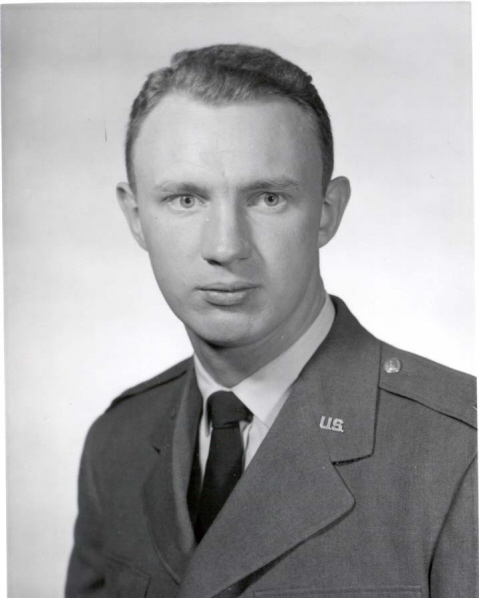
My fondest hope will be to see Major Park Bunker’s remains returned to his family in my abbreviated lifetime. Capt. Bunker was not an adventurer like most of his fellow FACs. He didn’t fit the mold. He actually was cautious and hidebound-one for doing it by the book- but had no qualms about getting down in the weeds. He augered in 30 December 1970. Capt. Bunker was what we called a “negative objective”. His O-1 was clobbered by groundfire and he actually landed in one piece. Knowing full well that there were no POW camps for us in Laos and that repatriation was not in the cards, he fought to the end with little more than a CAR-15 and his .38 cal. M&P revolver. With no air support, his fellow FACs watched from altitude as he and his Hmong GIB were killed. When this happened, the AF was rather a stickler that no more air assets be expended in recovery. Sadly, the forlorn radio message went out announcing Negative Objective. Thus Capt. Bunker joined the Sizemores and Andres in a long pantheon of KIA BNR (body never recovered). I’m sure that at some time on the 9th or the 10th of July, 1968 that negative objective was announced for Majors Sizemore and Andre. It always was.
This is why we celebrate so heartily when one of our fallen finds his way home. We talk of “closure” and giving the family a meaningful plot to visit at a cemetery but it is far more than that. The ethos of the military has always been that you do not leave your fallen on the field. People seem to think this is a Marine affectation. I can assure you it is not. In Laos, it was more often the rule rather than the exception that we lost our pilots-day or night.
It is enervating to see the eventual return of these brave men who volunteered for what they knew was a very dangerous job when they could do their 100 missions from a “normal base” in RVN or Thailand and not take inordinate risks.
Capt. Bunker’s photo above bears little resemblance to the man I met. I enclose a picture of the Captain below which more will be familiar with. Welcome Home, gentlemen. I’m glad your remains were not desecrated.
This week, the VA mailed my DH a shiny FAQ and a form letter about the health care law. They are “sell sheets” for the VA. Could the VA be concerned that too many veterans will drop out of the system in favor of the private marketplace?
Consider the benefits they write: no monthly premium, deductibles or enrollment fees! But wait, there’s more. The VA offers 1,700 places to get care! And, “most veterans have no out-of-pocket costs.” Is that a true statement? The VA website says that “copays…may be required from some Veterans for treatment of nonservice-connected conditions.” The co-pay to see a specialist is $50.00 per outpatient visit.
If a veteran stays with the VA, they CANNOT get the tax subsidy. (If someone qualifies for Mediaid, they will not get a tax subsidy because they will pay very little for health care.)
VA health care benefits depend on gross income and net worth. (LINK)
The whole priority group scheme and means test is confusing. If you are in Priority Group 7, you will have a co-pay and your income is determined by the Geographical region income limit. If you are Priority 8 (high income) you may not be eligible for any health care but there are some exceptions (read here). To determine if you are in 7 or 8, pick the fiscal year, pick your state’s county and family size and hope you’re not above the VA’s income thresholds for health care. (Service in the Republic of Vietnam should put a veteran in Priority 6 but some are still charged co-pays. What’s up with that?)
Either/or scenarios. Veterans who live more than 30 miles from a VA hospital might be better off with private insurance so they aren’t stuck with an emergency room bill should they have an emergency that the VA won’t cover. On the other hand, if a veteran needs a lot of expensive medications, the VA looks attractive in comparison to private plans. And if their current VA health care team is top-notch, it makes good sense to continue with them. The VA is also better about issuing needed medical equipment than, say, Medicare.
The VA does not want veterans to flee en mass. Question: Can I cancel my VA health care coverage? The answer is a warning: “Yes, however acceptance for future VA health care coverage will be based on eligibility factors at the time of application, which may result in a denial of health care coverage.” There’s that favorite word again, denial.
This is a not very veiled threat. But, if tens of thousands of new veterans decide to enroll in the VA, with few cancelling, Congress may push out more middle-class income veterans. It’s not really about one’s service to the country.
The number of Veterans who can be enrolled in the health care program is determined by the amount of money Congress gives VA each year. Since funds are limited, VA set up Priority Groups to make sure that certain groups of Veterans are able to be enrolled before others. instead of expanding funding to care for them.
Going forward, the VA is going to have to compete with the convenience that regional hospitals and local health care providers offer. The safest best option, for veterans who can afford to forgo the tax subsidy and pay a premium, is to stay enrolled in the VA (hopefully with your “spot” grandfathered in) and pay for private insurance through the marketplace even if it’s not a premium plan. That way you won’t face debtors’ court (or prison!) should you get hit by a thunderbolt far from VA-land. (In any case, family members may qualify for a tax subsidy even if the veteran stays enrolled in the VA.)
Ed. Note: Kiedove has done her homework on this one. If they had not tried to kill me (four times) I might be amenable to their brand of medicine. I believe VA suffers a “treat each item apart from the whole human”- e.g. you are service connected for disease A so come on down and we won’t charge you anything but if you even mention symptom B related to a non-service connected item, you can be billed for it. I dislike having to defend a ride to the hospital to get VA coverage. I know I’m Priority one and it is immaterial yet I have to submit the documentation each time to help my local Fire Dept. recoup the cost of the ride from the VA. Otherwise they wait two years to get the dough.