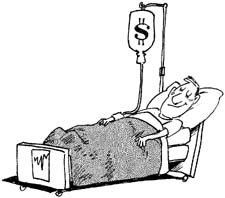
VAOIG–8 HOUR WAIT IN EMERGENCY ROOM “WITHIN LIMITS”

VAOIGI received this today from our Watchdog Guardians. Ever-vigilant, they were quick to descend on Denver for a quick check of rumors about excessively long delays in VA’s newer, larger Emergency Department (ED) waiting rooms. While there, they decided to kill two birds with one stone and investigate how long it takes to get your call answered at the VAMC front desk. My guess is Linda Fournier and her OIG pals haven’t had to call the Prize Redemption Center’s 800-827-1000 number in a number of years and experience a 4+-hour wait there. Maybe someone should call the ombudsman and complain. 

Here’s the gist of the good stuff. Remember, everything’s abbreviated so hard time in the waiting room is contracted to Length Of Stay (LOS). LOS is further slotted into four-hour increments and it is hoped that the maximum wait would not exceed 1.5 LOS.  Certainly you can see one LOS sounds a shit-ton better than 4 hours of Sports Illustrated. Additionally, LODs are time-managed by the Emergency Department Integration Software (EDIS) Thus, you end up with convoluted time management using the rotation of Jupiter as a predicate:

VHA requires that EDs use Emergency Department Integration Software (EDIS). EDIS allows staff to record and track ED patients. Recorded information includes patient arrival and disposition (discharge, transfer, admission) time, and is broken down into 4-hour increments. The time elapsed from arrival to disposition is referred to as length of stay (LOS). VHA’s LOS target is for 10 percent or less of patients to have a LOS
greater than 6 hours.  For our evaluation, we used a 4-hour LOS benchmark due to the software timing features.

Software timing features. I’ll have to remember that one at my next BVA hearing. “Well, your honor, due to software timing features, my disease does not manifest itself in a normal LOS that correlates with my medical forays to the VAMC. Thus it isn’t always notated in the EDIS accurately.”

Think the below through to its logical conclusion.

VA OIG’s Hotline Division received the following allegations: the ED “needs help,” wait times exceeded 8 hours, and a patient was treated discourteously and afraid to return; and staffing issues at the Call Center caused long call waiting times and callers dropped out because they grew tired of waiting. During this review, we received an additional allegation that another ED patient was treated discourteously. We did not substantiate the allegation that the ED “needs help.” While we found some ED wait times (length of stay [LOS]) exceeded 8 hours, we determined the facility met VHA’s target of less than 10 percent of patients with a LOS over 6 hours. We did not substantiate the allegation that ED staff treated two patients discourteously, or that one of the patients was afraid to return to the ED due to alleged discourteous treatment.

Can you imagine going to an emergency room with a raging fever and waiting over 8 hours to be seen? Wait.  Even six hours?  Well, maybe at Lackland AFB’s Wilford Hall but that’s military. Obviously, both the VA and the OIG are overjoyed that the wait isn’t over 10 hours but this is disgraceful. When I last went down to American Lake VAMC in Lakewood in August, I was unprepared for the remodel. The floor area for the doctor offices and examination rooms had decreased 40% and the waiting areas had metastasized equally as much. My old friend Gloria, who had for years greeted me at the Yellow Team reception area was gone. I now had to wait in a line that did intake for the Blue, Yellow, Red, Silver Teams AND the Emergency Department. What’s more, the ED waiting room was reduced to about 10 chairs smack dab in the front entry where the new reception desk had been erected. As you enter the foyer and reception, the waiting line blocks further progress.

Setting that disturbing non-finding aside, there were complaints of long waits to talk to the VA health Nurse and others we are required to converse with before pushing “Print” and heading out to an emergency room closer to our domiciles. Remember, you are not technically allowed to seek out medical care just anywhere when VA is your go-to provider a la Obamacare. By law, you have to give them a sort of “first right of refusal” before your significant other drags your lifeless body into the car with the help of the kids. This creates another metric called the EDIS LOC or Length Of Call. When the LOC exceeds 2 LOS and no fog can be seen on the mirror under your nose, you are then legally permitted to go to an ED nearer you. This is called the EC clause for Emergent Condition. It is also the only legal leg you have to stand on if you have waited less than 1 LOC on hold.

One thing I noted in my last visit was even though my appointment was early in the morning by VA’s standards (10 AM), the LOS was already pushing out to an hour (11 AM)before I was finally face to face with the doctor. While in the waiting room, I got to meet some of our latest class of Veterans recently released to Veterans status. The VA Secretary has graciously given them two free years of medical insurance (almost free) much like the GI Bill. Unlike this free medical, the GI Bill is not fraught with 2.0 LOS pitfalls. In fact, they use a different metric measured in months instead of hours.

Most of the Vets I talked to said this was no different from being in the military and going on sick call. I remembered back and damn if they weren’t right. Remember rolling in after morning formation and sitting there waiting for the recently arrived Commander’s wife’s 3 year-old daughter to be seen first? And you with a paltry 102.5 fever? Now that I’m on Medicare and back in the land of the real medicine, I find a 10-minute wait past my designated appointment to be a piece of cake. Never again will I fall for the “Dude, you’re 100% and Priority One. You get to step to the front of the line. We can schedule you in for that heart arrhythmia in two weeks. AM or PM?”

The waiting on hold is a Monty Python skit looking for a stage to happen on:

We substantiated the allegations that Call Center understaffing caused long call waiting times and callers to abandon calls. We found 40 percent of the Call Center’s authorized registered nurse, medical support assistant, and pharmacy technician positions were vacant and determined that inadequate staffing contributed to the Call Center’s failure to meet VHA targets for caller response time and call abandonment rates. We also found
that calls were dropped due to the telephone system’s 120-line limitation, and callers who used the automated call return system did not always receive a return call. An upgrade of the phone system is not planned until FY 2016 when the facility relocates. Additional staff and an upgraded system should eliminate the 120-line limitation and reduce callback system failures.

Yes indeed. Silly Vet. Just be patient until 2016 and then we’ll be able to put 1200 of you on hold. Wait until you see the new LOH (Length On Hold) breakdown into 6-hour increments so that some calls can be carried over to the next day making the the delay appear shorter than it really is.

downloadI have seen commercials on prime time inviting people to come work for the VAMCs. In an age of unemployment nationwide, I find it incongruous that jobs-government jobs, no less- can go begging.  These are much sought after in the VBA sector so I just assumed they received the same fervent response in the VHA. Based on this disturbing news and the rapid turnover of eight Personal Care Physicians (PCPs) in my five years with the VA medical machine, I can only surmise there is another detrimental dynamic I am unaware of that decreases the desire to seek VA employ. Apparently, it infests Denver as well.

One last observation. It seems the OIG krewe only ventures out to the Mile-High city in the winter months when the powder is about 40″ deep and the conditions on the slopes are rated “excellent”. I’m sure that’s an utter coincidence but Karaoke machine rentals also seem to spike at about these times when the OIG is in town. We report. You get to Sherlock.

Posted in Medical News, OIG Entertainment, VA Health Care, vA news, VAOIG Watchdogs | Tagged , , , , , , , , | 2 Comments

THIRD QUARTER BVA DECISIONS POSTED

download (1) The third quarter of BVA decisions were posted the other day. Surprisingly, HCV filings only jumped from 513 to 582 for a net increase of 69 decisions. Most of the decision dates are October or November of the current year. 

http://www.index.va.gov/search/va/bva_search.jsp?RPP=50&QT=hepatitis+c&LC=582&RS=201&DB=2013

Posted in BvA HCV decisions, Veterans Law | Tagged , , , , , , , , , , , , , , , | Leave a comment

BVA–EENY-MEENY-MINY-MO. WAS IT CLAP OR WAS IT SNOW?

FROM THE REDSKIN REGIONAL

OFFICE  IN INDIANVILLE, INDIANA


mcfbIn one of those convoluted rulings, the BVA Judge here is faced with some unalterable facts.  Johnny Vet has four or five risk factors. VD, which is proof of licentious sexual behavior, is not willful misconduct. In addition, he claimed sharing razors or group shaving haircuts like basic, jet guns and probably every illicit drug known to man. The list of drugs involves some I’ve never heard of and I’m not exactly a stranger to this game. About the only thing he didn’t claim was a tattoo risk.

The various VA examiners, doctors and gastrodocs all agree he came down with it in the seventies-undoubtedly via the results of a liver biopsy showing a very advanced state of affairs. Nevertheless, the consensus puts it squarely in the seventies during his service. All those wild and crazy drugs he snorted, smoked or otherwise ingested through his pores from the intervening years are inadmissible in court because they really do not show inception-just poor intercurrent judgment. VA has a really, really hard time getting by that.

In a September 2002 letter, Dr. D.C. Pound found that the Veteran had chronic hepatitis C, which he most likely acquired in the late 1970s while in the military.

In fact, our smart fellow Veteran here wisely introduced all the wonderful new evidence that the CDC and DoD elected to do away with jetguns when they figured out we were all coming down with HCV, HBV, AIDS etc. That in itself was a smoking gun pointing back to the unsanitariness in the seventies.

The examiner found that sexual intercourse was considered less of a risk for infection with hepatitis C and noted a recommendation to discontinue the use of air gun injections for vaccinations by the military due to the transmission of hep C.

Faced with this obstacle, they had to choose which drug or risk was more liable to have caused the hep. How do you do that 43 years later? Well, shucks Pilgrim. VA does it all the time but now it’s getting harder with the internet and asknod. So, in order of risk, instead of trying to assign some percentage to each one and then add them up, they have to consider each one equally. It used to be for about a year in the early to mid 2000s that VA raters would say ” VD-1% risk; Tattoo- 5% risk; shared razors-.001%; jetguns- unproven but plausible; Intravenous drug use-85%. Therefore the first risks listed add up to 6.001%. The IVDU, however, which is willful misconduct incidentally, is far higher ergo the HCV is not due to a legitimate service risk in the line of duty.”

va-rating-device-m212Here, the Veterans Law judge couldn’t even resort to the  VA’s legendary weighted Wheel of Fortune that always lands on DENIED. He had four legitimate choices and three were medically recognized risks. Hence, Johnny Vet wins because of the benefit of the doubt says more risks were “legal” risks than non legal ones.

Remember this decision because, while it is not precedence, it exhibits a finding that jet gun use was discontinued due to unsanitary practices and the inherent inability to guarantee a “clean” inoculation. This is the first BVA decision to be used  as evidence. While it may not have been the precipitating factor in the win, it is now a recognized facet of law that the jetguns are disease factories capable of transmitting all kinds of bugs. HCVets- 1, VA-0.


Posted in BvA HCV decisions, HCV Health, HCV Risks (documented), Jetgun Claims evidence, Nexus Information, Veterans Law | Tagged , , , , , , , , , , , , , , , , , | Leave a comment

BVA–HCV DIAGNOSED IN 1970

From the Hollywood Regional

Office in greater Los Angeles


downloadHere’s one of those HCV claims that looks for all the world like it has legs. Vet serves in Vietnam as a medic, or, in the alternative as a hospital orderly. In any event, his risk factors appear legitimate. Johnny Vet applies for the Hep   and is a little disingenuous and less than forthcoming when answering the Risk Factors Questionnaire (RFQ). In fact, he studiously avoided answering it completely. Which is okay with the VA because he’s already spilled the beans on his proclivity to use drugs way back thirteen months earlier. Just because he quit 25 years ago and leads a model life now does not a successful claim make. What’s more, offering no logical explanation for your lapse of good judgement leaves the door open to VA to supply the answers. 

Having a soupçon of medical knowledge can be anathema to your claim, too.  Johnboy apparently was unaware that HCV did not become a brand-name disease until 1989 and reach official recognized status by 1992. Thus, claiming you were diagnosed with it in 1970 can be a real dealbreaker when the subject of credibility comes up.


The Board has considered the Veteran’s statement that he was diagnosed with hepatitis C in 1970. As set forth, there is no objective evidence of liver problems during service or for many years thereafter. The Veteran underwent a physical examination in May 1972 in connection with his Reserve service. At that time, he specifically denied having jaundice or hepatitis. Thus, the Board finds the Veteran’s report regarding the date of diagnosis to be inconsistent with other evidence and not credible.

Johnny Vet has many deficiencies in his claim but the willful misconduct via the intravenous drug use undoubtedly worked against him. Additionally, when asking for a combat exemption under 38 USC §1154(b), it helps if you have a medal or two that proves you were in the fray. Alas, Johnny comes up short on this one as well.

Initially, the Board notes the Veteran’s reports of combat participation. Personnel records show that the Veteran was a hospital man and was assigned to the U.S. Naval Support Activity, Danang, Vietnam. The Veteran did not receive any awards or decorations establishing combat participation. The Board has considered the Veteran’s April 2009 statement discussing his Vietnam service, to include working at a military hospital and a security base. The overall evidence, however, is against finding that the Veteran engaged in combat with the enemy. 38 U.S.C.A. § 1154(b) (West 2002) is not for application.

To really put a fork in it all, our “hospital man”, under the able guidance of the Disabled American Veterans, has arrived (as usual) with no supporting nexus letter or Independent Medical Opinion (IMO) that could possibly support his contentions that he had exposure to blood or blood products. In sum, he arrives with little more than lay testimony that paints an admirable picture of a combat medical person with a debilitating disease caused by his MOS. As most of us know from experience, this rarely carries the day.

Evidence is king in this game. Lay testimony, in conjunction with facts and documented service records, is the repair order. I have no doubt this Vet could have won if he’d developed the case more completely but that is ostensibly why we go to the VSO experts. Here at Asknod we have demonstrated that negative evidence and “Imperial entanglements” are not the death knell to a HCV claim. Proper development in a logical progression with careful management of  evidence introduced most often is the panacea. However, arriving at the Board of Veterans Appeals with a saddlebag full of nothing more than contentions won’t even get you in the door. Arriving with no nexus when it is a legal requirement further enunciates the reason we advocate you simply do it yourself and get it right the first time. Each failure makes it more and more insurmountable the next time out as all too many of you have discovered.

Posted in BvA HCV decisions, HCV Health, HCV Risks (documented), Veterans Law | Tagged , , , , , , , , , , , , , , , , , , , | 4 Comments

TODAY’S FACEPAGE WINNER

My melon-collie baby

My melon-collie baby

Dennis “pop” Smoke wins this one hands down today. Humor is what makes the world turn in my tortured mind. A life without humor would be very dull indeed. Thanks Smoke.

Posted in FACE HUMOR | Tagged , , , , , , , | Leave a comment

What do those first three pints of blood cost?

blood cartoon1

An unexpected sticky wicket has crossed my monitor–the Medicare blood deductible!

Unless a private plan picks up the cost, Medicare patients must pay for those first three pints of blood by law (A., B.,) Clearly, this is a health care service no one wants.  However, if one day you find yourself in need of blood products, and didn’t know about Medicare’s blood payment policies, you might be surprised at the hospital’s blood bill.  Medicare doesn’t tell us what that cost may be. Just this:

Part A covers blood you get as a hospital inpatient. Part B covers blood you get as a hospital outpatient.  In 2013, you pay either the provider customary charges for the first 3 units of blood you get in a calendar year, or you must arrange (with limited exceptions) to have the blood replaced (donated by you or someone else) if the provider has to buy blood for you. In general, if the provider doesn’t have to pay the blood bank for the blood, you won’t have to pay for it or arrange for it to be replaced.

Blood processing & handling

Hospitals generally charge for blood processing and handling for each unit of blood you got, whether the blood is donated or purchased. Part A covers this service for an inpatient. Part B covers this service for an outpatient. In 2013, you pay a copayment for blood processing and handling services for each unit of blood you get as a hospital outpatient.

Of course, not all blood is donatable.  Enter the world of confusing and expensive world of private Medigap insurance.  Plans: A, B, C, D, F, G, M and N cover those first three pints 100%. But  K 50% and  L 75%.   (Out-of-Pocket Limits apply in K $4,640 L $2,320.)

Depending on location,  blood itself, sells for under $300 a pint.  A Forbes article about a new company, General Blood, sheds some light on the current blood business but finding the usual and customary charges for transfusions is proving elusive.  Ohio is apparently requiring hospitals to post their charges online but alas, no blood information: See: U Toledo.

But this out-of-pocket calculator for private insurance or uninsured people, is really cool for learning about the procedure’s cost using a CPT codes: 36430.   

http://www.fairhealthconsumer.org/medicalcostlookup/

Medical coding is no easy task since each insurance company has their own transfusuion rules but here are some from Blue Cross.  Other charges will likely to show up.   

For veterans being treated for leukemia or lymphomas, co-payment assistance may be available from charities.  So, I’m still searching for current “usual and customary” charges for blood.  Why, of all things, is blood singled out for special treatment?  If you have experience with this subject, let us know.

Posted in Guest authors, Medicare for VETS | Tagged , , , , , , , , , , , | 5 Comments

What 21.8 million death certificates do–and don’t–tell us about viral hepatitis

tests in

H-what? What is it?

ASKNOD members are already well aware that HCV now kills more people than HIV.  This study of data from U.S. recorded deaths held some surprises for me.   Standardized death certificates have two parts and utilize the International Classification of Diseases (ICD) codes.  Part 1 gives the immediate cause of death. Part 2, the contributing/underlying causes of death.  Four main co-morbid conditions were examined: HBV, HCV, chronic liver diseases, alcohol-related illnesses.

Some findings:

  • About 50% of liver cancer deaths (18,910) in 2010 were associated with HCV.
  • National serum surveys indicate about 3.2 million persons in the United
    States are living with chronic HCV.
  • When cause of death was listed as HBV and chronic liver disease, it was strongly associated with these co-morbid conditions in this order: HCV, then HIV, then alcoholic -related illnesses.
  • When cause of death was HCV and chronic liver disease, it was strongly associated with these co-morbid conditions in this order: HBV, alcoholic-related illnesses, then HIV.
  • At the time of death, the researchers estimate that 40%-50% of the decedents with HCV infection were not diagnosed with it.
  • 75% of known HCV-related deaths are in the 46-65 year old age group.
  • Only 44% of deaths among HCV-infected persons were attributed to HCV.  Yet almost all of deaths among HIV-infected persons were attributed to HIV.
  • If someone had HIV and HCV, HIV was listed as cause of death.  HIV is given a priority in reporting cause of death, a bias.
  • It is not always easy to assign cause of death to persons with HCV, HBV, and HIV or any combination of them.
  • Viral hepatitis deaths are under-reported on death certificates and thus inaccurate when compared to death data for HIV infections.
  • There has been no improvement in recognizing viral hepatitis deaths which have reached epidemic proportions.
pool

We’ll deal with the bad stuff next month.

The earlier we start routine testing for the major known lethal viruses, the healthier our American families will be.  Having one of these infections is bad enough for our bodies to fight, but two or three? Public health officials must be too busy planning their next Orlando  party to plan testing clinics.

At least with an Obamacare plan, boomers can receive one free HCV test beginning in 2014. (I don’t know about free HBV and HIV tests.)  In 2007, only 36% of all adults in the U. S. have been tested for HIV, a truly pathetic number. Why such a low percentage? I believe stigma remains the number one mental/emotional barrier because the government continues to target testing services to people who engage in “risky” behaviors.  The Hepatitis C Action Plan is still presented as a side issue on the flashy AIDS website, instead of being front and center as the biggest killer.  It’s illogical. It’s political. It’s all wrong.

Posted in Guest authors, HCV Health, HCV Risks (documented), Jetgun Claims evidence | Tagged , , , , , , , , , , , , , , , , | 1 Comment

BRAIN FOG WITH HCV–IT’S REAL

stressed old man holding head at homeHere’s a great article that explains what many a doctor pooh-poohs as being a fig newton of the imagination. Brain fog, or cognitive dysfunction, is real.

Posted in HCV Health, HCV Risks (documented) | Tagged , , , , , , , , , , , , , , , , | Leave a comment

A LEGEND IN HER OWN MIND

none

April 2012—Congressman Filner, you have my word that we’ll have this backlog under control by 2015. We now have the tools and the finances to implement the Secretary’s directives.


long

July 2013—Congressman Miller, The new VBMS, which converts files over to electronic format, is on schedule to be implemented at the rest of the Regional Offices as planned. Thanks to VA’s new Six Sigma and Kaizen training, we have everything well in hand.

longer

September 2013—Congressman Miller, We have now completed the VBMS installation in all 56 Regional Offices and the backlog is decreasing much faster than any of us imagined. Fortunately, my background at Accenture was of immense help in overcoming innumerable obstacles.  I am proud to report that we are “all systems go, sir”.

longestDecember, 2013—Congressman Miller, fortunately for our disabled Veterans, we are gradually dispensing with the backlog and see some daylight at the end of the tunnel. It appears we will have eliminated the backlog completely before January 2015- well ahead of our earlier projections. Veterans should expect an easy up or down decision within 125 days soon and the accuracy is expected to be a breathtaking 98%. The VA has been able to attain these stupendous figures by working overtime and sending some claims to other, less utilized Regional Offices in Alaska, South Dakota and Montana. Unfortunately, in order to motivate the raters, we had to re- institute the bonuses temporarily but that is a short term setback. May I have some Kleenex, please?

Posted in VA BACKLOG | Tagged , , , , , , , , , , , , , | 1 Comment

GWI-BAD PAPER= NO BENNIES

downloadWe’ve probably discussed the effects of bad paper or the Big Chicken Dinner on VA benefits so I just wanted to publish this sent in by Frank. While SPN codes are no longer the anathema they were in the 60s-80s, having a less than honorable discharge is still the hole in the bottom of your boat you’ll never plug. Even if you can manage to pry one out of your military branch, VA does not consider it a viable one equal to compensable benefits or medical care. For VA, your injury during a bad piece of paper, even if you had a prior enlistment with good time, is still an impediment to service connection. That is the barrier that no one can breach. It was enacted by Congress to reward those who stayed the course. For those of us who found it impossible to follow the rules, there is no repair order. BCD, Undesirable- whatever the designation, if it isn’t “under honorable conditions” it’s no dice.

P.S. Here’s recent precedence from the Court that reaffirms this concept of “clemency discharge upgrades”.

RobertsonTW_11-3521

Posted in Veterans Law | Tagged , , , , , , , , , , , , | 5 Comments