CAVC–Fenderson v. West – Staged Ratings

Asknod inc logo VECTORHere’s another one of those cases where you hear the term and wonder who or what it refers to and what it means where you are concerned. Before I start, look at the claim structure VA employs. There are new (original) claims never presented before, reopening an old claim, claims for increase of an existing SC disease or injury and lastly a collateral attack on a prior final decision based on clear and unmistakable error. VA does not consider a claim for dependency to be different from a claim for increase. 

     At the Regional Office (RO or VARO) level in your state, the process begins and here is where most claims seem to suffer from what at best can be politely described as misinterpretation. This is what happened to Mr. Joseph A. Fenderson. He was “represented” by the American Legion. They are normally a stand up outfit with the same spotty record as most VSOs. Unfamiliarity with the law is the reason for all VSOs’ ineffectiveness. They mean well, but that says it all. Murphy’s first law says no good deed goes unpunished. All VSOs aspire to greatness and a good result for their clients but the absence of any legal training leaves them in an awkward posture when it is needed. I digress and apologize.

     Mr. Fenderson was actively engaged in his claims process while still being represented by AmLeg. This can and does cause confusion as to who is driving the car. This confusion caused Mr. Fenderson to miss filing for some issues he wished to appeal (varicose veins). That’s unfortunate but when you have this haphazard representation and start doing things yourself, you can guarantee things will go haywire.

     The VA got terribly confused on this, too. They tried to interpret it with their Ouija Board and tea leaf readers. They came to the conclusion that old Joe was simply asking for an increase on claims that they had only recently granted when what he was asking for was an increase on the initial ratings. There is a distinct difference. An example is in order. You file for a hangnail and VA grants you 0%. You file your NOD and ask for 10% but they refuse. Finally on appeal five years later, you win and get the 10% you were fighting for. However, in the interim your hangnail became ingrown, infected and they had to hacksaw your finger off. You deserve more-you want more. You have to go back to the RO for that and you lose. Back to the BVA for more and finally you arrive 5 years later at the Court. Let’s say by now the finger beside it got infected and they amputated that too?  You would be entitled to more and it would have to commence on the day the hangnail first started, not the day you got around to filing for it as an increase of the original claim.

     The VA has an odd habit of examining correspondence you send in through binoculars backwards. This causes problems. They have a whole section devoted to trying to understand just exactly what it is you meant to say or claim. Because they want to make sure you get what’s coming to you, they will perform what is known as prognostication. You will read it later when the appeal says “it appeared the Veteran was filing for…” or “VA interpreted this to be a claim for.. .” My personal favorite is “It was construed to be…”. God, are we all that illiterate and word challenged?

     Joe had only recently been service connected for varicose veins, plantar fasciitis, migraine headaches and problems after testicular surgery. Naturally when he sent in the disagreement with the ratings they assigned, this enlightened group of prognosticators ignored his file and “construed”   it be a NEW claim for increase. And off they went on their merry way. You cannot get the VA to put the horses back in the barn when this happens. You have to go to appeal to straighten it out which buys time for the VA to come up with an excuse for screwing it up. Oddly, nobody gets a nasty letter in their personnel file for these inadvertent slip ups.

     Joe had to go all the way to the Court to unravel this one. The big boys had no problem dissecting this and agreed with him on almost all of it except for his verbally challenged attempt on the varicose veins. For that he had to go back and start a new increase claim. What they also did is what will give Mr. Fenderson his name in lights for years to come. AB v. Brown (1993) held that a Veteran is seeking the maximum benefit available to him when he files a claim. He shouldn’t have to beg again and again for morsels from the VA’s table. VA should give him that to which he is entitled when he is entitled rather than piecemeal. I guess the M-21 manual hasn’t been updated with that provision yet. It certainly wasn’t in there in 1999.  

     The Court decided that a rating is flexible and if, during the course of your appeal, the injury or disease gets worse (or better), then the rating percentage must follow that development. This principle is called a staged rating or a Fenderson rating. This is a very important distinction. If you win and do not disagree with what they hand out, you agree that it is correct. If you come back several years later and say “Hold the phone! I should have been given 20% back then. You screwed me.”, you are too late. The time to disagree is when the rating is granted. You can file a NOD as Joe did to accomplish this as long as it is done in the traditional one year grace period for objecting. Just make sure that you use single syllable words and make it crystal clear what it is you are trying to “construe”.

     In 1994 I filed for “PCT as a residual of Hepatitis or as a residual of Agent Orange exposure”. VA’s crackerjack sleuths interpreted this to mean I wanted to file for a) residuals of Hepatitis and b) PCT due to AO. This allowed them to a) declare I wasn’t currently suffering from Hep. and b) I was never in Vietnam and therefore I was never exposed to AO. Pretty tricky, huh? Get used to this practice. It happened to me in 94, it happened to Joe in 97 and you can be damn sure it will happen to you if it hasn’t already. It buys them time to come up with more creative ways to deny you as the claim progresses. One of their personal favorites used to say that you claimed Hep. C but you had Hep. B in service. Bingo. Wrong. Go back to Go. Do not collect $200.00 and please refile. If you are not allowed to make medical diagnoses about your illness when submitting lay testimony, how is it that they can hold you to this when you file? Welcome to the VA Hall Of Mirrors Funhouse.

     At any rate, Mr. Fenderson provided us with one more tool in the pursuit of our claims. It is a very important one and prevents the VA from depriving you of a rating % when it is legitimately due. The mere fact that Veterans have to negotiate this legal minefield to obtain that which is their due speaks volumes about the process and the people hired to administer the system. Never lie down and take it. Never rationalize it and say “Oh, there are so many other Vets that are more deserving.” VA is counting on you doing this. It’s factored in that a certain percentage of us will give up and go home. A very large percentage, I might add.

     Below is Mr. Fenderson’s rematch with Goliath.                                                                                                                                                                                                                                        Fenderson_96-947

Posted in Important CAVC/COVA Ruling | Tagged , , | Leave a comment

COVA–Bell v. Derwinski (1992)–Constructive Possession

With all the talk these days of the indiscriminate shredding of Veterans files at VAROs by lazy employees, we should look back 20 years to a seminal case  that was the precursor to any of this. 

     VA is adamant for the most part that its records, and by extension, its recordkeeping, are above reproach. If something turns up missing, it is the fault of the Veteran for not submitting it. This submittal is usually accomplished by the VSO representing him/her, so this maligns the VSO as well. This is why we so strongly advocate for Veterans to do all their filing with Certified Mail, Return Receipt Requested (CM3R).  The VA cannot call the USPS a liar and get away with it. The USPS may have a lot of faults, but recordkeeping is certainly not one of them. 

     Mrs. Velma Bell, the widowed spouse of a Veteran of the Second World War was seeking DIC (we presume this as the record is unclear) and ran up against a big problem. The evidence before the BVA Court Section was missing four very important documents, three of which were produced by the VA and one (a Form 21-4138 Statement in Support of Claim) by her. The BVA and the Secretary pretty much told her she was out of luck as the documents in question weren’t in the record. Velma cut this Gordian knot in half by promptly supplying copies she had of the missing documents. Catch 22 kicked in when the BVA said that the documents in question could not be submitted later if they were not before the Board at the beginning of the Appeal. Mrs. Bell was nonplussed to say the very least. How could it be that the keeper of the sacred records was missing the same records they created and then took the legal position that the decision had to stand as is because it was against the law to introduce them after the fact? 

     Velma might have been born at night, but she was not born the night before this legal wisdom was handed down to her. She promptly lawyered up and went to the Court for some answers. The Court, bless them, looked at this and immediately saw the dichotomy, circular logic and the Secretary’s defective reasoning. 

     The Court held that if you properly submit records, or more importantly, if the VA creates records of any judicial or medical nature related to you or your claim, they are responsible for maintaining them and assuring that they are properly filed in a central repository- namely your C-file. While this would be the ideal method, the Court went further and held that any documents or medical records held by VAMCs, while not explicitly in the C-file, were still in the VA’s “constructive possession”.  

     Case in point. I had a medical exam for Agent Orange after all the information started to surface in 1991 about this chemical. My exam was in September of 1993. I filed for hep. in March of 94 but these records, clearly showing a liver dysfunction, were never included in my C-file. My SO/future used car salesman from AMVETS assured me this would occur soon as “VA is like so totally suuuper-efficient, man.” We will not discuss VSOs today. That is still a sore point seventeen years later.   Add to that his sudden departure to become a used car salesman (due, undoubtedly to a mid-life crisis) and taking my F-9 with him.

     When I finally got my hands on my C-file in 2009, lots of things were amiss. One was that these records were still absent. These are important documents that VA has a responsibility to safeguard. Fortunately they were archived at the VAMC and I was able to get a copy of them there. They will be very instrumental in proving that my liver was misbehaving in 1994 when my claim for an earlier effective date is granted. 

     Most Vets are vaguely aware of some of their rights before the VA courts. Unfortunately VA has an ugly habit of shading the truth, failing to inform you of things that might help your claim and sometimes outright mistruths. I hesitate to use the word “lies” as I would sooner believe it’s due to inefficiency and low I.Q.  As for missing or misplaced records, Veterans would be strongly advised to maintain a set for themselves. VA has a “paper file” system, one of the last in existence from what we hear. If you were to ask them a question on some facet of your claim, it would require a month and a personal search by hand of a file in a filing cabinet. Add to that the chance that something can slip out and land on the floor when searching it or, God forbid, the “files technician” absentmindedly refiles something in John Jones file- right after your (Jack Jones) file. Oops! Color that gone with the wind. It will not see the light of day until or unless someone is reviewing Johnboy’s file. Up until Velma pitched a bitch, that evidence was “regrettably not part of the Veteran’s file”. 

     The VA Secretary and his employees do not like the Court. They feel their “judicial activism” is counterproductive to the job at hand- namely denying Vets. They would prefer that the Court mind its own business and speak when spoken too. This is why there are so many cases that result in a win for Veterans on appeal.  Not because the Court has a judicial hard-on for the Secretary, but that the Secretaries of the VA have a long, storied history of mimicking Chicken Little. They a)over-interpret the regulations to find something that doesn’t exist; b) insist they have done things this way since the dawn of time and: c) warn that any relaxing of the regulation will produce a flood of claims and thus endanger the financial stability of the VA. What this produces is absurd results that disenfranchise some and reward others. We as Veterans need one set of rules to abide by. Left unchecked, this system would be far worse than the Tax code.

     Meet Velma Bell. I bet you had no idea how important her contribution was to your claims process.

P.S. The Bell decision is in the CUE regs as well. If you file a claim for CUE of an action prior to November 26th, 1992 that depended on records VA had but did not incorporate into the file then you cannot claim this precedent. It is oddly the only COVA decision exempted by CUE.

Bell_91-1749

Posted in Important CAVC/COVA Ruling | Tagged , | Leave a comment

CAVC– Bradley v. Peake(2008)

This is a great Court of Appeals for Veterans Claims (CAVC) decision. It will show you, the VET, how the the CAVC operates and also demonstrate that they do not work for VASEC (Veterans Affairs Secretary Peake). They will not tolerate having their turf trampled and the VA rules and regs. trifled with. You will get real justice here. If you feel shortchanged, you can go up to the Federal Circuit Court and even to the Supreme Court, if you feel like it. Money (under the Equal Access to Justice Act or EAJA) will be appropriated for a law dog all the way to the Supreme Court if you prevail at each level.Oddly enough, if you win here at the Court and the Secretary doesn’t agree with it, he can take you up to the Fed. Circuit to contest it.   What is important is how the CAVC looks at these cases and how they rule on them. You will love this. They just changed the rules here on TDIU back to 1994 regs from the more restrictive ’99 change and reinterpreted the law on Special Monthly Compensation “S”(SMC-S) more liberally for the VET. An eagle-eyed member , one 71 Infantry, disagrees with my assessment above. He posts:
“Actually, the court did not change the law, the court clarified the law as it was written. This is a big difference, because if the law changed then CUE claims will be denied. Since the law was clarified CUE claims will have to be approved.  Were just going to have to wait and see if claims are approved based on Bradley v Peake.”

I will defer to his assessment, howeverI feel it was more of what I describe. The Court certainly “clarified” it. But they nevertheless did revert back to the more liberal 1994 interpretation. The Buie decision this year supersedes and improves on this anyway so it is yesterday’s news now.


  Well, as you can see, Mr. Bradley cut down a few trees to make some paper for this claim. This Veteran started his claims as soon as he left the Army which was wise. He had quite a few claims to file and he did a credible job. He failed to appeal the first one or two, but began to realize that VA was going to make life miserable. I would never think that if you were on the wrong end of a Bouncing Betty that you would have to fight to get SC for every scar and then go back and file for every muscle group, too. God forbid if you missed one! This guy must give the RentACops at the Airports conniption fits with all that microscopic shrapnel still floating around in there. He is a testimonial to Veterans everywhere of how persistence can pay off, though. Interestingly, VA really dropped the ball on several denial/decisions and denied him for things he never even filed for. The big banana that has changed is that VA now will have to go back for every Veteran who reads this and files and give them their SMC “S” rate. If you had trouble deciphering the Lawspeak, I’ll reduce it to Dick and Jane Format. If you get over 70% rated and you are a basket case, they will issue a TDIU which in essence is a 100% Permanent Total Rating. Now, if other parts of your body start falling apart and it hurts, you can file for more SC above that 100%. If you reach a point above 60% more(i.e. 160%) then you are entitled to that “S” rate, which is , in essence, about $325 more. VA always used to give you this if you had TDIU(not quite 100% but above 70%) plus 60% more. There was some confusion about doing this in 1994 so they rewrote the regs to agree with it. In 1999, they got stingy and took it away. They said you had to have an honest 100%(often referred to as 100% schedular rating) plus an honest 60% to get “S” rate. The VASEC decided to make this change arbitrarily without discussion and review. The CAVC has never had a chance to review the legality if this action so this was an opportunity to decide if it was legal to do. We talk about setting “precedent” on our HCVETS site and this is Precedent with a capital P. You guys from Arkansas can relax- its still called setting a president.What the CAVC does in every adjudication is to look at the laws as written and make sure they still are what CAVC says they are.This is called DE NOVO review. The Court in this case had a MAJOR disagreement with what the VASEC felt was correct interpretation. The Court has the last word in these matters so they get the honor of the B*TCHSLAP, which they administered harshly. They told Mr. Bradley he was also entitled to have some of his other stuff readjudicated as well, since the RO and the BVA failed to issue an SOC for one of his NODs. So if you think VA doesn’t give you a fair shake, read this through carefully and you will see they do. It makes me proud to be a Veteran and I hope the wealth of claims I’m currently shepparding through the system won’t require as many trees and time as my liverbox has almost reached the 10 year/100,000 mi. warranty limit. Remember, Veterans. Your claims die with you if they are not completed before you go to the Happy Hunting Grounds. File Early and Often the same way they vote inChicago.

http://www.uscourts.cavc.gov/documents/Bradley_v._FINALWITHNITS.v.3.12.03.08.pdf

Posted in Important CAVC/COVA Ruling | Tagged , | Leave a comment

Fed. Cir. (Via CAVC)–Maxson v. Gober (2000)-You Waited Too Long

 When prosecuting a Hepatitis C claim against the VA, one thing pops up over and over again. That is the allegation that you didn’t manifest this disease in the service. Well, setting aside the most obvious reason that HCV doesn’t manifest itself like the measles, it also doesn’t make its presense known for decades. A lucky Vet is the one whose civilian doctor happens to do a liver panel thus uncovering abnormal liver functions. Absent this, one doesn’t become aware until the shit hits the fan. By then the damage often is beyond repair and little can be done. 

     When litigating this up the ladder on appeal, you will often run into the Court’s and the Federal Circuit’s holding in Maxson v. West (1999- CAVC) and Maxson v. Gober (2000-F 3d.). This may seem insurmountable, but it really isn’t. The VA likes to wave the Maxson banner and squelch any more discussion on your claim. Let’s analyze what Maxson actually said. It isn’t quite as cut and dried as the VA would have you believe. 

     Raymond G. Maxson was in the Army from 1941-45. He was in the reserves prior to that, but it has no bearing on this. He had a partial colectomy that cured a bowel obstruction problem prior to service in ‘38 and in the days after Pearl Harbor, the rush was on to join the military.  Mr. Maxson had some difficulty digesting K rations on Guadalcanal in ‘42 and some other issues with malaria. The malaria never resolved and he was discharged in 45 due to that and another disorder. 

     Everything went swimmingly until 1989. Mr. Maxson decided to file for problems associated with the colectomy and had extensive medical evidence from his private doctor. VA didn’t bite. Neither did the Board in November of 1991. Raymond reopened his claim in 1994. The RO denied again on the grounds he hadn’t submitted any new evidence. He promptly submitted new letters from several doctors in an attempt to buttress his arguments. On appeal to the Board, he assembled even more testimonials from friends, neighbors, hitchhikers, the family dog and anyone who would confirm his contentions. All this was to no avail. The primary contention was that he was well (as far as the colectomy) from ’43 to 89 for medical purposes. The other reason was that this was preexisting to his service and did not technically undergo an increase in severity. Mr. Maxson disagreed and filed his NOA with the Court. He met with the same fate there and decided to appeal higher to the Federal Circuit.  His claim was denied there as well and that was the end of his story. However we are graced with his presence virtually every time we enter an appeal. The VA drags this case out and reverently recites its holding as being apropos to the argument for denying SC for HCV. 

     Herein lies the problem. HCV is not very cooperative in rearing its ugly head upon infection in its host. If it does, it often mimics the same symptoms as a light flu with nausea and muscle ache. A normal person probably would not be prone to seek a liver functions test (LFT) blood panel to ascertain whether this “flu” involved his liver. Having no reason to seek medical care for something that doesn’t incapacitate you, you proceed on your merry way, oblivious to the gradual damage accruing in your liver. When you do finally discover this decades later, you probably go to great lengths to obtain medical care to abate it. Just because there is no history of symptoms or treatment is not dispositive of an absence of the disease. HCV takes years to develop to lethal proportions. VA has a mindset that dictates one mode-denial unless proven otherwise. And guess what their favorite CAVC holding is to deny you? Yep. Maxson. As in ” While the VA commiserates with the Veteran over this insidious disease, there was no evidence of it in service and, indeed, none in the intervening 30+ years since his separation”.

     You can head them off at the pass by making sure your Doctor or ARNP carefully explains that this disease process is subtle and silent. There are no “Aha!” moments with this. It’s more often the “By the way, Mr. Nod. Were you aware you have a very strange kind of hepatitis called non-A, non-B?” I can virtually guarantee that you will see our Mr. Maxson mentioned somewhere in your denial at either the RO, but most assuredly at the BVA if you don’t take precautions to prevent this. One way is to just be blunt about it and say” Maxson does not control because…”.

      Mr. Maxon’s colectomy also was preexisting, which VA clearly ignores. This is a seminal legal point that makes the holding immaterial where a presumptive risk factor in service is cited as the culprit.

      I attach the Federal Circuit synopsis for the Veteran’s perusal as it subsumed the CAVC finding:

http://openjurist.org/230/f3d/1330/raymond-maxson-v-hershel-w-gober

If you or your NSO run up against this in you fight for SC, we would be happy to locate other cites to buttress you claim if we can.  VA thinks they’re hot on these denials. We are proving them wrong one Vet at a time. 

Posted in Fed. Cir. & Supreme Ct. | Tagged , , | Leave a comment

COVA–Colvin v. Derwinski Nobody Here But Us Doctors

We at Ask Nod are always searching for ways to overturn prior decisions, be it by collateral attacks (CUE) or by finding old service department records bearing on the claim. Towards that end we spent many months, indeed years, researching the early days of the Court of Veterans Appeals (COVA) now known as the CAVC. 

     When attacking a final, unappealed decision of the RO or BVA, the Vet has to search for some procedural error that was so egregious, indeed so glaring, as to sandbag everything that followed in its wake. Prior to the Russell decision in 1992 (en banc), the new standard for CUE before the Court was any procedural error that was prejudicial to the Veteran’s claim. Russell narrowed that down to say that the error had to have manifestly changed the outcome of the decision. It also removed benefit of the doubt from the equation. 

     This decision was before Russell and has its roots in another area-that of the BVA and the RO leaping to medical conclusions or making them without independent medical analysis. Prior to the inception of the Court in 1989, there were 20 sections of three judges each at the BVA. Each of these sections included a medical doctor as evidenced by the M.D. after his name. As medical experts on the Board section, they were required to inveigh and provide all decisions with needed clarification if necessary. They also sat as  judicial members and thus wore two hats. 

     When the VJRA was passed by Congress in 1988, all this changed. The VA, nevertheless, continued to do things as they always had. They retained the medical Board member and ignored the new paradigm. After several years of this misbehavior, the Court finally put its collective foot down in Murphy v. Derwinski (Nov. 8th, 1990): 


Although the Secretary appears to argue to the contrary in this appeal, Br. of Appellee at 11, the fact that a BVA panel may include a physician is not by itself sufficient for the purposes of the statute, the veteran or this Court. BVA decisions must include the “reasons or bases” for medical conclusions, even those opined by a BVA physician; a mere statement of an opinion, without more, does not provide an opportunity for the veteran to explore a basis for reconsideration or for this Court to review the  BVA decision “on the record” as required by 38 U.S.C. § 4052(b) (1988).  Murphy supra. 


This precept apparently didn’t sink into their thick, dense skulls. The Secretary blithely ignored this and proceeded on his merry way as if nothing untoward had occurred. The Court was not amused and waited patiently for another Veteran similarly situated to arrive. Almost four months to the day from the Murphy holding, the Court filed its decision in Hattlestad v. Derwinski (March 6th, 1991):


While the Board is not required to accept the medical authority supporting a claim, it must provide its reasons for rejecting such evidence and, more importantly, must provide a medical basis other than its own unsubstantiated conclusions to support its ultimate decision.  Hattlestad supra 


Just in case the Secretary had not absorbed the enormity of this precept in Murphy or Hattlestad, the Court followed it two days later with the Colvin decision. I don’t know exactly why, but some decisions are more memorable and cited in subsequent years at the expense of the cases they were predicated on. So, too, with Murphy and Hattlestad. In all jurisprudence for a decade after, Colvin was cited exclusively with only sidebars acknowledging the other two. An interesting fact that some legal scholars fail to note is the action the Court takes to enunciate their displeasure at being dissed. Murphy was vacated and remanded to be reaccomplished with assistance to the appellant and a better description in the Reasons and Bases section of why she should be denied. Hattlestad was remanded for reconsideration and disposition with 6 enumerated reasons why it was judicially insufficient. Colvin was an entirely different proposition. The Court reversed the BVA decision and remanded it to be accomplished the way the Court said it should have been done in the first place. What this means is the decision-making and fact-finding authority invested in the BVA was rudely suspended and the imprimatur of the Court was superimposed over theirs. This is the ultimate bitchslap only the Court can inflict. Reversal is rarely used, but when it occurs, it is not done gently. Mr. Derwinski and his minions finally sat up and took notice. While it was several more years before the VA relinquished the requirement of an M.D. on the Board section, the error continued to perpetuate itself because old, bad habits die hard. The most obvious reason was to let the M.D. judges either retire or seek employment elsewhere in a truly medical environment. Veterans think this error is an anomaly. We disagree because we see it as a well-defined denial ploy that has been utilized repeatedly by the VA for over half a century since their modern inception in 1946. This decision signaled the death knell for the practice and IMOs have finally supplanted the ugly habit.

     William H. Colvin is one of our generation.  He was seeking SC for Multiple Sclerosis. We can readily identify with his plight in a more modern setting. I don’t wish to demean the accomplishments of WW2 and Korean War Vets, but I identify with Mr. Colvin and Vietnam as I spent two years over there. I get ahead of myself here. A little history is in order. It personalizes the man I am about to describe. 

     Mr. Colvin was drafted and served two years in the Army from 3/66 to 2/68. While in Vietnam, he was wounded three separate times: shrapnel wounds to the head and right arm on February 26, 1967; shrapnel wounds to the right leg on March 26, 1967; and shrapnel wounds to the left forearm on May 10, 1967. For those of you who have no military background, that means he got three Purple Hearts. One military historian summed it up by saying a Purple Heart proves three things;

1) You were smart enough to come up with a plan

2) Stupid enough to try it and;

3) Lucky enough to survive it.

     On April 27, 1967, he was treated for a urinary problem that was diagnosed as a kidney stone. Medical evidence in the record indicates that urinary problems are a possible precursor of multiple sclerosis.  

     In 1982, Mr. Colvin was diagnosed with Multiple Sclerosis. The VA held that he had to come down with this within the presumptive period of 7 years or less after service absent a medical nexus. The BVA decision of 1986 denied his claim (in spite of his nexus) and that was all she wrote because there was no judicial review available to Vets then. 

     In March of 87, Mr. Colvin was seen at a VAMC for his knee issues and the neurologist stated the MS began in Vietnam. One would think that would be the end of it. Nevertheless the RO denied again and he didn’t appeal it up to the BVA this time. 

     Once again, in August of 88, Mr. Colvin reopened his claim. Being slightly more educated in the process, he arrived with a doctor’s nexus predicated on the doctor having read all his medical records. The doctor even went so far as to say that extreme stress could be a aggravating factor in inducing MS. I think we can safely say that shrapnel wounds from exploding ordnance on three different occasions would qualify as stress. Once again, the RO said “No dice”. The BVA decision announced in December of 1989 concurred with the RO and continued the pattern of denial. The BVA went further and implied that the reopening of the old claim, while introducing new evidence, failed to bring material evidence to the table. 

     I won’t bore you to death with the Board’s findings verbatim. Suffice it to say that they put on their Dr. Kildare outfits and played doctor. That’s a Bozo no-no in 50 states and the Court didn’t view it any differently. In fact, they were so incensed with the Secretary’s intransigence on this subject that they took it one step further and reversed in favor of Mr. Colvin:


The BVA decision does not cite medical evidence of record in this case or recognized medical treatises to support these medical conclusions. The BVA, in finding that the new evidence did not provide a new factual basis for a claim was, in effect, refuting the expert medical conclusions in the record with its own unsubstantiated medical conclusions. BVA panels may consider only independent medical evidence to support their findings. If the medical evidence of record is insufficient, or, in the opinion of the BVA, of doubtful weight or credibility, the BVA is always free to supplement the record by seeking an advisory opinion, ordering a medical examination or citing recognized medical treatises in its decisions that clearly support its ultimate conclusions. See 38 U.S.C. § 4009 (1988);Murphy v. Derwinski, U.S. Vet. App. No. 90-107, slip op. at 4 (Nov. 8, 1990).This procedure ensures that all medical evidence contrary to the veteran’s claim will be made known to him and be a part of the record before this Court. 

     Lest we be misunderstood, we are not saying that the BVA was compelled to accept the opinions of Drs. Cohen and Kassirer. We merely state that having reached a contrary conclusion, it was necessary for the panel to state its reasons for doing so and, more importantly, point to a medical basis other than the panel’s own unsubstantiated opinion which supported the decision. Colvin supra 


     Mr. Colvin, via the Court, has left us this judicial gem. He could have given up and walked away. His decision to pursue justice before the COVA was a novel experiment in that they were newly incarnated. As I pointed out, this wasn’t the end of the Board playing Ben Casey, M.D.  They made this mistake numerous times afterwards, but were always on the losing end of the stick. It became commonplace for the Court to simply delegate it to a single judge and treat it like a speeding ticket. The Secretary gradually realized that avenue to deny Vets was a dead end and promptly instituted newer ways to accomplish his agenda. The Court continues to uncover these new ploys when presented with them and gradually eliminates them. The Secretary is very prolific in his denials of Veterans’ claims.  We liken his actions to the Hepatitis C virus that forever mutates to avoid eradication. As quickly as the Court identifies and invalidates a disingenuous “holding” of the VA regulations, they are hard at it constructing a new iteration of the same thing under different auspices. 

     When you lie down and go to sleep at night, say a prayer for the Court and their continued good health. They are all that stands between you and an overzealous VA intent on denying you that which invariably is your due. 

     Attached below is the Colvin PDF. At 5 pages, the brevity of the Court is displayed in its entire shining splendor.  Murphy accomplished it with six pages and Hattlestad 10. I guess you don’t have to keep shooting the horse after its dead to make your point.  The Court certainly didn’t think so.                                                                                                                    

Colvin_90-196                                                                                                                                                                

Posted in Important CAVC/COVA Ruling | Tagged , , | Leave a comment

CAVC–Theofrastou v. Shinseki- You Have the Right To Remain Stupid

 I am including this Court decision for Vets to review. Even though it’s a Single Judge disposition, it clearly illustrates what a panel would find as well.  The Veteran is representing himself before the Court, which I wouldn’t wish on my worst enemy. Even though they handle him with kid gloves and bend over backwards to do things for him they wouldn’t even consider for a represented Vet, the outcome is still the same.     Wayne C. Theofrastou, a former member of the U.S. Coast Guard, is appealing a denial of his motion for Clear and Unmistakable Error in a January 2007 Board decision. As the Moving party in the suit, he can appeal this to the Court.     So, let’s see what went so horribly wrong here. The Waynester lost this at the R.O. way back in 2005 He appealed to the Board and lost there in Jan. of 2007. He then let it slide with no appeal to the Court. He might have gotten traction there for a remand due to some obscure error. The raw facts are that he was chasing a jetgun claim with a fistful of internet articles and a tall order for VA to come up with the make and model of the jetgun(s) used on him in Basic training, the types and quantities of the shots he received in Basic, and the lot number of the Gamma Globulin he was administered for hepatitis protection. Yes, you read that right.     Had he appealed in 07, as I said, he might have fought to a draw and gotten something. He didn’t. So he filed for the CUE which was the only way he could revisit the unappealed BVA decision. Here is where he stubbed his toe. CUE is an utter bitch to prove even when VA has done something wrong. The rules say you have to use the law as it was written in 2007, the error had to be dispositive, and of such magnitude as to alter the ruling against the Vet. The actual facts cannot be reexamined and failure to assist the Vet does not constitute CUE. You can only argue the same facts at the Court on appeal. You are not allowed to keep thinking up new reasons for a do over. Waynemeister, being pro se, was blithely unaware of these constraints and threw in some new gripes when he arrived up at the Big House on Indiana Ave.  Seems he felt the benefit of the doubt was not considered by the Board (not allowed in CUE) and that the Board failed to consider documents and articles submitted in support of his claim (not mentioned in 09 BVA CUE appeal).     The Court, being a cultured, soft-spoken institution, was polite in pointing out these errors to the Waynedude.  They were very gracious and gave him the standard “Y’all come back now, heyuh?” just as soon as he refiled these new allegations of CUE and they were properly heard and denied before the Board-and no sooner.     When a Vet sets out to defend himself, he has many assets at his disposal. He has websites devoted to helping Vets he can visit. He can even obtain a lot of free advice from well wishers at these interactive sites, regardless of their qualifications. He has the right to defend himself and apparently, he also has the right to remain stupid. This he does with abandon. He has just received a rude awakening and a large dose of jurisprudence for his efforts. In the meantime, we fellow claimants find ourselves in the waiting room.     Vets have a marvelous judicial system that accords them many rights. It’s slower than the seven year itch, but it has myriad protections. There is nothing preventing Mr. Theofrastou from tying up the R.O. and the Board for years pursuing the impossible.  VA will dutifully go through the motions and try to accommodate his requests. However, the requests should have to be reasonable. No one would expect the military to keep the info he demands, so his taking umbrage with failure to assist is misguided. Because he represents himself, there is no legal entity to guide him or dissuade him from this frivolous filing and the ensuing cost of time and judicial assets squandered on it. It’s selfish and myopic. One judge each from the two Courts, a minimum of 12 associate counsels at the Board and probably as many from the Court have labored on and off for several years so that Mr. Theofrastou could have his day in Court. You’re welcome, Wayne.  Deserving disabled Vets everywhere salute you and your misguided pursuit of justice. Now be a peach and go home.     The sad fact is he can start over on this same CUE project and bring up the two other items he forgot to include in the 09 CUE filing. This will consume even more assets and again hold up BVA appeals for other, more deserving Vets.  It’s the hand we are dealt, but you will excuse me if the desire to throttle Wayne seems uppermost in my mind. Anger management training would come in handy right now.

      Let us now travel to Wayne’s World.  

Go here: http://search.uscourts.cavc.gov/ . Erase [Query} and type in

 09-4156 and hit search

Click on the blue word “download ” in the upper left corner in between “view” and “details” to view normally.

Posted in CAvC HCV Ruling, Complaints Department, Important CAVC/COVA Ruling, Jetgun BvA Decisions | Tagged , , , , , | 1 Comment

COVA– Bagby v. Derwinski (1991)–Presumption of Soundness


Let us embark in the DeLorean and turn the clock back to April 22, 1991. A former Governor from Arkansas was putting down his marker for the 1992 Presidential primaries and the new Court of Veterans Appeals (COVA) was busy creating jurisprudence that later Courts would come to see as wise precedence. The Court was being forced to cite Social Security law decisions, Federal Circuit and even Supreme Court law to buttress their new Article One Court status. A legal note here. Courts tend to cite precedence laterally within their own specialty. They reach higher to the Fed. Circuit for more momentous cites when altering the existing way law is interpreted. They cite the Supreme Court when they strike down existing laws as being unconstitutional. Courts normally convene in panels of three. Simple decisions are dispensed with by single judges. When a finding of law or new precedent is affirmed, it is often done en banc– the whole Court sitting together. The Supreme Court is the only body that sits en banc all the time.

The decision we look at today is unique. It enunciates a holding- a finding- that proclaims a right for Veterans. Forget for a moment that Mr. Bagby was trying to hoodwink the VA and the Court. Yes, he lost, but that is immaterial. He should have lost. He was a bald-faced liar and he got caught. The Court was polite enough to overlook this egregious lack of upbringing and stick to the facts. Nowhere will you find an attack on his character.  It’s a hallmark of this style of jurisprudence. We need more of that in government these days

Jesse E. Bagby signed up to fight in the Big War in February of 1943. While in training and still in the United States, it was determined that he probably wasn’t going to be Rambo. He had a bodacious duodenal ulcer which required hospitalization. After recovering slightly and being discharged from the hospital, he was given his walking papers September 1, 1943. He was awarded his National Defense Service Medal for serving in a time of war and he promptly filed a claim for bingo! – a duodenal ulcer , but was denied in 1944. And that is where matters stood until 1984. His second attempt fell as flat as the first and he failed to appeal it as well.

Jesse filed yet again in 1988. This time he brought medical records and testimony from his doctor, but once again came away empty-handed. I’m betting this dude was being repped by a VSO with their own bar this time. He had to have been sitting around getting sudsed and heard another Vet running on about how easy it was to pull down some comp. pay from VA. He was unceremoniously denied at the BVA in 1989, but the big difference now was that he could appeal this all the way up to the new Court. Which is exactly what his non-attorney practitioner (read liberally as a very high ranking member of his VSO with no legal training) promptly did.

Mr. Bagby now found himself in a court where they frequently discussed what the correct meaning of “is” is. Doing his shuck and jive dance special wasn’t going to convince these folks. He had to do some quick thinking, but he didn’t have any material to work with. His own doctor admitted that he’d been treating Jesse since 1939 for ulcers. The man was out of his element here and in way over his head. He must not have thought the VA was smart enough to have a chat with his M.D. This illustrates the difference between having a free, non-attorney practitioner rather than a full-blown law dog as your mouthpiece.

The teaching moment , as we said, was what the Court held, not Mr. Bagby’s loss. The Court held that a Veteran was deemed to be of sound mind and body at the time of his enlistment or commissioning unless otherwise noted on the induction physical. That is what Mr. Bagby tried to hang his hat on. As the duodenal ulcer was not noted on his induction physical, he assumed that he was in scot-free. The regulation has some other stipulations that somehow got overlooked when they were formulating this defense. The beer bottle must have been covering up the small print that said “unless the finding of soundness can be rebutted”. As we discussed above, the gentleman’s doctor admitted freely that he had this problem prior to enlistment.

A finding of presumption of soundness as described in 38 CFR § 3.304(b), is more than just a finding. It is a positive finding and as such, a significant counterweight when it gets down to a benefit of the doubt argument. The VA is obligated to prove that you were not of sound body (or mind) when you entered service. Veterans don’t realize how closely they were examined when they enlisted. The M.D.s were required to discover any infirmity at the beginning of service to avoid exactly what Mr. Bagby was trying to get away with.  When you file a claim, you attempt to prove your ailment is related to service. The fact that you arrived without it and later began to suffer from it in service is a pretty strong indicator of where it originated. Well, perhaps to everyone except VA raters. In the same paragraph in § 3.304(b), the last sentence ends with:

Only such conditions as are recorded in examination reports are to be considered as noted.

This is very important, too. It clearly states that in order to rebut the presumption, the VA is required to rely only on medical records. They are not permitted to contact your neighbor next door who hates you (and your dog that shits on his lawn every morning) and get a statement from him that you play tennis daily with your so-called “back injury.” Binoculars are right out, too.  No, the regulation stipulates that VA obtain this damning evidence through medical channels only. Incidentally, this also protects your constitutional right to let FI-Fi out at 0 dark thirty to defecate wherever  she chooses.

With all this in mind, when you are planning out your legal defense (I prefer to think of it as an offense, or attack), this is an important element in your arsenal. I exhort you to exploit it at every turn. VA is nothing, if not anal, in their denials using a litany of excuses and phrases. I had the opportunity to observe this at a recent V,R&E examination. I watched the clerk (technician?expert?) type in my acceptance letter using a potpourri of other letters and phrases from a pull down Adobe Acrobat program. That’s undoubtedly  why some of the letters you receive from VA have flawless English until it gets to a discussion of your individual circumstances. All of a sudden the Spell-checker craps out  and  run on sentences, dangling participles and double negatives abound.  By now most of you are probably more than aware of how they hamburger the facts.

If you put VA on notice that you are well-versed in some of these legal precepts, it doesn’t guarantee a win. What is most important is that it gets entered into the record and the next higher Court will note the discrepancy and correct it.  You can assume a 70% error rate at the VARO on your claim. That sounds outrageous on its face, but the records bear it out. Remand and reversal are endemic at the BVA and the Court.  Veterans are long overdue for a revamping of the legal process at the local level.

     Gaze now on the wisdom of the ages. Justices Kramer, Mankin and Holdaway, as a panel, managed to keep this down to a three page ruling, thus unwittingly helping in our future battle to prevent Global warming and reduce our dirty little carbon footprints. Click on the Bagby PDF file below to view this gem.

Bagby_89-31  

Posted in Important CAVC/COVA Ruling | Tagged , , | Leave a comment

CAVC–Freeman v. Shinseki 2011–Assigning Fiduciaries

Approximately two and a half years ago, we started examining CAVC cases to see what we could potentially gain from them to help Vets. I must admit we have managed to extract some important information from them. I suspect Groves v. Peake will stand for some time as the holy grail of decisions where hepatitis claims are concerned. 

     We have recently discovered that other sites who advocate for Veterans have taken up this practice. While imitation is considered the most sincere form of flattery, we don’t see it that way. Any medium that furthers the Veteran’s ability to obtain information pertinent to winning his claim is okay by us. We certainly don’t even care if they abscond with it chapter and verse. The important thing to keep in mind is the Vet, not the source or interpretation of the newest ways of succeeding. 

     With that said, let us examine the newest offering from the Court. William E. Freeman, most likely through the able legal representation of Doug Rosinski, petitioned for a Writ of Mandamus to compel a recalcitrant Secretary to allow him to appeal VASEC’s choice of his assigned fiduciary. By way of explanation, Mr. Freeman had been adjudicated non compos mentis for mental reasons. He desired that his sister be his guardian and control his finances. Makes sense to me given VA’s execrable record of fiduciary fraud. The Secretary ignored his wishes and appointed a VA-chosen fiduciary who nicks him for about 3 percent of his monthly stipend. While this only amounts to slightly less than one hundred dollars a month,  it adds up, and more importantly, it deprives Mr. Freeman of choosing a close relative who would serve for free. 

Gen. “Chia” Shinseki

The Secretary took the position that it was his privilege and his alone, to choose who would be the fiduciary. He categorically denied any efforts to disagree with this decision and went so far as to refuse to entertain Mr. Freeman’s NOD filed to contest the choice. As Mr. Freeman had no other venue to appeal to, he approached the Court and petitioned for a Writ to compel the Secretary to allow him to appeal through normal channels. And that is how we find ourselves here reading about it. 

     Some of the Veterans Advocacy groups hold that this order compelling the Secretary to issue a Statement of the Case to Mr. Freeman strips him of a power granted by law. Nothing could be further from the truth. The Court has done nothing more than interpret the law for the statute-challenged Secretary and instructed him to issue said SOC –and to be quick about it. The Secretary has many enumerated powers granted him by Congress in the VJRA of 1989. The Court, created by that same Act, also was granted certain powers that permit it to look over his shoulder and occasionally correct his excesses. This is a prime example. 

     The Court has been exercising its jurisdiction very subtly for the last 22 years and has tried to operate out of the limelight. Occasionally the Secretary compels them to jerk his chain and make him heel when he exceeds his mandate. That is all that has transpired here. Nothing earthshaking, judicially speaking, came to pass last week as some would have you believe.  The decision in Harvey several months ago was far more severe and actually fined the Secretary for his intransigence. 

     Fortunately for Vets, we do have a forum where our best interests are reviewed for legal sufficiency. The Court is nothing, if not thorough, in vociferously defending our rights from the excesses and mission creep of the very one legally appointed to defend our rights. One cannot help but observe that it is incongruous we require an overseer to monitor those employed to grant us those very benefits we are guaranteed by law. The obverse would be true in most cases.  Perhaps the    Anti-Veterans Administration would be more apropos considering past history and our continuing battles for justice.

     Here is the Order directing the Secretary to produce a SOC for Mr. Freeman dee-dee mao. Dee-dee mao is Vietnamese for “be quick about it”.

http://www.uscourts.cavc.gov/documents/Freeman_10-1462_published_opinion_4-26-2011.pdf

 My money is on the sister for Mr. Freeman’s new fiduciary. If not, it will probably resurface soon in the Court’s calendar.


Posted in Important CAVC/COVA Ruling | Tagged , | Leave a comment

CAVC–Strong v. Shinseki–Shared razors–SJD

   Meet Michael J. Strong. Mike has a problem. He has hep and DM2. Sound familiar? Mike decided to fight this one and ended up at the Court. What’s interesting is Judge Hagel’s carefully reasoned thought processes for querying the BVA over it’s denial of Mike’s claim.

     For decades we Vets have been subjected to the same treatment when we present hep claims. It becomes a witch hunt to dig up the dirt, criminal background checks, snide insinuations as to our lifestyle and mostly a rant about how we are IDVU/ alcohol abusers with no socially redeeming values. Mr. Strong encountered exactly the same.

     Mr. Strong was no saint and had a brief run in with crack cocaine in the early eighties after service in the Nasty Guard. On his risk factors questionnaire, he didn’t address this because it had no bearing on his disease process. One would not introduce evidence of hemorrhoids into the questionnaire, so why discuss smoking anything-be it crack or cigarettes?  He answered the risk factors questionnaire quite truthfully insofar as denying intranasal cocaine and/or IVDU abuse. Nevertheless, the VA adroitly used this omission to imply he was a “poor historian” which is VAspeak for “Liar, liar. Pants on fire”.  They also threw in alcohol abuse as another risk factor. Shooting up alcohol ? That’s a novel (and lethal) concept. The Court agreed. This is what Judge Hagel had to say about the BVA’s fact finding prowess:

The medical examination report indicates that Mr. Strong reported sharing razors with fellow soldiers during service as his only risk factor for hepatitis C and denied using cocaine.  The examiner considered the following factors in reaching his opinion: the claims file; all available medical records; the date of the first diagnosis of hepatitis C compared to Mr. Strong’s dates of service; Mr. Strong’s statements regarding the community use of razors; and Mr. Strong’s statements denying the intravenous and intranasal use of cocaine.  After reviewing Mr. Strong’s medical history of hospitalizations for drug abuse and after finding no evidence of razor sharing in the record, the examiner determined that “it is at least as likely as not that the current hepatitis C condition is related to his extensive cocaine use.”  R. at 117.  The examiner’s opinion in this case was based on the following factors: (1) there was no documentation in the medical records of shared razor use; (2) Mr. Strong used cocaine; (3) Mr. Strong had lied about cocaine use.  First, there is no reason to believe that a soldier’s sharing of razors with other soldiers would be documented in the soldier’s service medical records, and this absence of “corroboration” cannot be dispositive.  Second, the examiner did not discuss the risk factors for hepatitis C at all, including the relative level of risk involved in intravenous or intranasal cocaine use versus the level of risk involved in smoking cocaine, which is how Mr. Strong has consistently alleged he abused the drug. Therefore, the examiner’s conclusion that Mr. Strong’s hepatitis C is more likely than not related to his drug abuse is presented without any rationale and renders the opinion inadequate Strong v. Shinseki (2011)

    The reader will note the above in red. For years the VA has relied on this simple precept that there was no evidence anywhere in Vets’ records of sharing razors ergo it never happened.

     The other salient point that emanated from the BVA decision was that any kind of cocaine use was risk-positive as a hep. disease vector. This was unsupported by the evidence and the follow-on supposition that Mike was a liar for not listing it has been standard VA protocol for years. It’s as if they were using a story generator like a Stephen King novel to write the script.  Change the title of the book and the names of the characters and Voila ! A new book (read decision). 

     For years the AOJ with the BVA as its rubber stamp, have gotten away with this. Their attitude has been to discount any lay evidence as lacking any probative value or blithely dismissing a risk factor as unproven or not present in medical/military records. Forget for a moment that the Vet would have no reason to trot down to the base hospital and say something as inane as “Hi. I was out on field maneuvers and we shared razors and toothbrushes in the same helmet. Would you please be so kind as to include that in my SMRs just in case I come down with some unheard of disease in 20 or so years and need documentation?” Chances are he would be given a medical discharge for “personality disorders”. 

     It is a breath of fresh air to see the Court finally address some of this folderol  after twenty or so years. We submit claims in good faith (for the most part) and expect that the evidence will be viewed from a rational standpoint.  VA examiners work from the M21 manual which tells them how to process the evidence. If the Vet asserts something happened such as sharing razors, I suppose the boys look that up in his medical records. If there is no mention of it then he is adjudged a liar or it is considered unsubstantiated. There apparently is no room in the M21 for a section on logical deductions or inductive thinking. This practice has dogged our claims process far too long. Judge Hagel finally shed some light on the absurdity of it all. Allow me to rephrase that. He called bullshit on it.

     Again, this is a single judge disposition which carries no precedental value. It does illustrate viable arguments for you, the Vet, when the RO or the BVA arrives at these unfounded and circular arguments. Therein lies the reason for my posting them. Any ammunition that a Vet can use to buttress his claim is invaluable. Moreover, being able to rebut illogical theories is even more crucial to winning.

     Mike did this pro se which really is amazing. It’s too bad he wasn’t more careful as it appears that in his haste to defend the hep. claim he inadvertently forgot to do the same for his DM2. He will probably have to file again for that unless he can cogently argue that it is part and parcel of the hep. (inextricably intertwined as in Harris v. Derwinski (1991). Well done, Mr. Strong. 

StrongMJ_09-2499


Posted in Important CAVC/COVA Ruling | Tagged , , , , | Leave a comment

CAVC–Buie (5) v. Shinseki (0) (2011)

VetCourtAppealsPromoNow here is a case that is worthy of a panel. We are seeing more and more hilarious and comical decisions and orders handed down that are mundane and/or run of the mill. It can’t be that justice has been clarified like butter and needs no more work. And then along comes a case like this. It is novel in many respects. The most salient is the way the BVA and by extension, the General Counsel try to turn everything into a timeline wherein the Vet ends up on the wrong side of it.  Consider the following enigma (in VA’s mind).

Mr. James E. Buie was a groundpounder from 12/65 to 6/67 including Vietnam. He didn’t fair very well over there, but more about that later. He applied for, and was granted, a 10% disability for his low back condition in 1971. In late 1995 he applied for an increase and let VA know he was receiving 100% Social security as he was unable to work since 1974. As usual, the VA promptly handed him an 8940 IU form to fill out. Wonder of wonders. He was denied. In early 1997, Mr. Buie tried yet again to reopen his back claim. This time the RO found the exact same thing (no evidence of prerequisites for 20%), but strangely upped his rating to 20% anyway in July. He persisted in August and said his injuries had gotten worse during the course of the claim that year. 8 months later in March of 1998 the RO granted him a 40% rating. A month later, in April and again in May, Mr. Buie busted out the magic typewriter that was his new money machine and petitioned VA again- this time for a 60% rating on his back.

The RO dawdled for an incredible 18 months before finally refusing to increase to 60% in October of 1999. Mr. Buie promptly filed his NOD in November along with another 8940 for IU. Mr. Buie was finally getting the hang of this game. The RO almost immediately (in VA time) issued a SOC  continuing the 60% denial in January 2000 and dragged its collective feet until November of 2000 to issue a denial of the TDIU request. Mr. Buie at this point could see the writing on the wall and lawyered up. His new legal pony was none other than the illustrious Kenneth Carpenter of Topeka fame. Mr. Carpenter promptly filed an NOD for the denial of the IU in December of 2000.

The immediate result of lawyering up was that the RO rethought its 60% denial and caved in six months later in July of 2001. They also threw in the TDIU and basically conceded total defeat. That wasn’t good enough for Mr. Buie. He filed new NODs for the effective dates of his 60% and IU respectively.  In for a penny. In for a pound, right?

 As if this wasn’t an interesting case already, another of his claims came to fruition in May of 2004. This was in the form of 30% for PTSD effective May 1998, which was upped to 70% effective 2001. Mr. Buie was starting to realize his investment in Mr. Carpenter was probably the smartest thing he’d ever done. The reader has to realize at this point that they haven’t even left the RO to visit Washington, D.C. on appeal yet.

 Finally in May of 2008, after a game of Ping Pong between the Court and the BVA, the BVA agreed on a date of April, 1998 for his award of 60% and the IU.  

Now, if you’ve followed this crooked path with a stick drawing and a timeline flow chart up to here, the claim takes another turn. Mr. Buie has now been granted an IU (100%) rating as of 4/1998 based on 60% (back). He has also been granted 70% for PTSD as of 1/2001. Relying on Bradley v. Peake (2008), he argues for SMC (S) for a ripping $325 extra per month back to 2001, which is when he qualified.  The Secretary choked and said Agh! No way, dude. Mr. Buie’s argument was a little shaky. Because the VA argued that Mr. Buie’s TDIU consisted of multiple ratings to attain TDIU, it didn’t meet the requirement of §1114 (S). It finally boiled down to a definition of TDIU being a rating and not a condition ! You can see the Secretary’s point. He sees a 60% rating bumped to 100%, but when the 70% shows up, he wants to supplant the TDIU rating back to a 60% and then add the 70% to make it 100% combined. With this scenario, there is no extra 60% above 100% which is the SMC S qualifier. Mr. Buie, through his Topeka mouthpiece, seeks to substitute the 70% as the underlying rating and make it IU plus 60 % for the back from 2001. This yields the SMC S and the extra three and a quarter per month. The Court agreed:

 That is not the end of the matter, however.  The Secretary is also incorrect in asserting that this analysis means that Mr. Buie is necessarily ineligible for special monthly compensation under section 1114(s).  There is no language in either the statute or the regulation that relates to timing or suggests that the relevant disabilities must be awarded in a particular order. See 38 U.C.S. § 1114(s); 38 C.F.R. § 3.350(i).  The Court envisions a scenario in which a veteran receives a total disability rating based on individual unemployability that is based on multiple underlying disabilities and then later receives a schedular disability rating for a single, separate disability that would, by itself, create the  basis  for  an  award  of  a total  disability rating  based on individual  unemployability.  In this scenario, if the order in which the veteran received the awards for his disabilities was determinative, he would not be eligible to receive special monthly compensation. However, if the veteran had been awarded service connection for these disabilities in the reverse order, he would be eligible to receive special monthly compensation. There is no evidence to suggest that Congress intended such an absurd result, and nothing in the plain language of the statute or the regulation requires it.

Buie v. Shinseki (2011)

Awesome, huh. This must have made the VASEC apoplectic. But wait. Here’s the punchline:


Therefore, the Court holds that the order in which disabilities are service connected is not relevant to VA’s determination of a claimant’s eligibility for special monthly compensation under section 1114(s). Whenever a veteran has a total disability rating, schedular or extraschedular, based on multiple disabilities and the veteran is subsequently awarded service connection for any additional disability or disabilities, VA’s duty to maximize benefits requires VA to assess all of the claimant’s disabilities without regard to the order in which they were service connected to determine whether any combination of the disabilities establishes entitlement to special monthly compensation under section 1114(s).  If, after such an assessment, VA determines that the claimant is entitled to special monthly compensation, the effective date of the award of special monthly compensation will be the effective date assigned  for the award  of  benefits  for the  final  disability that  forms the  relevant combination of disabilities.  In this case, there is evidence in the record to suggest that Mr. Buie may be eligible for a total disability rating for individual unemployability based on his service-connected post-traumatic stress disorder alone.  Buie (supra).

This is one of those situations where it just didn’t pay to get out of bed, trundle down to Indiana Ave. NW and tangle with the Court. Mr. Buie won everything he set out to obtain. Mr. Carpenter’s phone will be ringing off the hook for years to come with breathless Vets desirous of his services. The Secretary retreated to Vermont Ave. and tried to recover from his wounds. The poor man must have been born under a bad sign or has incredibly bad karma.  April 26th dawned with the dogwoods in full bloom. I know. I was born there and I have a valid birth certificate to prove it.   Several hours later the Court kicked in the Secretary’s teeth and told him he no longer had plenipotentiary powers over the selection of fiduciaries for Vets. The eons-old practice of total strangers nicking Vets for $90/month to manage their affairs had finally come to an end. But that is another story for another day.

      This is Mr. Buie’s day and we wish him the best.  A big  Attaboy is due Mr. Carpenter as well.  The community of Vets salutes you for your unswerving devotion to Mr. Buie and our cause, sir. 

     Read about how Mr. Buie goes 5 and 0 with the Big Guy:

http://www.uscourts.cavc.gov/documents/Buie_08-2705_opinion_with_errata_April_2011.pdf

   Letters of Condolence may be mailed to the Secretary c/o BVA at:

810 Vermont Ave. NW

Washington, D.C. 20420

 P.S. One thing a lot of VSOs and attorneys stub their toe on is the specific language of SMC S in 38 CFR3.350 (i). Note that it specifies the initial qualifier for SMC S is ” a single disability”. If you arrive with TDIU based on a package of disabilities that add up to the 70% required to qualify for 4.16, then you have not met the single disability codicil. 

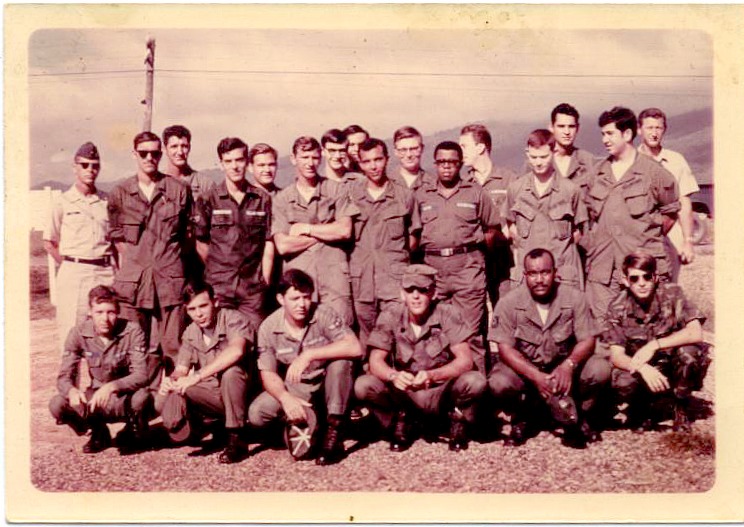
I’m on the bottom right in camo with no stripes, no USAF and no nametag. I traveled light back then.

Posted in Important CAVC/COVA Ruling, TDIU | Tagged , , , , , , , , , , , | 9 Comments