Stolen Valor Act- Pandora”s Box?

Finally. The Supreme Court has agreed to hear the case about the Stolen Valor Act. Readers may recall that an enterprising 43 year old named Xavier Alvarez of Claremont, California informed potential voters that he was the recipient of the CMOH in 1987. A quick check by some enterprising sleuth revealed no such thing. In fact, further investigation uncovered the fact that he’d never even served in the Marines as he claimed. This provoked a legal action by the U.S. government that culminated in the 9th Federal Circuit Court of Jokes to declare it was permissible under some tortured reasoning associated with the First Amendment. Prosecutors wisely decided to take this up to the Supremes.

Some of you may feel this is a waste of time and resources. Others are too busy playing thumb tag with their friends via their new IP4s. I suppose time marches on, seasons change and mores evolve into more “compassionate” rationalizations. When is a lie a “lie”? If it only hurts someone else? Defamation of character is an example of this. It is actionable in a court of law and celebrities regularly employ it when the Inquirer exposes some juicy peccadillo regarding their behaviour.

When a person aspires to public office or wants to create a positive persona for a position in his community, he or she regularly lists their qualifications. These are then used as a yardstick to measure their worth. Lying about your military service or your awards and medals gives you an unfair advantage over your competitors. If believed, it implies you are of superb character and a cut above Joe Blow Citizen who didn’t feel that call to arms. As you can see, this creates an unfair advantage. How the 9th Fed. Circus can come down on the side of misstruth and deception and defend it with the Bill of Rights will escape me forever. Some may say I am a dinosaur in a new world. The same ones may say I am not empathizing with Mr. Alvarez because he was abused as a child and is a member of the Hispanic minority. He is truth challenged but he has “issues” that permit this behaviour.

This is a slippery slope and the government recognizes such. What would this provoke if left standing? Jez, where would I start? I used to be Davy Jones of the Monkees, but I changed my name to achieve anonymity because the paparazzi continually make my life miserable? Did I mention I was the founder of the Mensa Society? Our President regularly consults with me privately about Veterans Affairs? Come on. If left standing, anyone can say anything about themselves, be it military or otherwise. It gives a whole new meaning to the Army’s tagline “Be all you can be”.A whole new industry will have to arise just to determine who is telling the truth about themselves. While this will help the President’s poll numbers by lowering the unemployment percentages, it forebodes a host of new ills. Truth, as an integral part of our psyche, will become subjective or simply optional.

I think I would prefer to be the dinosaur or is that apatosaur now? Did I mention that I strongly resemble Davy Jones? It’s true. People stop me on the street all the time and say “Hey. I remember you.” Why would I lie about a thing like that?

Posted in General Messages, Uncategorized | Leave a comment

BVA–Muskogee Jetguns

When I spot a jetgun win at the BVA, I really dissect it from every different angle. They are still rare, but yield a plethora of valuable information for others. Sometimes something as minor as a physician’s note in the file, an absentminded remark by a VA examiner or an intuitive judge will be the dernière crie on the subject.  The decision below was an amalgam of several of these.

From the marijuana-free city ofMuskogee, we are treated to a win for Vetkind. The fact that he was represented by the DAV can be looked at as either a plaudit for them or a testimonial to one individual who has done his homework and impressed the VLJ. The man had a video conference with his wife at his side. This is a positive thing. It implies she stands by her man. I guess it could equally imply she was a conniving welfare cheat and wanted a shot at Monty’s Cookie Jar, but as you watch this develop, you will see my first supposition is more likely.

The Court has spoken on the private physician treating rule. They held that this opinion is to be given no more weight that anyone else’s- including the fractured reasoning of the VA examiner. This case partially contradicts that. His private doctor has been treating him for over 15 years and is well-acquainted with his illness. He has been the Vet’s caregiver to include a liver transplant in 2004. Having been around the block with him, the doctor’s observations about a risky lifestyle would be apparent after this amount of time. The lack of a “history” combined with little or nothing in the way of risk factors other than four sexual encounters and jetguns weighs heavily in his favor. The VA is prepared to poke a hole in this, but cannot find a purchase. The boy is simply as slick as a pig at the County fair contest. Examiner after examiner tries to inject doubt or lack of evidence in an attempt to create “negative evidence”-all to no avail.

With regard to hepatitis C risk factors, the Veteran has consistently denied IV drug use or the receipt of any blood transfusions prior to 1992.  The Veteran reported having had four sexual partners in his lifetime, none of which have been diagnosed with hepatitis C.  The Veteran is not a combat Veteran; he was not a military corpsman or medical worker; and his post-service occupation was as a postal worker, so there is no occupational exposure.  Finally, the Veteran denied having any tattoos or body piercing.  As noted, the Veteran contends that he contracted hepatitis C as a result of exposure due to the air gun used to inoculate the Veteran when he started active duty service.


Witness the fact that the Vet doesn’t prevaricate. He sticks with his contention that it was jetguns from start to finish. He doesn’t meander off target and mumble about sharing razors and toothbrushes. His story is monolithic and unchanging. Vets would benefit by taking notice of this. When you file, you will be asked (even though you have no medical training) to opine on the etiology of your disease. If you choose to contribute a theory, keep it the same and never vary. Don’t add to it later in hopes that the “spray and pray” technique will hit some resonant chord. Once you become equivocal your credibility is irreparably compromised. You will be accused of being a “poor historian”. You can also say you don’t have a clue, but that isn’t advised. They may say you don’t have a viable reason to attribute it to service.

Vets will take notice that in jetgun claims, the VA will fight tooth and nail to deny. This case is no exception.  The accepted wisdom in Caluza and Hickson was that you had to have a nexus letter. Later they started adding even more verbal baggage about having reviewed the service medical records. When that requirement started to become well-known, they moved the goalposts yet again and said we had to have a “probative” analysis that discussed the pros and cons of all the risks and why the one claimed was most likely the culprit to the exclusion of all others. This evolved yet again into a discussion in recent years about how “speculative” a nexus was or wasn’t. As of 2011, we have graduated to the point where arriving with a nexus from your private treating physician is almost as useful as tits on a boar hog.  They will still deploy their examiners in the “circle the wagons” plausible defense. I’m sure you’re familiar with that one-the 2004 FAST letter that said “Yeah. We let one slip in under the wire, but that’s it. There’s no proof jetguns do this.”

In an August 2007 VA examination, a VA examiner stated that transmission of hepatitis C with air gun injectors is possible in theory, but noted a lack of scientific evidence to document the transmission.  He then stated, in essence, that because the Veteran had no other risk factors for hepatitis C, he would be unable to give an opinion about the etiology of the Veteran’s hepatitis C without resorting to mere speculation.

So, after scratching their asses and picking their noses, they decided to renexus three years later:

Given the speculative nature of the August 2007 VA examiner’s opinion, the Veteran was afforded another VA examination in July 2010.  The July 2010 VA examiner reviewed the entirety of the Veteran’s record as well as research regarding the likelihood of hepatitis C transmission through an air gun.  The examiner noted that the Veteran did not have any of the other risk factors and that transmission of hepatitis C with an air gun is biologically plausible, however he opined that as there is no scientific evidence that a transmission of hepatitis C from an air gun has ever occurred, the Veteran’s hepatitis C is less likely than not causally or etiologically related to the Veteran’s service or the inoculations received therein. 

Lay statements submitted on the Veteran’s behalf attest to the fact that the Veteran did receive inoculations during service via an air gun.  The Board acknowledges the various statements in support provided by the Veteran’s fellow servicemen.  Each letter verifies that the Veteran did receive his inoculations by an air gun injection.  Although, the Board notes that none provide evidence that anyone else was infected with the hepatitis C virus as a result of the inoculations by air gun injection that they received.

The Board acknowledges that the Veteran also provided internet research to support his contention that he could have contracted hepatitis C from an air gun.  The information provided stated that there is scientific proof that hepatitis B can be contracted through the use of the air gun.  The July 2010 examiner responded to the information by noting that hepatitis B virus is heartier and more readily transmitted than hepatitis C and that while there is at least one reported case of hepatitis B being transmitted by an air gun injection, thus far, there have been no case reports of HCV being transmitted by an air gun transmission.

Mr. Muskogee here has a really well-reasoned nexus from no less than his doctor of 15 years and the VLJ sits up and takes notice. If Mr. M was a reprobate, the doctor would never go to the floor for him. Most doctors have high moral standards. Most doctors, mind you. The ones at the VA apparently can be suborned, but we won’t discuss that today. Of more import is the obvious re-examination of the evidence (rebuttal) by the July 2010 examiner that trots out the old “HBV is heartier that HCV” nonsense. Notice this surfaces after it goes up to D.C. when the Vet can no longer rebut it? If they believe you can get HCV with only one exposure to IVDU (with or without a shared needle), why is it suddenly unproven science that you could possibly pick it up from a jetgun that 47 others whom you first met three days ago recently used? The VA loves to bandy about the word “speculative” right up until the Vet employs it against them. At that point the argument reverts to the term “plausible but unproven”. Where is the scientific study that conclusively proves the transmission via IVDU 100% of the time by the admittedly “less hardy” HCV?  Who’s the fool, fool? I submit the whole process is speculative and the medical professional who can keep the straightest face comes out the most probative.

The Board notes that the record contains a positive nexus opinion, a negative nexus opinion and a speculative opinion.  In this regard the Board refers to the previously noted positive nexus provided in the April 2007 letter from the Veteran’s private treating physician which stated that the Veteran’s hepatitis C is as likely as not caused by the air gun injector, given the absence of any other risk factor; the negative nexus opinion provided by the July 2010 VA examiner stating that although a relationship is plausible, the Veteran’s hepatitis C is less likely than not causally or etiologically related to service, including the inoculations, because there is no scientific evidence that supports transmission of hepatitis C by air gun; and the speculative opinion provided by the August 2007 VA examiner.

So the score is:

1) Yep. It was the guns.

2) Nope. It’s plausible, but we don’t buy it.

And last but not least

3) Beats the shit out of me. It would be too speculative for me to say he got it in the service,  and I was paid well to say this.

The VLJ, S. L. Kennedy, deductively reasoned this one out as being a rocks/ paper/scissors decision. Throw out the wet paper and the dull scissors and you are left with a rock solid nexus. Game, set and match.

While it can be said that you are precluded from using these decisions in an effort to prove your case, you can plagiarize to your heart’s content from them. That’s why I post them.

Posted in BvA HCV decisions, Jetgun BvA Decisions | Tagged , , , , | Leave a comment

CAVC– Jones v. Shinseki 2010 + BVA Case

Jones v. Shinseki examines what to do when, after numerous tries, the VA examiners are stymied as to the cause of your disease or whether it is service-related. This is usually summed up somewhere in your denial. It will say that after much construing, prognosticating, opining and interpreting, the poor fellows are unable (or unwilling) to grant your claim under the umbrella of any attempt being speculative. Invoking the word has been successful in the past. Here, Mr. Michael H. Jones, the appellant, appeals the practice of denial based on being unable to figure it out.

Funny how this problem rarely arises where Hep. is concerned.  Seems the Boys at the VARO have it all figured out before you get there and simply fill in the blanks with your name, rank and airspeed.  Jones set forth a rationale that supports this denial via speculation. They used McLendon v. Nicholson (2006) to hang their hat on but it wasn’t completely on point for this argument:


 Of particular significance to the matters at hand, the McLendon Court stated that “when a nexus between a current disability and an in-service event is ‘indicated,’ there must be a medical opinion that provides some  nonspeculative determination as to the  degree of likelihood  that a disability was caused by an in-service disease or incident to constitute sufficient medical evidence on which the Board can render a decision with regard to nexus.”  Id. at 85 (emphasis added).  The Court also noted that medical evidence that is too speculative to establish nexus is also insufficient to establish a lack of nexus; McLendon v. Nicholson (2006) (emphasis mine).

Mr. Jones’ defense put forth a different proposition. His major contention was that the VA should not prevail simply because they could not make an informed nexus statement. He advocated for as many attempts as necessary until the jury wasn’t deadlocked and hung.


The appellant raises a new question, however, with which this Court deals today.  How should the Court treat a situation in which an examiner’s opinion is unclear or silent as to whether all information that reasonably bears on a medical analysis has been gathered or the reasoning behind the inconclusive opinion is absent?  Stated another way, how thoroughly must an examiner develop and describe the information gathered and explain the essential medical reasoning before the Board may rely on his or her representation that an opinion cannot be rendered “without resort to mere speculation”?  This phrase must not become a mantra that short circuits the careful consideration to which each claimant’s case is entitled. Jones supra. (emphasis mine).

This is what makes this case so interesting to Vets seeking SC for Hep. We all know when the jetgun theory is laid on the table, the examiners sharpen their pencils and start doodling the word “speculation” and “plausible”.  They might as well be interchangeable terms.

This passage is what disturbs us as litigants:

While VA has a duty to assist the veteran by providing a medical examination in certain situations, that duty does not extend to requiring a VA physician to render an opinion beyond what may reasonably be concluded from the procurable medical evidence.  Notwithstanding the duty to assist, it remains the claimant’s responsibility to submit evidence to support his claim.   See 38 U.S.C. § 5107(a); see also Skoczen v. Shinseki, 564 F.3d 1319, 1328 (Fed. Cir. 2009) (interpreting section 5107 and stating that the duty to assist requires VA to bear the “primary responsibility of obtaining the evidence it reasonably can to substantiate a veteran’s claim for benefits”). Jones supra

So the Court has simply put off for another day any cutting edge precedence which might be useful to our situation.  His remand will be based on poor wording and an incomplete verbal assassination.  Chances are the VASEC will feel emboldened enough to deny yet again. They’ll give him the tinnitus. That’s a throwaway issue for 10%. Oddly, the hearing, even if Mike won, will be worth 0% until he’s deaf as a post in one ear and well on his way in the other.  But any decision the BVA renders de novo will be non-speculative this time – I guarantee it. As for the SMC K (erectile disfunction), my guess is it’ll go to an IMO at QTC and he’ll get a good nexus. One thing is for certain. This gentleman is going to be eligible for Social Security, if he isn’t already, years before he sees a meaningful resolution to all this.

http://www.uscourts.cavc.gov/documents/Jones_07-3060_published_opinion_3-25-2010.pdf

And here is the beginning of the fallout from this non-decision. The BVA is already citing it before it has been resolved.  Say all after Jones, over?

http://www.va.gov/vetapp11/Files1/1107350.txt


In this case, the September 2007 VA examiner’s opinion was of the type specifically noted by the Court in Jones, where the record yielded multiple possible etiologies with none more likely than not the cause of the Veteran’s hepatitis.  Moreover, the Board finds it significant that the IV drug use and 1993 blood transfusion were both post-service events.


The Board notes that the Veteran emphasized in both his September 2005 statement, and at his May 2010 hearing, that he only used clean needles for his IV drug use.  In other words, he did not share these needles with anyone else.  However, he did not provide any evidence how that would affect his case, as IV drug use itself is the VA recognized risk factor without reference to shared needles.  Moreover, the September 2007 VA examiner was presumed to be aware of this fact as it was documented in the September 2005 statement that was presumably reviewed along with the other evidence contained in the VA claims folder.

This is where the Vet has to be on his toes. Simply stating that you didn’t share your hardware doesn’t cut it now. Remember about 40 or 50 posts ago where I admonished the reader to be careful about VA’s propensity to come up with new ways to deny? I rest my case. We will spend another year of two before something like this finally gets a hearing before a Court judge or Judges.  Seeing it here now is useful so you can close that avenue of denial before you get there. Ex parte justice has a propensity for getting away from you. Trying to repair an error is time-consuming and requires a lot of paper and postage. Once the BVA has spoken, the only avenue is a NOA, not a NOD. More time is wasted and resolution is pushed out several more years when this occurs. Knowing full well, that what you do not include in your claim will be seized upon as the causative factor, its almost axiomatic that you become more anally retentive than they are. I know that’s almost impossible like attaining the speed of light, but you will have to learn how.

Our teaching moment is obvious. Simply stating a lay fact does not influence a VA examiner’s assessment of risk in this. You have to be specific and explain why to them- as in: “Because I didn’t share needles, the risk of contracting hepatitis from this vector was avoided. And to keep the record straight, I did it once or twice and never did it to the point of addiction. It was isolated and infrequent and it had no deleterious effects on me.” Then shut your friggin’ pie hole. Better yet. Write it all down and avoid having to do it in front of a judge unless you can honestly look him in the eye and convey your credibility and sincerity.

Posted in BvA HCV decisions, Important CAVC/COVA Ruling | Tagged , , , | 3 Comments

FROM THE FOOTLOCKER

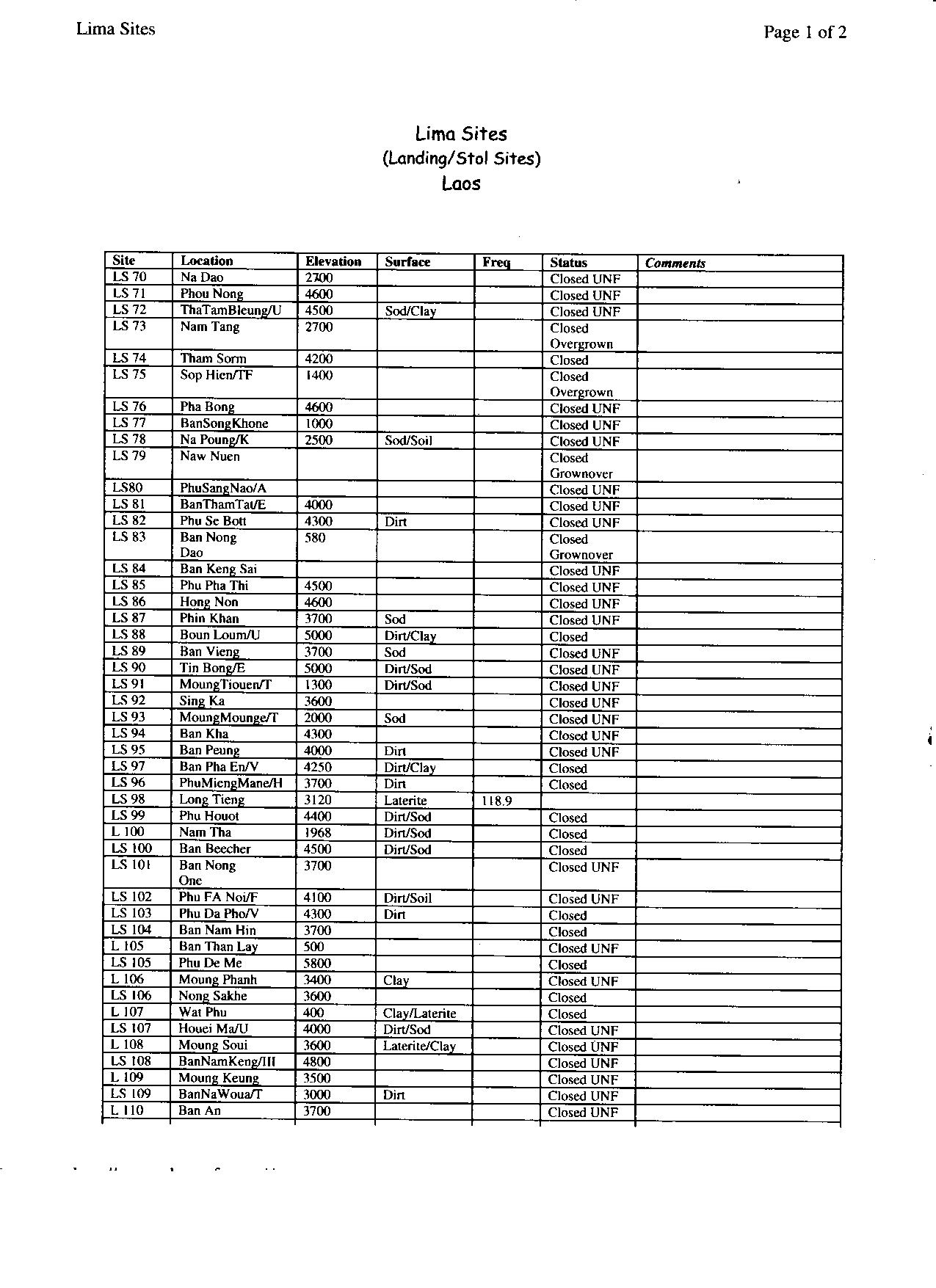
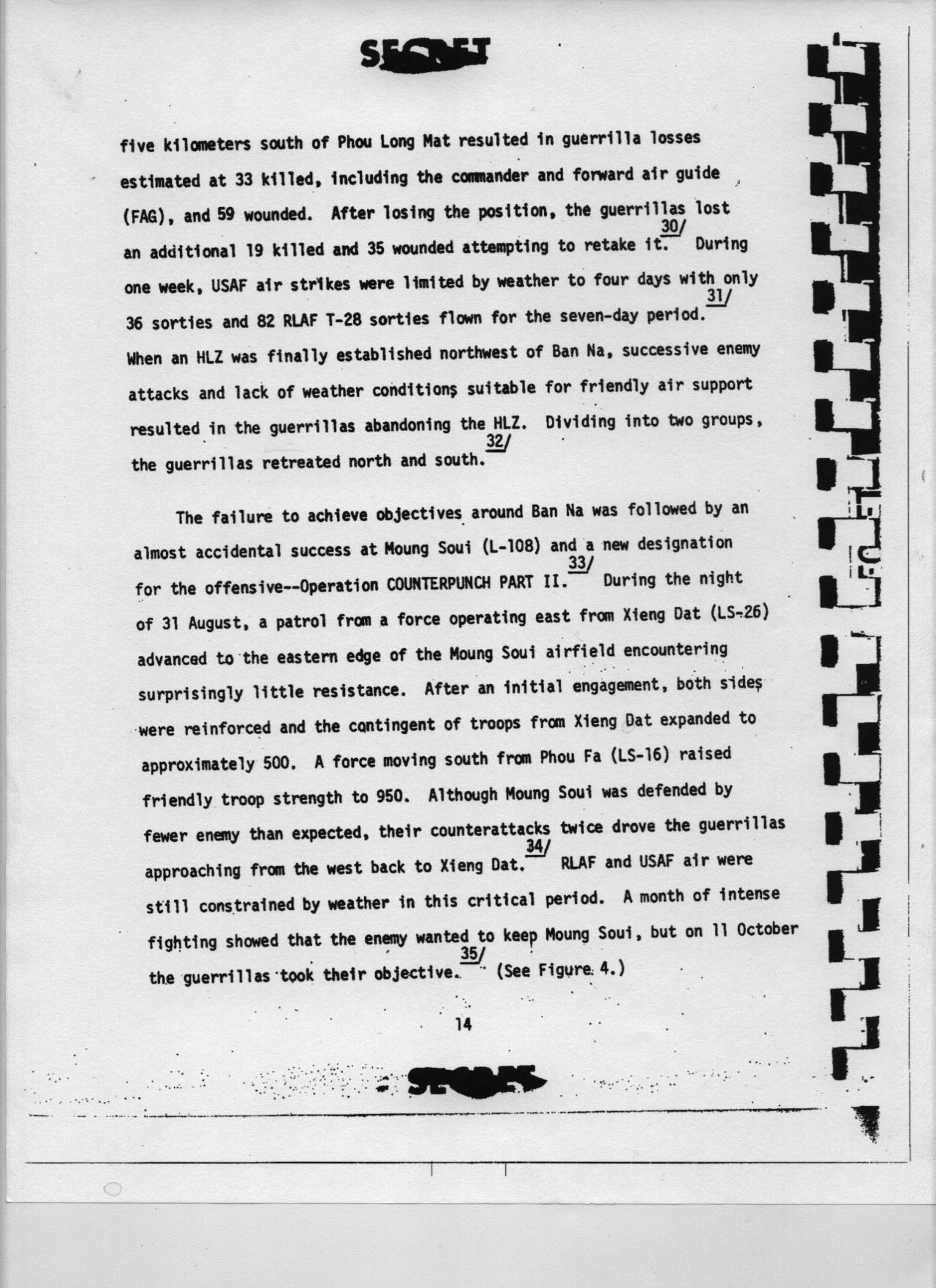
Always in search of oldies that may help Vets accomplish a claim, I constantly run across weird things I saved from SEA and old flight maps. The ones we had were leftovers from when the French controlled the Indochinese peninsula (Laos, Cambodia and what is now all of Vietnam).  I can’t believe I have some of this. My wife says I’m a packrat and I’m beginning to believe her.  All I remember bringing back was a bunch of guns.

The white circle is the operating location and the line tells you which way the runway aligns. Muong Soui’s paralleled Route 7 just to the south.  Route 7 goes from Hanoi to Vientiane. Still does. Route 71 branches off to the north to Luang Prabang  (L-54).  Moung Soui is in the northwest corner of the famed Plane of Jars.

 L-108 traded hands quite frequently. We owned it during the monsoon ( August to January) and lost it every winter. My brain is starting to go. I think UNF stood for Unknown Nationality of Forces or else it was Unsafe for Navigable Flight.  We never paid too much attention to that column.

Flying is a hazardous business as you can see.

Lima Site 20 Alpha-Long Tieng. This was home from 7/70 to 11/70. We called the Karst limestone hills at the end of the runway the titty karsts. We also referred to them as the vertical speed breaks. Runway was Laterite 1100 feet. 3120 ASL, Approach and Departure freq. was 119.1 mhz. The only major base with a unidirectional runway. A C-123 hit it in 69. The reason you don’t see any weeds around the runway is because the Hmong children used bleach bottle scoops and poured AO undiluted all over the approach and the parking aprons.  That would explain why I have PCT. I bet there’s still nothing growing there. I’d also bet every one of those kids are dead, too.

Posted in From the footlocker, General Messages, Humor, Uncategorized | Tagged , | Leave a comment

BVA– Remand to Nashville Cats

BVA—Remand

NashvilleCats

While I compliment the  VLJ on his candid observation that the Nashville Cats at the Nashville VARO aren’t playin’ as clean as country water, the cause is lost. Judge Michael E. Kilcoyne has been around the BVA for quite some time. He has seen innumerable cases come up the ladder. As hopeless as this seems, he is still going to insist that the VARO give the poor Vet a blindfold before the firing squad cocks and locks.

It’s almost unconscionable in this day and age that an organization as august as the DVA purports to be would kick Sgt. John Doe to the curb without performing due diligence on his claim.  This stinks. He’s obviously filed his “Fetch!” forms (VA Form 21-4142 – Authorization and Consent to Release Information to the Department of Veterans Affairs (VA) ) with them as it says as much. His Tennessee DVA (the VSO) doesn’t appear to be into the Lovin’ Spoonful because they sure aren’t on the same page. In fact, about the only one on the same page with him is Hizzoner Kilcoyne who is several hundred miles away.

Another one who seems to be overly helpful is his wife. I got out the magnifying glass to see if the prefix “ex-“ had escaped me, but alas, it just wasn’t there.  This is worse than a bad hair day:

Furthermore, as mentioned supra, the Veteran has reported engaging in various hepatitis C risk-related activities during service, and the Veteran’s spouse has reported discovering the Veteran’s illicit drug use approximately six months after his discharge from service.

A word to the wise. While I abhor the idea of lying to the VA, there is really nothing a spouse is going to be able to contribute to your claim that is beneficial.  Camp followers went out of style after the War of Northern Aggression (that’s the “Civil War” for all of you from Chicago).  Here, it was fatal. I commend his spouse for her honesty. She must have been briefed by the VSO on how helpful this would be for his claim. Has anyone a better hypothesis? Feel free to contribute. This is a forum.  I feel she could have submitted a statement on his ills and how the disease impacted his life. Assuming she was like my spouse, I doubt she would have purposefully sabotaged the process and thus deprived them both of a potentially compensable grant of SC. I fear we’ll never know.

One of the things that makes this  beyond the pale is that the VARO is in Nashville and they were too lazy to even send over to the hospital (which is less than 18 miles away) to get his medrecs. How lame is that? No one I’ve met who has been subjected to the VA “experience” has ever had a cheerful chipmunk attitude about it. I guess you have to draw the line somewhere. Disobeying the law and pissing off the VLJ is not going to win you friends anywhere but at the VARO. What’s worse is that there’s no complaint form that will ever punish the miscreants or reprimand them for committing such an obvious error. Wasted time? No big. We’re gonna be here for the next 15 years waiting for the golden parachute. We’re indemnified. Like, what are you going to do? Sue us?

This will wend its way back to the venerable VLJ in due time- probably about 16 to 18 months from now- with another Dear Sgt. John letter attached. It will dutifully be noted that there is still no medical nexus forthcoming other than the one thoughtfully and meticulously prepared by those sweet, utterly efficient little VA raters on their busy little hamster wheels cranking out justice for all. All his damning medical records documenting numerous mentions of a former life of sin and degradation will now be collated, color tabbed and part and parcel of his C-file . There will also be highlighted portions wherein he has turned over the new leaf after service with the help of wife and church. Amen.

The VLJ will then intone a mournful soliloquy about willful misconduct and how it cannot be rewarded. The Judge will finally pronounce Extreme Unction and wash his hands ceremoniously. The inevitable is so foregone as to be anticlimactic. Nevertheless, the music must be allowed to finish before the dancers can retire from the floor. At some point after this is over, the SO will pipe up and say something dumb like “Who would’ve figured? Are you buying?”

Peter of Menalteed fame has a wonderful suggestion for all this claptrap. Why not have an impartial jury of seven composed of say, two VA poobahs to bring the correct rules and regulations to the table; a third, an impartial lawyer well-versed in the same discipline, to keep an eye on the poobahs and prevent mission creep; and lastly, two unversed civilians and two military personnel to approximate the term “of his peers” with no ax to grind. Hand them the evidence and everyone can play Pontius Pilate using their thumbs to affirm or deny. This should separate the ribbon clerks from the poker players. They can remand for more evidence as necessary as many times as they want-just as they do now. This can be done in person in small cities everywhere. It will be synonymous with regular jury duty and you’ll be exercising your rights and duties as only a loyal American can. What could be more perfect? I suppose this might upset the jobs applecart at the VAROs , but what the hey? We can retrain them on the concept of Innocent until proven guilty instead of the obverse.  Yep. Pretty soon they’ll be saying things like “Stinky, dude! What a totally new concept! Imagine treating a Vet’s testimony as being potentially credible instead of merely “contentions? Is that tubular or what?”

I admonish Vets not to hold their breath as it makes those little black spots in the corners of one’s vision such as when you stand up too rapidly. In time, grasshopper. Just think.  Twenty years ago they were looking at us and saying “Hep. C? There is no such thing and you sure as hell didn’t get it from no toilet seat in the service, sonny. Now move on.”

Ladies and gentlemen Vets: I give you former Sgt. John Doe of Saint Petersburg, Florida where all veterans go to file. He then moved back to Nashville.

http://www.va.gov/vetapp11/Files1/1109751.txt

Onwards through the Fog. Vote For Oat Willie in ’12.

Posted in BvA HCV decisions, Frivolous Filings | Tagged , , , , | 3 Comments

TEACH A MAN TO FISH

Give a man a fish and you feed him for a day.

Teach him to fish and you feed him for life.

I don’t know who said this. It isn’t germane to my discussion here. The thought is, though. Yesterday, I had the pleasure of lunch with one of our members and his wife. As we are few and far between, this occurs rarely. In fact, this is only the second time it has occurred. “Members” of HCVets are a loose, unaligned bunch. Due to this disease process, we have an ugly habit of passing away before we have an opportunity to develop long-term relationships with one another, too.

Peter (Menalteed) and his charming wife traveled a great distance to buy my wife and me lunch, as I said. He is the epitome of perseverance. I have had several members tell me via the internet that they followed my prescription for pursuing their claims and it worked. Peter was no different. He actually read everything I had posted here and followed the program to a “t”. The payoff is vindication for all of us who aspire to help others. Nothing brings me greater joy than helping one of you attain that which is rightfully yours. The fact that the VA erects such an impenetrable barrier to service connection is no accident. They have limited assets and loads of time.  Finding a path through this jungle seems to be the problem.

Recently Peter and WGM (Bill) succeeded in accomplishing this at the VARO level without having to appeal to D.C. This doesn’t mean that the VA has changed its modus operandi. It reflects a dogged, intense preparation which caught their respective VARO examiners off guard and compelled them to throw in the towel. They are not accustomed to Vets arriving with this kind of evidence and the requisite letters connecting their diseases to service. VSOs seem to overlook this little requirement on a regular basis. Peter did this all by himself and he’s 68.  In addition, he’s stage 4 on his second liver and undergoing chemotherapy.  Look no farther than Miriam Webster’s seminal tome on the English vocabulary under “perseverance”. There undoubtedly will be a picture of him under the word.  This gentleman, with astute assistance from his wife (who is a nurse), assembled a bulletproof claim for cirrhosis, HCV and a host of secondaries including DM2 and coronary artery disease. He has now won them all. Having a sawbones in your corner is a prerequisite but the impetus required to pull all this off when you are knocking at death’s door is stupefying.

I have often cajoled Vets into greater efforts to win when it seems they have hit the wall. Peter, on the other hand, did virtually all this with little or no input from me.  He simply read what I posted and acted on it.  It is one thing to advocate a path of attack, propose backup measures and assemble evidence you think you will never need.  Likewise, when denied, some lose hope or become despondent. Peter exhibited none of these mental maladies. He simply soldiered on and put one foot in front of the other. The results will stand his wife in good stead when he is gone vis a vis DIC. By covering every possible contingency, VA will not be able to try their sleight of hand tricks and say “Well, that’s all well and fine that he was connected for the HCV/cirrhosis, but our esteemed experts have determined he died from a heart condition”. Fine. Let them say that. Peter has covered that base so it is a moot point. In fact, Peter has covered a plethora of bases. The word “checkmate” comes to mind. VA is going to have writer’s cramp before they finish penning all his ratings. I strongly suspect he will have somewhere in excess of 180% in ratings- more than enough to qualify for the SMC “S” he so richly deserves.

You have to ask, of course- what was the risk factor? Hold on to your hats. Jetguns.  With nothing more than several pounds of medical literature, a buddy letter from a fellow recruit about the sanitary practices of pecker checkers and several nexus letters, VARO Seattle examiners granted his claim with little more than a whimper. They did send out for a QTC IMO on whether all the secondaries he filed for were legitimate. They were-and QTC said as much in VAspeak.

If you Vets out there keep this up, I won’t have any time to write funny posts like Agent B and the new Libyan medal.  I consider that grossly unfair. All my time will be consumed writing congratulatory letters to successful Vets on their prowess at bearding the VA lion in his own den. Where does that leave me?  Well, there is the danger of obesity. With Vets showing their appreciation by buying me meals at fine restaurants, I endanger my own health.  Damn it, I say.  It pains me to think I must set aside my concerns over my health for the greater good of helping all of you. You task me, ladies and gentlemen. Your success(es) are earned. Providing you with the assets to do so is less than half the battle. Peter is ample proof of that.

Posted in General Messages, Tips and Tricks | Tagged , , , | 4 Comments

VA — TRICK OR TREAT

On October 31st, 1990, the VA instituted the concept of willful misconduct. Prior to this the measurement was nominally Line of Duty (LOD). If you did something stupid like driving drunk and really messing yourself up, that was not LOD. However, the two Specialist First Class buddies who were twice as toasted as you were passengers and were LOD because they were unwitting hitchhikers of sorts. Confused? You needn’t be.  If you were not responsible for an accident (unforeseen), then you were LOD. If you were doing something you knew was stupid and managed to cause yourself great harm, then you had to repay Uncle Sam by staying in the service longer to compensate for the lost time. AWOL was assessed this way as well. We’ll address desertion in another post.


With the advent of drug usage and abuse, the problems gradually multiplied one hundredfold. The military method finally percolated down to the VA on Halloween, 1990.  If you came down with cirrhosis of the liver from too much Tanqueray prior to that Halloween, you could claim it as SC. All you had to document was one detox while in service to prove your case and pow! SC. Too cool for school. VA finally put their foot down and closed this loophole. 20-year junkies from Nam were filing and getting SC. This had to stop. So henceforth from that All Hallowed’s Eve of 90, the practice came to a halt. Everyone before was good to go but all those after…weren’t. This, of course was the new 38 CFR § 3.301. Allow me:


(a) Line of duty. Direct service connection may be granted only when a disability or cause of death was incurred or aggravated in line of duty, and not the result of the veteran’s own willful misconduct or, for claims filed after October 31, 1990, the result of his or her abuse of alcohol or drugs.

(b) Willful misconduct. Disability pension is not payable for any condition due to the veteran’s own willful misconduct.

(c) Specific applications; willful misconduct. For the purpose of determining entitlement to service-connected and nonservice-connected benefits the definitions in §§ 3.1 (m) and (n) of this part apply except as modified within paragraphs (c)(1) through (c)(3) of this section. The provisions of paragraphs (c)(2) and (c)(3) of this section are subject to the provisions of § 3.302 of this part where applicable.

(1) Venereal disease. The residuals of venereal disease are not to be considered the result of willful misconduct. Consideration of service connection for residuals of venereal disease as having been incurred in service requires that the initial infection must have occurred during active service. Increase in service of manifestations of venereal disease will usually be held due to natural progress unless the facts of record indicate the increase in manifestations was precipitated by trauma or by the conditions of the veteran’s service, in which event service connection may be established by aggravation. Medical principles pertaining to the incubation period and its relation to the course of the disease; i.e., initial or acute manifestation, or period and course of secondary and late residuals manifested, will be considered when time of incurrence of venereal disease prior to or after entry into service is at issue. In the issue of service connection, whether the veteran complied with service regulations and directives for reporting the disease and undergoing treatment is immaterial after November 14, 1972, and the service department characterization of acquisition of the disease as willful misconduct or as not in line of duty will not govern.

(2) The simple drinking of alcoholic beverage is not of itself willful misconduct. The deliberate drinking of a known poisonous substance or under conditions which would raise a presumption to that effect will be considered willful misconduct. If, in the drinking of a beverage to enjoy its intoxicating effects, intoxication results proximately and immediately in disability or death, the disability or death will be considered the result of the person’s willful misconduct. Organic diseases and disabilities which are a secondary result of the chronic use of alcohol as a beverage, whether out of compulsion or otherwise, will not be considered of willful misconduct origin. (See §§ 21.1043, 21.5041, and 21.7051 of this title regarding the disabling effects of chronic alcoholism for the purpose of extending delimiting periods under education or rehabilitation programs.)

(3) Drug usage. The isolated and infrequent use of drugs by itself will not be considered willful misconduct; however, the progressive and frequent use of drugs to the point of addiction will be considered willful misconduct. Where drugs are used to enjoy or experience their effects and the effects result proximately and immediately in disability or death, such disability or death will be considered the result of the person’s willful misconduct. Organic diseases and disabilities which are a secondary result of the chronic use of drugs and infections coinciding with the injection of drugs will not be considered of willful misconduct origin. (See paragraph (d) of this section regarding service connection where disability or death is a result of abuse of drugs.) Where drugs are used for therapeutic purposes or where use of drugs or addiction thereto, results from a service-connected disability, it will not be considered of misconduct origin.

(d) Line of duty; abuse of alcohol or drugs. An injury or disease incurred during active military, naval, or air service shall not be deemed to have been incurred in line of duty if such injury or disease was a result of the abuse of alcohol or drugs by the person on whose service benefits are claimed. For the purpose of this paragraph, alcohol abuse means the use of alcoholic beverages over time, or such excessive use at any one time, sufficient to cause disability to or death of the user; drug abuse means the use of illegal drugs (including prescription drugs that are illegally or illicitly obtained), the intentional use of prescription or non-prescription drugs for a purpose other than the medically intended use, or the use of substances other than alcohol to enjoy their intoxicating effects.


So, what does that say about all this business being legal before 10/31/90? I’m not that moral so I won’t conjecture. What I will point out is something that most Vets are unaware of- the old escape clause. This is part of the Santa clause.  Read again more slowly…

(2) The simple drinking of alcoholic beverage is not of itself willful misconduct.

(3) Drug usage. The isolated and infrequent use of drugs by itself will not be considered willful misconduct;

Oftimes, what a regulation permits is hidden in what is forbidden by it. Sometimes in plain sight. This has been there all along and I have only seen one VLJ parse it exactly the same.  § 3.301(c)(3) comprehends that some idiot may want to “experience” the rush of heroin, speed or whatever.  This rare occurrence should not condemn the poor boy to perdition and denial via willful misconduct if it was a one of a kind lark or even several over 3 years.  Under these unique circumstances, you can pass the mirror test and advance to a claim. On the other hand, if you have been clean for only six months and you’re 63, forget it.

The humor I find in regulations like this has to be that they even allowed alcoholic lifers to file for hyaline cirrhosis due to ETOH abuse before this was enacted.  I think drug addiction is sad. I fear it may be harder to break the addiction than booze. That’s why I come down hard on alcoholics. I think I may have been one once.  Nevertheless, there you have it. Trick or Treat from the happy folks at VA.  Their Motto? We will grant no claim before its time (time is such a subjective concept).

Posted in Introduction-Read these first, Tips and Tricks | Tagged , , | Leave a comment

BVA–PEER PRESSURE

I am always amazed at the entries in the excuse book for how a Vet got infected with HCV. I say excuse in the sense of a disenfranchised Vet- i.e. one who has been denied and will never attain SC for it. We here at AskNod thought we had heard them all. My all-time favorite was  the one where the stateside Vet had been infected by returning Vietnam Vets because he drank from the same water tanks as them. Eating contaminated feces was another wild tale. This one is not inherently incredible, but lacks something besides the fact that we all know it’s against the law to do this and get remuneration. My daddy said “Excuses are for entertainment purposes only. They serve no useful purpose beyond that other than to convert oxygen into carbon dioxide.”

With that, I leave you to contemplate the idea that one’s superiors would consciously attempt to coerce you into drug abuse on a fairly regular basis…

In this case, in statements and testimony, the appellant contends that his hepatitis infections were caused by his use of intravenous drugs (heroin and cocaine) beginning during his period of initial active duty for training in the Army National Guard.  He explains that, immediately after his basic training, higher ranked personnel introduced him to heroin and cocaine, and that he felt peer pressure to partake.  He contends that the Medical Board findings concerning a history of intravenous narcotics use that began at age 16 (prior to service) were a lie. The appellant testified that he attended detoxification three times during that first period of training, and that he continued using illicit drugs until 2009.  He testified that he was first diagnosed with hepatitis in 1994 or 1998.

http://www.va.gov/vetapp11/Files1/1101518.txt

Take about one hundred of these filings out of the system and I’m willing to bet jurisprudence would accelerate like those defrag programs they sell called speedupmypc.com

Posted in BvA HCV decisions, Frivolous Filings | Tagged , , | Leave a comment

LOOKING FOR CUE IN BVA PLACES

Looking For CUE


I have posted examples of CUE (Clear and Unmistakable Error) on several occasions but have never posted decisions where the reader can look for CUE in a BVA decision and discern it. I have chosen my first battle with the VA in 1989. I didn’t know anything about this process and trusted the DAV to do this for me. I fault no one but myself in retrospect, but feel I was represented by Huey, DUI and Louey.

The COVA, the forerunner to the CAVC was empanelled about one month after I filed. They were just hanging their sheepskins when I lost. They moved to new digs four months after they were ensconced in their first offices. My claim arrived in D.C.  early in 1991 and my docket date was March 5th, 1992. This was truly the dawn of time for the Court. If I had known about them, I could have appealed. My service officer never told me. I suspect he was so wet behind the ears he honestly didn’t know either. He didn’t go to D.C. personally. Some chowderhead higher up who lives there did the honors.   What I think of him doesn’t bear repeating. He tried to play doctor. Then he tried to do the benefit of the doubt argument. All for naught it seemed.

The beauty of our cloistered legal system is the fact that we can go back and correct deficiencies, glaring errors that were prejudicial, and judgments that were clearly and unambiguously defective.  In order to accomplish this, you, the Veteran, have to know what to look for. Just having the shopping list of what constitutes CUE isn’t enough. Being able to see it is harder. They don’t type their errors in red. One other thing they don’t do is call you up 22 years later and apologize with a back check in their hands. If this is going to happen, you have to be the active participant.

Fugo v. Brown held that you could not come into court shouting just CUE. It required that you show what you thought was CUE, why you believed it to be so, and why it manifestly changed the outcome.  We won’t go into all the facets here. What we want to examine is how you can spot it. If you have any decisions from way back when like this one, get them out, pour an iced tea and keep a pad of paper and a pen handy.

http://www.index.va.gov/search/va/bva_search.jsp?QT=+Citation%3A+BVA+92-04999&SQ=vetapp92&RPP=100&LC=0&ET=&UA=Search

In 1992 there were 20 sections of 3 judges each for a total of 60. Mostly, but not always, the same three engaged in a certain geographical area of theU.S.  They sat as two occasionally, which was legal, but never as one. That is what happened here. One of the members was required to be a medical doctor and was allowed to make decisions of a medical nature to keep things moving right along. This all changed with the COVA. They ruled that was no longer an option in 1991 several times. The BVA doesn’t listen very well or else they didn’t get the fax/email on it.  They continued to make this mistake right on up until things got so backlogged that they opted to do this with one judge and retired all the doctor judges. The error is almost unheard of now. You will find it in early ones however.

As you can see, I filed for four items. Ron whatizbutt from DAV said I was going to knock them dead at the VARO. When that phrase was pronounced “no longer operable”, he told me not to worry. We were going to D.C. for some real justice. He decided at the last moment to try to make them see reason here in Seattle at a DRO hearing and review. That dragged it out for almost all of 1990 and I finally got the F-9 filed in early 1991.  To be honest, I forgot about it until Ron called me all breathless in late March of 1992 and told me we had WON! Not exactly. I had won 0% for hearing and 0% for tinnitus. That’s an ice cream cone with two scoops of air. My VARO shared that with me in June, 1992 just on the off chance I hadn’t figured it out by myself.

The big one for my back/hips was tossed. Ron never said “Dude, let’s motor on up to the Big House.” Nobody from DAV said boo. I was led to believe I had fought the good fight and lost. If I ever came up with any new and material evidence I could refile anew and start over.

While I waited for justice in 2007/2008, I ate a steady diet of BVA and then CAVC decisions. Every time I ran across a cite, I followed it. Why did that Vet win and this one lose? Imagine my joy when I found the term CUE. Here was a way to go back in time and right this injustice. Well, not exactly. I had to find the error. I came up with a long laundry list of defects, but each in and of itself, could not manifestly change the outcome. They were procedural. You are called the moving party if you wish to upset the decision. As the movant, you have to find the perfect error- the one that caused you to lose. It has to be  seminal-that it produced an outcome determinative decision.  The error had to be such that others can point to it and say “Jez, who’s the idiot that authored that?”

I read my decision from top to bottom several hundred times with  a yellow highliter pen. I’d then go to the CAVC archives and read all those antique rulings. Finally I found it staring me right in the face. Two of them, no less.

If you read the above, you will notice I protested vociferously at every turn that my records were incomplete. Hell, I even retrieved a small portion at great expense from a rural hospital at the ass end of nowhere inThailand.  VA still refused to obtain the complete file. This violated a big precedent about 3 months old-Shafrath v. Derwinski. The Court had already said this was a bozo no-no several times before, but Roger Shafrath will always have his name in lights for as long as the CAVC holds sway on this precedent:

Although the veteran contends that the service medical records are incomplete, we are satisfied that these medical records, which include the veteran’s service entrance examination, treatment records throughout service, and his service separation examination, provide a fair basis for determining the issues on appeal.

The VA loves to move the goalposts and has done so over the years. Caffrey v. Brown in 1994 purported to overthrow failure to assist as a CUE defect. Caffrey only deals with private medical records, not official service medical records. If you tell the VA where they are, the address and what to look for, they are legally required to fetch them.  If they cannot come up with them, they have to have an excuse from their parents as to why.

One year before, the Court decided Colvin on March 8th, 1991. This again was a reminder that playing doctor, even if you were a doctor, was not according to Hoyle when you did it sitting as a judge. Lo and behold, right smack dab at the end of my back claim was the Ben Casey moment:

Based on the record, it appears likely that the  “pain” referred to was the left hip pain documented in the service medical records rather than back pain.

So, having discovered errors that would have manifestly changed the outcome of your decision, you have to dodge minefield number 2. If you send in your neatly typed CUE claim, you have to be very specific as to what you want these gentlemen to do with it. Simply asking for a revision can have unintended consequences. There are two kinds of revisions and one isn’t appealable.

A motion for revision under CUE is a redo of a prior claim. It is not a new claim, a reopening of an old one or a request for an increase. This is a battle where the VA is going to try to defend its good name. None of the rules for regular claims exist here.  This is a knife fight in a dark alley. There exists no room for error or misunderstandings.  Either you’re right or they are.

A Motion For Reconsideration (MFR) is a different genus and species. If VA entertains your request accidentally to be an MFR, a lot of things may happen. I have told readers to be wary when submitting claims because VA often plays dumb and does the “Gee, we never learned phonics so we tried to sound this out and we construed it to be a MFR”.  Here’s the long and short of MFRs.

If your BVA decision was more recent (after 1994), you had one judge. Any MFR motion entertained must be in multiples of two judges after that. Therefore you would have a three judge panel of VLJs hearing your Motion. In my case above, they would add two judges and come up with four. That is not an odd number and could conceivably result in a tie. That means I would have to have a panel of five VLJs. They do not have to grant it (the motion) and they don’t have to tell you why. To add insult to injury, you cannot appeal a decision not to hear a MFR to the CAVC. This is one of those lose-lose venues and the BVA knows it. If they agree to hear it, chances are you lost already before they start. If you are turned down, you can never bring this back to litigation. You’re done. Period.

When you file, you should use language that precludes the GS-0 from doing the MFR Macarena.  A firm disclaimer that this filing is to be construed only as a Motion for Revision must be prominent in the first paragraph. This will protect you when and if you have to go up to Indiana Ave. NW. You think I’m joking? VA is famous for handshakes that are worthless. When I filed for PCT as a residual of Hepatitis, it was “construed” to mean I was filing strictly for residuals of hepatitis and the PCT was from AO. Do not give them any corral room. Make it a cattle chute from start to finish. A) You screwed up; B) Here’s why; C) The law said this back then; D) You did that; E) Please mail my check to1234 Yellow Brick Road Oz, Kansas. 60609 – and be quick about it.

VA will resort to semantics. They will claim it’s your entire fault. They may be so bold as to say it is not unequivocally an outcome-determinative error.  Your saving grace in all this is the CAVC. When they did Gilbert v. Derwinski, they vocalized a wonderful legal principle for Vetkind:

A “[m]aterial fact is one upon which [the] outcome of litigation depends.” Black’s Law Dictionary, 881 (5th ed. 1979). Under § 4061(a)(4), in order for a finding of material fact made by the BVA to be set aside, this Court must conclude that the finding is “clearly erroneous.” The Supreme Court has defined the “clearly erroneous” standard as follows: “A finding is ‘clearly erroneous’ when although there is evidence to support it, the reviewing court on the entire evidence is left with the definite and firm conviction that a mistake has been committed.” United States v.United States Gypsum Co., 333 U.S.364, 395 (1948). Gilbert v. Derwinski(1990)

This is where you can cut a notch in the butt of your .45. If you have done your homework and you have made your case, you will prevail. CUE is fraught with pitfalls, so it behooves you to consider legal representation when you enter this den of iniquity. The VA Secretary is not going to consider you a kind, soulful, disenfranchised Vet who deserves a fair shake. If the BVA was a knife fight, then this is akin to gladiatorial combat in the Coliseum. Only one of you will prevail and the VASEC is determined not to be “it”.

Research your work. Research it again. Do not do what some try and attempt to read things into a regulation and “construe” it to be in your favor. You must find errors that are so egregious that everyone can point to as such. You need to have Court precedence to back up your contentions. Often, failure to cite to the Court decision will allow the BVA bozos to attempt to blow smoke up your alimentary canal.  Getting it all down on paper before you have to go up the ladder is paramount. VA knows this and won’t turn into a Chatty Cathy doll and tell you. If you do not get specific at the BVA, you cannot go up to the Court and say “Oh, yeah. And you know what else they did? Get this. They forgot Colvin v. Derwinski.” If you didn’t mention it in the BVA motion, that’s all she wrote and VA will win.

This is not for amateurs. BVA loves to deal with Vets one on one like this because they usually win.  Show them that you did your homework when you get around to pitching a bitch. One last admonition- keep your wallet in your front pocket and sit in a corner facing out whenever seated at a VARO.

 

Posted in General Messages, Tips and Tricks, Uncategorized | Tagged , | Leave a comment

BVA–A Well-Reasoned Jet Gun Win

Over the years we have noticed a small coterie of very successful lawyers who take on Hep. cases and win them with seeming ease. Virginia Girard-Brady is one. Here, she demonstrates that even in a pool full of VA law sharks, she can emerge unscathed with victory in her grasp.

The client she chose to represent has a checkered past to put it mildly. He has some down time at the Texas Home for Wayward Vets, a possible, although undocumented, drug history and testimony that changes over time. He has one thing he needs though-jet gun immunizations while in service. Because the VA examiner left the door ajar, the VLJ has pushed it open wider:

However, the October 2008 VA examiner further stated that a
relationship between the Veteran's hepatitis C and air gun
injections in service cannot be excluded without resorting to
speculation.  Such clinical statements lend toward an
interpretation that it is biologically plausible that the
Veteran's hepatitis C was transmitted in service by air gun

As a class of Veterans, we seem to be getting more traction on this. Four years ago I would not have even suggested listing it as a risk factor. Now, I wouldn’t consider filing a claim without throwing that in. If one looks at the history of VA hep. claims, they can see a gradual maturing of the process. The practice of denying simply because your medrecs didn’t metion HCV in service in 1970 is being debunked by courts who have finally come to realize that it was impossible to test for it then. This was a long time in coming. It almost always involved a doctor pointing it out to an uninformed VLJ. While there is no substitute for the gold standard of a qualified nexus letter, having a good law dog at your side and a smart judge can often go a long way towards achieving a win.

http://www.va.gov/vetapp11/Files1/1101581.txt

I don’t know when or if VA will ever do a study on HCV and jetguns. It seems more remote every day as if they just wish we’d all hurry up and die before they have to litigate in earnest or worse- admit culpability for this sorry mess.

Agent Orange claims began to surface as early as 1982 with the culmination of the 1984 Nehmer settlement (Nehmer 1). VA did their ostrich imitation for another 7 years before being called to task in 1991 (Nehmer 2). Patricia Lupole of HCVets and her merry band have been waving the jetgun allegations under the VA’s nose far longer with limited success. This decision is vindication for her work. These victories are far too infrequent and  the consensus is that the VA still is in denial. Rome certainly wasn’t burned down in a day and we can’t expect a landslide acceptance of this overnight either. The mere fact that Vets are winning these claims without having to lean on other risks to buttress their contentions bodes well for the future of the process. And yes, having Ms. Girard-Brady in your corner is a mighty big plus as well.

I’m not advertizing here, but if you have a claim for hepatitis, this is the one you want. She can be reached by viewing this site:

http://local.yahoo.com/info-17899398-girardbrady-virginia-a-abs-legal-service-lawrence

No one’s perfect at law, but the sun does seem to rise over her shoulder.

Posted in BvA HCV decisions, Jetgun BvA Decisions, Tips and Tricks | Tagged , , , | Leave a comment