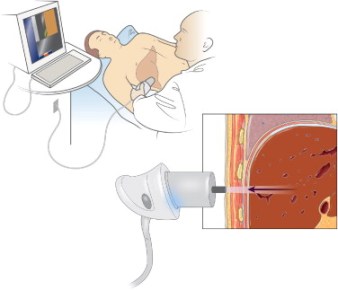
” Briefly, a pulse-echo ultrasound signal is obtained by placing a transducer probe between ribs over the right lobe of the liver. The low amplitude signal transmitted to the liver induces an elastic shear wave that propagates through liver tissue. The pulse-echo ultrasound allows measurement of wave velocity obtained provides a measure of liver stiffness.”
We wish this non-evasive technology had been available in the United States market ten years ago. Instead, my DH had to endure getting stabbed with a long fat needle while fully awake. According to a press release, FibroScan® has been available in Europe since 2003.
Fatty liver disease, DM, and hepatitis C are often seen together but fatty liver alone is a disease of the liver and can progress to cirrhosis and cancer. Two acronyms to learn:
NAFL =Non Alcoholic Fatty Liver can progress benignly.
NASH=Non Alcoholic Steatohepatitis can lead to serious complications as its name suggests.
Hepatitis C and fatty liver diseases are associated according to this Oxford article:
In order to make a diagnosis of NAFL, other aetiologies have to be excluded, especially diseases that can cause an increase in hepatic fat. These include hepatitis C infection, Wilson’s disease, autoimmune liver disease, galactosaemia, alcoholic liver disease and secondary causes of NAFL.
True to form, the VA obscurely refers to fatty liver on its Hepatitis C website but doesn’t connect the dots between NAFL, NASH and HCV for us. Even if a veteran achieves Sustained Virologic Response (SVR) fatty liver diseases have to be managed to avoid cirrhosis. Fatty liver can be a residual–that which remains–after HCV is undetectable. Oxford Dictionary states that the medical term used is sequelae, “a condition which is the consequence of a previous disease or injury: the long-term sequelae of infection. “
The VA sees liver biopsy as “the best method for staging the degree of fibrosis (typically staged from 0 to 4 with the METAVIR, and 0 to 6 with the Ishak scoring system) and grading inflammation (typically graded from 0 to 4). …Alternative approaches, such as liver imaging and serum fibrosis markers, can be performed instead of a liver biopsy, although with careful recognition of their limitations.
However, liver biopsies also have limitations according this study:
The diagnostic accuracy of liver biopsy is limited by sampling variability. The average size of biopsy is 15 mm in length, which represents 1/50 000 the size of the entire liver. There is significant variability in the histological assessment of two readings of the same biopsy by the same pathologist and between two pathologists, even among those who are highly specialized. This variability is low for the diagnosis of cirrhosis (kappa coefficient of concordance ≥0.80), moderate for earlier fibrosis stages (kappa 0.70–0.80) but high for the activity grades (kappa 0.40–0.50).
(How embarrassing to be the pathologist caught giving two very different opinions on the same specimen!) According to Echosen, regular ultrasounds only detect “major cases of steatotis.” The FibroScan method is called ultrasound Transient Elastography [TE,FibroScan (FS)].
The only thing that disturbed me when viewing the French manufacturer’s demo patient exam on YouTube (5-min-cc) was that the device probe is only sanitized between patients. The probe should have a disposable covering because it presses into the skin and the patients with liver diseases may be infectious; DNA skin cell/blood exchange could occur by accident. However if the probe isn’t held at the proper angle, or pressure, the devise will not take a measurement. Better accuracy is a big advantage for clinician and patient alike although some studies have challenged the preciseness of its readouts. The procedure is fast and measurements correlated with liver stiffness measurements are immediately available on this “smart”machine.
To dig into the subject of liver fibrosis more deeply, this resource is available:
http://www.gastrojournal.org/article/S0016-5085(07)02130-0/fulltext
There is a law in this country called the Buy American Law which the VA often ignores in favor of cheaper Chinese goods. I support this law but in this case, when time is of the essence for so many patients, I say “Vive le France.”
At a recent FDA meeting (10/17/12) on ENDOCRINOLOGIC AND METABOLIC DRUGS ADVISORY, this participant, Dr. Chalasant, says:
DR. CHALASANI: Thank you. If I may, there is a fair bit of research in noninvasive monitoring of fibrosis. It’s not yet available in this country. For example, if you go transatlantic, there is transient elastography called FibroScan, and is approved and used widely.
Yes, we needed these ten years ago but we can now ask physicians about being monitored by this device to see how lifestyle changes and other interventions are working.

Here’s to French medical technology.


 asknod
 Bethanie Spangenberg
 kcraveiro
 robinhoodesqvetsatty
 Wesley McCauley
 Veterans Claims Help
Similar to when new drugs are introduced and yet it takes the VA years to make them available to Vets. Guess it would interfere with those GS bonuses wehave all heard about.
So true. Special interests at play perhaps? I don’t know why we are so behind. European science is more transparent and courageous.