Fed. Cir.– Padgett v. Shinseki Fed. Cir. (2011)–Substitution on the Claim

We do not normally look at Federal Circuit decisions unless they involve Vets. This one is like the iceberg that the Titanic struck- and with similar results for the BVA and the CAVC.

Clara Sue Padgett took over her husband’s long and tortuous case after he succumbed during its pendancy. We can all relate to this. The phrase “deny until they die” rises in the back of my throat, but I will resist it.

Barney O. Padgett was a survivor of the “Big One”. He was awarded SC for a bum knee in 1945. Fast forward to 1993 and a filing for a right hip injury related to service. He did it right complete with two nexi from accredited doctors no less. The RO showed him the door. This started a very long ping pong game with his claim. The BVA would remand on some minor technicality and the RO would deny yet again. And so on and on. Finally, in 1999 the ping pong game moved to the Court where the same process ensued. Starting in 2001, it went back down to the BVA and back up to the Court and yet again to the BVA.

Barney and the VASEC asked the Court for an en banc review which they accepted in 2004. In April of 2005 (12 years after this all began) the en banc Court reversed the BVA and found in Barney’s favor. As usual, this began another jaunt down to the BVA and thus to the RO for a rating Perhaps this was too much for old Barney’s heart because he set sail on his new life adventure in November of that year. I don’t blame him.

This didn’t set well with the VASEC. He promptly petitioned the Court to recall the en banc decision as moot in light of Barney’s recent departure. Clara Sue didn’t cotton to this as she had a lot of law dog time invested. Moreover there was a lot owing due to the VA’s fighting tooth and nail with her for over a decade. The Court agreed with VASEC and bingo- bye bye to Clara Sue’s petition to be substituted in the claims process. Clara armored up and headed up to the Fed. Cir. and won! So, Back down to the Court where it was handed back to the BVA where it was handed back to the RO(again).

Clara was getting her sea legs now and concurrently filed for accrued benefits on Barney’s claim. VA denied and that began another legal brouhaha. First the RO denied, then fell on their sword and admitted CUE in old Barney’s hip claim. The Court reinstated the en banc decision in 2008 and all seemed fine in Mudville. Unfortunately, the VASEC just couldn’t leave well enough alone. One would think with his track record recently against aggrieved war widows, he would have tucked his tail between his legs and quietly exited the building.

But noooooo! He couldn’t walk away after being dissed by an old woman. She filed an EAJA claim for $87+ K for all this work as rightfully she should have. After all, she had won this hands down and the Fed. Cir. concurred. The VASEC got rather purple in the face and said no way- Barney’s dead and this has to end. The Court decided she was only partially entitled to the funds due – but only up to and ending upon Barney’s ending. That amounted to about $27K and left a substantial sum still due and payable for work done after he passed to obtain a judgment for monies owed from before he passed. When you get rid of all the sua spontes and nunc pro tuncs and turn this into  DickandJanespeak, it  suddenly makes perfect sense. It did to Clara at any rate.

So, guess what ? Back to the Fed. Circuit yet again to get what should never have been a bone of contention. The Feds agreed and not only agreed, but reversed the CAVC and sent them an accelerated payment plan- Pay Up!

What Clara Sue has accomplished for us is monumental. This is a piece of work 18 years in the making of legal wrangling to obtain that which should have been granted long ago. How many trees did they have to cut down to print all this? Why? Law is cut and dried. It sometimes takes some legal reasoning to discern the trees for the forest but this is a classic example of “we’ll see it when we believe it” rather than the obverse. Thank you Clara Sue from all of who will benefit from your dogged determination to see justice accomplished. If this isn’t a teaching moment of how far VA will go to deny one their due, I don’t know that I can supply a more illustrative example.

http://www.veteranslawlibrary.com/files/Fed_Cir_Cases/2011/Padgett_10-7081.pdf


Print this up and take a nice glass of iced tea out to the porch with you. This will warm your heart.

Posted in Fed. Cir. & Supreme Ct. | Tagged , , | Leave a comment

CAVC–Trusty v. Shinseki (2011)– Never Trust a VA Patient Advocate (SJD)

VetCourtAppealsPromoHere is another one of those “Can you believe this ?” decisions. It’s a Single Judge decision so we can’t use it for a precedent, but it sure does a wonderful job of illustrating what can happen to you in this system that was geared towards He who shall have borne the battle, his widow and his orphan child…

Carol Trusty, widow of Edward L. Trusty, filed a claim in May, 2005 after the demise of her Vietnam Veteran husband. She claimed DIC in that the VA had given him substandard care as envisioned under 38 USC § 1151. There was some evidence of this in his VA medical records, but the RO denied. They raced out and grabbed a VA “yes man” for an IME to state that he was really whistlin’ like a locomotive right up to about  a week before he completed his bucket list. Well, not exactly- as Avis is wont to say. He’d been circling the drain with a possible drug reaction/interaction for almost a year and VA was giving him the pat on the back and the “it’s nothing to worry about.”chat.

In July of 06 they sent Carol the Dear John letter and said they’d really done all they could for him and how this whole unfortunate thing unfolded in such a short period of time that there was really nothing doctors could do for him. Again, all this discussion of his impending demise was focused entirely on a 7-day period prior to death and never addressed the salient facts in the file that showed this brewing like a hurricane off the Azores in the Atlantic (two months out).

The BVA essentially gave a rubber stamp to the RO’s version with their blessing. Big mistake. Carol rightly decided it was better to be pissed off than pissed on. She lawyered up and headed to Indiana Ave. NW for some real justice. She caught the ear of Judge Schoelen with her claims of  a misdiagnosis and negligent treatment. The VASEC went NASDAQ and cried foul. Apparently, in his mind, she had never raised these issues on appeal and had no legal right to bring them up at this late stage. This is where having a good law dog or long eyelashes helps. The Judge had this to say about that argument:

Contrary to the Secretary’s assertion, the evidence of record reasonably raised the issue of whether the veteran’s death was caused by mistreatment by the Evansville Clinic.  First, the record indicates that the appellant informed VA that the veteran was treated at the Marion VA hospital and the Evansville Clinic. Second,records from the Evansville Clinic show that the veteran received lab results indicative of a problem with his liver.  Moreover, the veteran’s hospital discharge records from the Evansville Clinic show that the veteran received lab results indicative of a problem  summary, which listed “liver failure” as a cause of death, noted that a workup was in progress as an outpatient for the veteran’s abnormal liver function tests.  R. at 91.  Although the veteran’s death certificate identifies the immediate cause of the veteran’s death as “cardiopulmonary failure,” the evidence clearly shows that in the days preceding death, the veteran was being assessed for probable liver cancer and the discharge summary notes that he was in liver failure.   Given that the veteran was treated by the Evansville Clinic for liver problems in the months preceding his death and the evidence clearly suggests that the veteran was in liver failure at the time of his death, the Court finds that the issue of whether the veteran received proper treatment from the Evansville Clinic for his liver-related problems was reasonably raised by the record.  Trusty v. Shinseki (2011)

So, kids, this little faery tale is more proof that its simply not over until the Judge sings. Carol will more than likely prevail on this because VA usually gets the message on these things when they boomerang. If she does come back, the VA will have had to do some extraordinary IME work to come up with a better “yes man” and a lot of money to elicit the magic incantation from him. They have too many fish to fry at the moment so this one will be catch and release.

I was saving the most egregious error for last (add the Dragnet-Badge 714 music here). During the inception of her claim, she sought the services of the VA Patient’s Advocate, someone she undoubtedly came in contact with when her husband was gravely ill. My wife elicited the services of one of these bobbleheads when it looked dicey for me in 09, too. When asked how to proceed, the Advocate pointedly omitted telling her (and my wife, too) of her option to sue the Government ( and VA) via the Federal Tort Claims Act (FTCA). This allows you to sue for malpractice. The statute of limitations is 2 (two)(deuce)(a pair of) (24 months) years from the date of the mistake. Not two years, 20 hours, 16 minutes and 31 seconds but two (2) years exactly. The Government doesn’t cut you any slack on that unless the two year anniversary occurs on a Sunday and then you get until midnight Monday to have it postmarked. And if you are lucky, one of your Vet friends will say “So you filed your SF 95, right?” before two years elapses.

Carol opted for the only thing she could get after this “justice” was dispensed. Her filing was for injuries suffered due to the 38 USC  § 1151 statute which fortunately has no time restriction. She simply sought DIC for this and was unceremoniously  rebuffed. Shakespeare decidedly had someone like Carol in mind when he opined about a woman dissed.

Carol will have her claim remanded back to the BVA and a whole new trial will be trotted out. This time they will have to take off the blinders, hire an IME who isn’t so myopic and truly address the medical facts. Odds are way better than even, maybe 4 to 1 that she will prevail. She’s probably 60-ish like all of us Vietnam leftovers and won’t put a hole in the financial bucket. DIC only pays about 1300/mo. and VA isn’t going to go to the floor over that. They thought they had her buffaloed until she bolted up to the Court like Asparagus in July . This time it isn’t worth the hassle. The cat’s out of the bag, so to speak.

Meet one tough cookie, ladies and gentlemen- Carol (NMI) Trusty. I’m willing to bet she has a concealed pistol permit, too.

Trusty v. Shinseki


Click on the blue download in the upper left corner to view normally.

Posted in 1151 claims, HCV Health, Important CAVC/COVA Ruling | Tagged , , , , , , , , , , , , , , , , | 2 Comments

CAVC–Kahana v. Shinseki (2011)–Another Faceplant


In keeping with a long tradition of screwing up Veterans’ claims, our exalted Leader has once again stepped on his  necktie and  had another unproductive tête-a-tête  with the CAVC. This one is so predictable I’m surprised they didn’t just give it a single judge disposition and be done with it.

Rick K. Kahana comes before the Court to plead for justice. He has an airtight, open and shut case and the Secretary simply refuses to acknowledge it. He (the Secretary) therefore instructs all his horses and men to fight with all they have to obfuscate, temporize and prevent justice from reaching fruition. If they spent this much time on our claims in the first instance we wouldn’t have these problems. As it is, they have spent hundreds of thousands of dollars wrongfully denying this poor boy what is rightfully his. The Court agreed and vacated the Board’s findings. This is the bitchslap. A remand is the Court’s method of telling the VA to shut up, sit down and take notes on what is going to be said. The Court will order the VA to give Rick a new review and to be quick about it. Chances are you are not going to see Rick back at Indiana Ave. NW on appeal again for this issue.

Rick hurt his left knee in service and no one disputes that. VA gave him SC for that in 1980 shortly after his discharge. Although the Court transcript is unclear, Rick was afforded a Board hearing in 2007 so he must have filed for the right knee prior to that and gotten the bum’s rush from the RO. Knowing it takes a while to get that  hearing, you can interpolate backwards and figure he filed in 02 or thereabouts. The Board made a litany of errors so basic that one wonders who was behind the wheel-if anyone. In another of our CAVC postings, we brought you Colvin v. Derwinski- Nobody here but us Doctors. This case parallels Mr. Colvin’s dilemma- namely the Board putting on their Ben Casey outfits and playing doctor. This is why we feel this should never have been assigned to a panel. Perhaps it was a “teaching moment” for the Court to enunciate the Colvin holding. Who knows? The important thing is the Court felt obligated to reacquaint  the Secretary with how business is conducted and the consequences of violating the protocols. Remands based on 1991 decisions are few and far between and are necessarily rare-as they should be. With that said, we are seeing more and more of them every year. This is disturbing for any number of reasons, the least of which is that had Rick not appealed, he would have been sucking the hind teat.

Consider this. VA regulations summed up in 38 CFR are not that onerous or confusing. They are rather static and change very rarely, if at all. Being cognizant of these regulations is all VA is required to be versed in. That is a relatively narrow field of law with unique rules applicable to only Vets. The process is well-defined and requires less law training than a comparable attorney would encounter in the real world. So why are they clueless and confused?  Patience, Gentle Reader. Therein lies the enigma.  VA is predisposed to deny any and all claims. They generally decide to deny and then craft the reasons to fit the facts. In the event that evidence supporting the claim is present, the approved method is to simply ignore it. If they get caught with their pants down later, they can simply apologize and cough up the bucks. No harm. No foul (or at least not an irrevocable one)

This is what happened to the Rickster. There was mention in his SMRs of an injury to his right knee, but nothing glaring or definitive. Bingo. VAthink kicks in and sayonara to that rating. The Court had this to say about the Board’s disingenuous  attempt to gloss over the SMRs:

The Secretary further argues that since the SMRs show no right knee injury during service, “there was no bias or impartiality in the addendum request.”  Secretary’sBr.at 16.  The Court does not agree.  As noted above, there appears to be one notation in the SMRs as to a right knee injury. R. at 634.  In any event, the lack of medical evidence in service does not constitute substantive negative evidence.  McLendon v. Nicholson, 20 Vet.App. 79, 85 (2006).  The examiner could have potentially determined,  based on  other evidence  of  record including lay statements and  private medical opinions, that, regardless of the lack of documentation in the appellant’s SMRs, the appellant injured his right knee in service.  The statement in the request that there was no right knee injury in service indicated to the examiner that all of the evidence had already been analyzed and a conclusion reached, and thus impeded her impartialityKahana v. Shinseki (2006)

This bears out my contention that VA will deny in spite of evidence supporting a contrary or plausible conclusion. The fact that they decided to play dress-up doctor compounded the error with interest. I have always held that this is their modus operandi. It works like a charm unless or until a Veteran appeals to the Court. The house of cards disintegrates when subjected to a closer examination. We at Ask Nod do not arbitrarily assign fault to the Veterans Law Judge who hears this. Remember, he is ably (ha!) served by no less than 12 young eager wannabe VLJs who sometimes do sloppy research just as the ROs do with their flawed examiner’s logic predicated on the M21 manual. The difference is that once the decision is set in stone at the BVA,  the Secretary is loathe to upset the scales of justice and correct the error. Whether this is due to embarrassment or to assuage the feelings of the VLJ is immaterial. Letting a flawed decision stand is wrong. Rigorously defending it to the tune of untold dollars and delay to the Vet is unconscionable. Yet it happens so frequently that it has become the norm rather than the exception.

Where does this leave you? Well, without insulting your intelligence, it’s apparent that a failure to appeal makes as much sense as screen doors in submarines. You have a lot of time invested into your claim when you finally get the wave off from the VLJ. If your claim truly has merit and the facts have been  obscured or ignored, a trip up to Indiana Ave.is imperative. Veterans may not be aware of this, but the Court is not part of the VA. It has been set up as a watchdog to restrain the excesses of the VA. The mere fact that Congress felt a need in 1988 to enact the Veterans Judicial Reform Act is very telling.  The old adage that “If it ain’t broke, don’t fix it” says it all. Congress, it would seem, saw a broken process and decided to remedy it. VA has never been the same since. The Secretary considers his authority has been abridged and has had his proverbial heels in the dirt since. This is why we find ourselves denied virtually automatically at the RO. The same process follows almost invariably at the Board absent any new evidence.

Rick’s predicament was salvaged by errors discovered by a process VA has consistently held to be arbitrary and redundant (the Court). Our rejoinder at Ask Nod is “Who’s the fool, fool?” Read all about Rick’s exciting adventures in D.C. below.

http://www.uscourts.cavc.gov/documents/Kahana_09-                                                            3525_published_opinion_June_15_2011.pdf

Posted in Important CAVC/COVA Ruling | Tagged , | 1 Comment

CAVC–Nelson v. Shinseki 2011- AWOL= No Dough (SJD)

his is another in a series of Hepatitis-related Single Judge Rulings (SJR). Veterans ask us frequently what kind of treatment they can expect to receive at the Court. This will give you an idea how respectable and forthright the Judges are. This one is before Judge Alan G. Lance who treats the Veteran with the utmost respect. 

     Mr. Gary L. Nelson approaches the Court, hat in hand asking for a reversal of what could politely be described as a train wreck of a claim. He has more problems with this than even he knows. I wonder if he told his legal help all the details before or on the way to his Court date. In any case, he is going to be given another bite of the apple. This won’t result in a win. Nothing he can do will ever allow him to prevail absent the Army giving him a new DD214 and a Form 256 with the word “honorable” on it. 

     Gary, it seems, went off the reservation as soon as he got in-country in Vietnam. He got caught in the wrong part of town where the poontang roam (7/70), reckless driving and disrespecting an officer (11/70), Absent from his guard post (1/71) and last but not least shooting at an unarmed Vietnamese civilian. The first three netted him an Article 15 each. The last one cost him some R &R at the Long Binh Stockade for 57 days (4/71). 

      Feeling the need for more unscheduled R & R, Mr. Nelson stepped out again in late June of 1971. They found him and returned him to Long Binh 201 days later in January of 1972. The next day he was transferred to the hospital with a bad case of poppyitis (heroin addiction). Amazingly, the Army still tried to salvage him instead of giving him the boot. He rewarded them with 4 more AWOLs in quick succession. The last one was for all the marbles. They preferred charges against him and he agreed he was doomed. He asked for, and was granted, an administrative discharge for the good of the Army (not to mention for the good of Gary). Unfortunately this “divorce” came in the form of an Undesirable Discharge printed on Form DD 258. Since we all know that the Tooth Fairy only visits those Vets who possess either a Form 256 or 257, the following should not have come as a big surprise. 

     In 1977 Mr. Nelson petitioned for an upgrade to his undesirable. He was granted a General under Honorable conditions in 1978. Thinking he had bearded the lion, he applied for VA bennies. His balloon was popped in May of 1979 when the VA pointed out that his AWOL status in excess of 180 days (201), in conjunction with the other 4 AWOLs and his unarguably poor behaviour towards his superior officers, precluded his ever getting a dime out of the VA. He didn’t appeal and that was the end… for a while. 

     Twenty six years later in 2006, Garbo returned and asked for his share of the Nehmer class bucks for his DM2.  He had also picked up Hep C from that steady diet of smack. The chickens had finally come home to roost and he wanted a seat at the VA compensation table.

     VA once again patiently explained to him how this was not going to be in his cards. He lawyered up and headed for the BVA. They did a sloppy job and turned him down too. But when you turn someone down at the BVA, you have to do it politely and legally. The Board only satisfied the first tenet. Legally, he currently is not entitled, but it is necessary to do it and say it in legalese. This they didn’t do and this is what the Court is taking them to task on.

     Gary doesn’t stand a chance of getting away with this and by now he should realize it. His best bet is to sharpen his pencil and go down to the Social Security office.  President Carter issued a Presidential Proclamation in 1977 to allow Vets to upgrade their discharges if they were less than General. It had one little clause in it that precludes any VA benefits if you had deserted or were AWOL from a combat zone. We discussed the Undesirable, but there is a special place in military hell for Vets with the BCD. Nicknamed The Big Chicken Dinner, the Bad Conduct Discharge (DD Form 259) is only given out when you go AWOL, come back from Canada 12 years later-and accidentally get caught speeding. The Army has a long memory. You can get the Dinner for killing too efficiently (think unarmed civilians in a FFZ), for killing a fellow soldier, bank robbery or for any number of underhanded things. It usually is accompanied by an all expenses paid vacation at Fort Leavenworth in Kansas for several years before they give you your Certificate of Achievement. Nevertheless, Gary was and is in “Undesirable” hell because Congress passed a law in 1995 denying VA benefits even with a upgrade to honorable. Were he to go before a Army Discharge Review Board, seek and be granted a similar concession from them, then he would be eligible for full VA benefits. We here at AskNod see his chances as about equal to the proverbial snowball’s. But, as they say, Nothing ventured, nothing gained. 

     We say go for it, Gary. I looked up the rules on this and VA does have some compassion. He can get free medical as they will turn no Vet away.  Above and beyond that? Nothing. No VA Home Loan either. This is rather sad and was so utterly avoidable. 

So if you think you have problems, meet Mr. Gary L. Nelson.

http://search.uscourts.cavc.gov/isysquery/44a4c223-8ba0-4761-88dd-6aec838cb13e/24/doc/NelsonGL_09-3266.pdf#xml=http://cavc-isys1.cavc.adir/isysquery/44a4c223-8ba0-4761-88dd-6aec838cb13e/24/hilite/

Posted in Important CAVC/COVA Ruling | Tagged , , , | Leave a comment

CAVC–Fenderson v. West – Staged Ratings

Asknod inc logo VECTORHere’s another one of those cases where you hear the term and wonder who or what it refers to and what it means where you are concerned. Before I start, look at the claim structure VA employs. There are new (original) claims never presented before, reopening an old claim, claims for increase of an existing SC disease or injury and lastly a collateral attack on a prior final decision based on clear and unmistakable error. VA does not consider a claim for dependency to be different from a claim for increase. 

     At the Regional Office (RO or VARO) level in your state, the process begins and here is where most claims seem to suffer from what at best can be politely described as misinterpretation. This is what happened to Mr. Joseph A. Fenderson. He was “represented” by the American Legion. They are normally a stand up outfit with the same spotty record as most VSOs. Unfamiliarity with the law is the reason for all VSOs’ ineffectiveness. They mean well, but that says it all. Murphy’s first law says no good deed goes unpunished. All VSOs aspire to greatness and a good result for their clients but the absence of any legal training leaves them in an awkward posture when it is needed. I digress and apologize.

     Mr. Fenderson was actively engaged in his claims process while still being represented by AmLeg. This can and does cause confusion as to who is driving the car. This confusion caused Mr. Fenderson to miss filing for some issues he wished to appeal (varicose veins). That’s unfortunate but when you have this haphazard representation and start doing things yourself, you can guarantee things will go haywire.

     The VA got terribly confused on this, too. They tried to interpret it with their Ouija Board and tea leaf readers. They came to the conclusion that old Joe was simply asking for an increase on claims that they had only recently granted when what he was asking for was an increase on the initial ratings. There is a distinct difference. An example is in order. You file for a hangnail and VA grants you 0%. You file your NOD and ask for 10% but they refuse. Finally on appeal five years later, you win and get the 10% you were fighting for. However, in the interim your hangnail became ingrown, infected and they had to hacksaw your finger off. You deserve more-you want more. You have to go back to the RO for that and you lose. Back to the BVA for more and finally you arrive 5 years later at the Court. Let’s say by now the finger beside it got infected and they amputated that too?  You would be entitled to more and it would have to commence on the day the hangnail first started, not the day you got around to filing for it as an increase of the original claim.

     The VA has an odd habit of examining correspondence you send in through binoculars backwards. This causes problems. They have a whole section devoted to trying to understand just exactly what it is you meant to say or claim. Because they want to make sure you get what’s coming to you, they will perform what is known as prognostication. You will read it later when the appeal says “it appeared the Veteran was filing for…” or “VA interpreted this to be a claim for.. .” My personal favorite is “It was construed to be…”. God, are we all that illiterate and word challenged?

     Joe had only recently been service connected for varicose veins, plantar fasciitis, migraine headaches and problems after testicular surgery. Naturally when he sent in the disagreement with the ratings they assigned, this enlightened group of prognosticators ignored his file and “construed”   it be a NEW claim for increase. And off they went on their merry way. You cannot get the VA to put the horses back in the barn when this happens. You have to go to appeal to straighten it out which buys time for the VA to come up with an excuse for screwing it up. Oddly, nobody gets a nasty letter in their personnel file for these inadvertent slip ups.

     Joe had to go all the way to the Court to unravel this one. The big boys had no problem dissecting this and agreed with him on almost all of it except for his verbally challenged attempt on the varicose veins. For that he had to go back and start a new increase claim. What they also did is what will give Mr. Fenderson his name in lights for years to come. AB v. Brown (1993) held that a Veteran is seeking the maximum benefit available to him when he files a claim. He shouldn’t have to beg again and again for morsels from the VA’s table. VA should give him that to which he is entitled when he is entitled rather than piecemeal. I guess the M-21 manual hasn’t been updated with that provision yet. It certainly wasn’t in there in 1999.  

     The Court decided that a rating is flexible and if, during the course of your appeal, the injury or disease gets worse (or better), then the rating percentage must follow that development. This principle is called a staged rating or a Fenderson rating. This is a very important distinction. If you win and do not disagree with what they hand out, you agree that it is correct. If you come back several years later and say “Hold the phone! I should have been given 20% back then. You screwed me.”, you are too late. The time to disagree is when the rating is granted. You can file a NOD as Joe did to accomplish this as long as it is done in the traditional one year grace period for objecting. Just make sure that you use single syllable words and make it crystal clear what it is you are trying to “construe”.

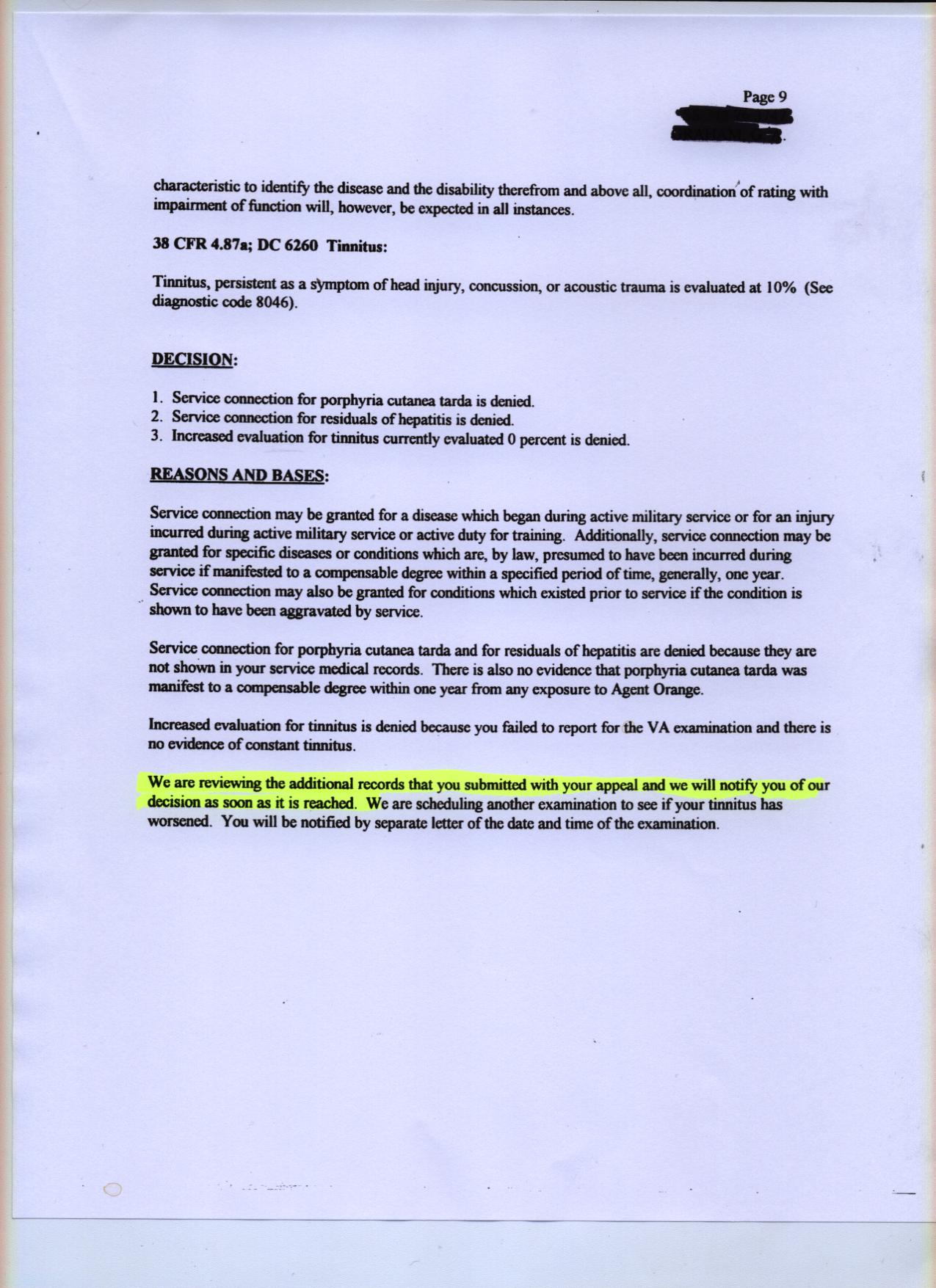
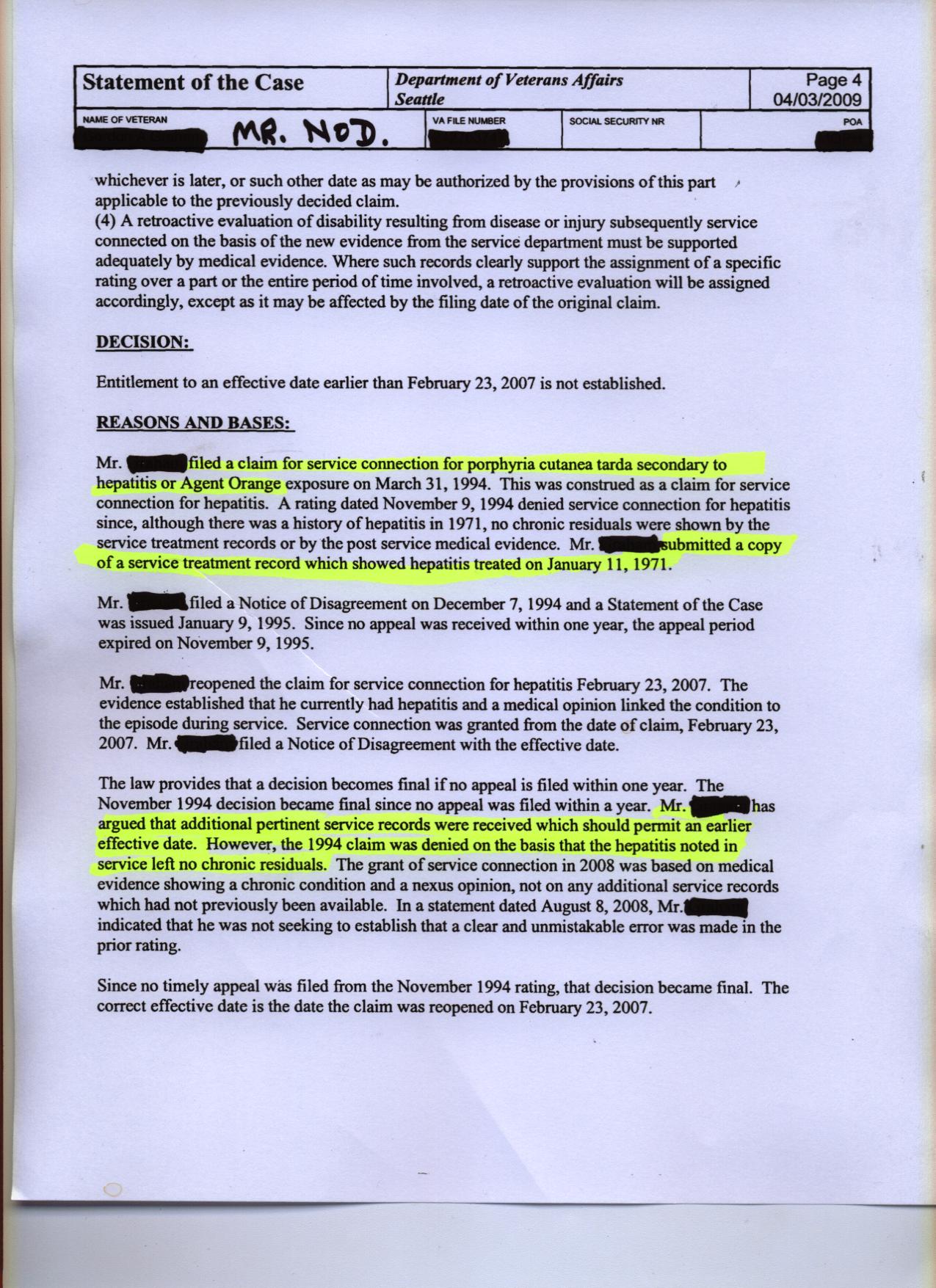
     In 1994 I filed for “PCT as a residual of Hepatitis or as a residual of Agent Orange exposure”. VA’s crackerjack sleuths interpreted this to mean I wanted to file for a) residuals of Hepatitis and b) PCT due to AO. This allowed them to a) declare I wasn’t currently suffering from Hep. and b) I was never in Vietnam and therefore I was never exposed to AO. Pretty tricky, huh? Get used to this practice. It happened to me in 94, it happened to Joe in 97 and you can be damn sure it will happen to you if it hasn’t already. It buys them time to come up with more creative ways to deny you as the claim progresses. One of their personal favorites used to say that you claimed Hep. C but you had Hep. B in service. Bingo. Wrong. Go back to Go. Do not collect $200.00 and please refile. If you are not allowed to make medical diagnoses about your illness when submitting lay testimony, how is it that they can hold you to this when you file? Welcome to the VA Hall Of Mirrors Funhouse.

     At any rate, Mr. Fenderson provided us with one more tool in the pursuit of our claims. It is a very important one and prevents the VA from depriving you of a rating % when it is legitimately due. The mere fact that Veterans have to negotiate this legal minefield to obtain that which is their due speaks volumes about the process and the people hired to administer the system. Never lie down and take it. Never rationalize it and say “Oh, there are so many other Vets that are more deserving.” VA is counting on you doing this. It’s factored in that a certain percentage of us will give up and go home. A very large percentage, I might add.

     Below is Mr. Fenderson’s rematch with Goliath.                                                                                                                                                                                                                                        Fenderson_96-947

Posted in Important CAVC/COVA Ruling | Tagged , , | Leave a comment

COVA–Bell v. Derwinski (1992)–Constructive Possession

With all the talk these days of the indiscriminate shredding of Veterans files at VAROs by lazy employees, we should look back 20 years to a seminal case  that was the precursor to any of this. 

     VA is adamant for the most part that its records, and by extension, its recordkeeping, are above reproach. If something turns up missing, it is the fault of the Veteran for not submitting it. This submittal is usually accomplished by the VSO representing him/her, so this maligns the VSO as well. This is why we so strongly advocate for Veterans to do all their filing with Certified Mail, Return Receipt Requested (CM3R).  The VA cannot call the USPS a liar and get away with it. The USPS may have a lot of faults, but recordkeeping is certainly not one of them. 

     Mrs. Velma Bell, the widowed spouse of a Veteran of the Second World War was seeking DIC (we presume this as the record is unclear) and ran up against a big problem. The evidence before the BVA Court Section was missing four very important documents, three of which were produced by the VA and one (a Form 21-4138 Statement in Support of Claim) by her. The BVA and the Secretary pretty much told her she was out of luck as the documents in question weren’t in the record. Velma cut this Gordian knot in half by promptly supplying copies she had of the missing documents. Catch 22 kicked in when the BVA said that the documents in question could not be submitted later if they were not before the Board at the beginning of the Appeal. Mrs. Bell was nonplussed to say the very least. How could it be that the keeper of the sacred records was missing the same records they created and then took the legal position that the decision had to stand as is because it was against the law to introduce them after the fact? 

     Velma might have been born at night, but she was not born the night before this legal wisdom was handed down to her. She promptly lawyered up and went to the Court for some answers. The Court, bless them, looked at this and immediately saw the dichotomy, circular logic and the Secretary’s defective reasoning. 

     The Court held that if you properly submit records, or more importantly, if the VA creates records of any judicial or medical nature related to you or your claim, they are responsible for maintaining them and assuring that they are properly filed in a central repository- namely your C-file. While this would be the ideal method, the Court went further and held that any documents or medical records held by VAMCs, while not explicitly in the C-file, were still in the VA’s “constructive possession”.  

     Case in point. I had a medical exam for Agent Orange after all the information started to surface in 1991 about this chemical. My exam was in September of 1993. I filed for hep. in March of 94 but these records, clearly showing a liver dysfunction, were never included in my C-file. My SO/future used car salesman from AMVETS assured me this would occur soon as “VA is like so totally suuuper-efficient, man.” We will not discuss VSOs today. That is still a sore point seventeen years later.   Add to that his sudden departure to become a used car salesman (due, undoubtedly to a mid-life crisis) and taking my F-9 with him.

     When I finally got my hands on my C-file in 2009, lots of things were amiss. One was that these records were still absent. These are important documents that VA has a responsibility to safeguard. Fortunately they were archived at the VAMC and I was able to get a copy of them there. They will be very instrumental in proving that my liver was misbehaving in 1994 when my claim for an earlier effective date is granted. 

     Most Vets are vaguely aware of some of their rights before the VA courts. Unfortunately VA has an ugly habit of shading the truth, failing to inform you of things that might help your claim and sometimes outright mistruths. I hesitate to use the word “lies” as I would sooner believe it’s due to inefficiency and low I.Q.  As for missing or misplaced records, Veterans would be strongly advised to maintain a set for themselves. VA has a “paper file” system, one of the last in existence from what we hear. If you were to ask them a question on some facet of your claim, it would require a month and a personal search by hand of a file in a filing cabinet. Add to that the chance that something can slip out and land on the floor when searching it or, God forbid, the “files technician” absentmindedly refiles something in John Jones file- right after your (Jack Jones) file. Oops! Color that gone with the wind. It will not see the light of day until or unless someone is reviewing Johnboy’s file. Up until Velma pitched a bitch, that evidence was “regrettably not part of the Veteran’s file”. 

     The VA Secretary and his employees do not like the Court. They feel their “judicial activism” is counterproductive to the job at hand- namely denying Vets. They would prefer that the Court mind its own business and speak when spoken too. This is why there are so many cases that result in a win for Veterans on appeal.  Not because the Court has a judicial hard-on for the Secretary, but that the Secretaries of the VA have a long, storied history of mimicking Chicken Little. They a)over-interpret the regulations to find something that doesn’t exist; b) insist they have done things this way since the dawn of time and: c) warn that any relaxing of the regulation will produce a flood of claims and thus endanger the financial stability of the VA. What this produces is absurd results that disenfranchise some and reward others. We as Veterans need one set of rules to abide by. Left unchecked, this system would be far worse than the Tax code.

     Meet Velma Bell. I bet you had no idea how important her contribution was to your claims process.

P.S. The Bell decision is in the CUE regs as well. If you file a claim for CUE of an action prior to November 26th, 1992 that depended on records VA had but did not incorporate into the file then you cannot claim this precedent. It is oddly the only COVA decision exempted by CUE.

Bell_91-1749

Posted in Important CAVC/COVA Ruling | Tagged , | Leave a comment

CAVC– Bradley v. Peake(2008)

This is a great Court of Appeals for Veterans Claims (CAVC) decision. It will show you, the VET, how the the CAVC operates and also demonstrate that they do not work for VASEC (Veterans Affairs Secretary Peake). They will not tolerate having their turf trampled and the VA rules and regs. trifled with. You will get real justice here. If you feel shortchanged, you can go up to the Federal Circuit Court and even to the Supreme Court, if you feel like it. Money (under the Equal Access to Justice Act or EAJA) will be appropriated for a law dog all the way to the Supreme Court if you prevail at each level.Oddly enough, if you win here at the Court and the Secretary doesn’t agree with it, he can take you up to the Fed. Circuit to contest it.   What is important is how the CAVC looks at these cases and how they rule on them. You will love this. They just changed the rules here on TDIU back to 1994 regs from the more restrictive ’99 change and reinterpreted the law on Special Monthly Compensation “S”(SMC-S) more liberally for the VET. An eagle-eyed member , one 71 Infantry, disagrees with my assessment above. He posts:
“Actually, the court did not change the law, the court clarified the law as it was written. This is a big difference, because if the law changed then CUE claims will be denied. Since the law was clarified CUE claims will have to be approved.  Were just going to have to wait and see if claims are approved based on Bradley v Peake.”

I will defer to his assessment, howeverI feel it was more of what I describe. The Court certainly “clarified” it. But they nevertheless did revert back to the more liberal 1994 interpretation. The Buie decision this year supersedes and improves on this anyway so it is yesterday’s news now.


  Well, as you can see, Mr. Bradley cut down a few trees to make some paper for this claim. This Veteran started his claims as soon as he left the Army which was wise. He had quite a few claims to file and he did a credible job. He failed to appeal the first one or two, but began to realize that VA was going to make life miserable. I would never think that if you were on the wrong end of a Bouncing Betty that you would have to fight to get SC for every scar and then go back and file for every muscle group, too. God forbid if you missed one! This guy must give the RentACops at the Airports conniption fits with all that microscopic shrapnel still floating around in there. He is a testimonial to Veterans everywhere of how persistence can pay off, though. Interestingly, VA really dropped the ball on several denial/decisions and denied him for things he never even filed for. The big banana that has changed is that VA now will have to go back for every Veteran who reads this and files and give them their SMC “S” rate. If you had trouble deciphering the Lawspeak, I’ll reduce it to Dick and Jane Format. If you get over 70% rated and you are a basket case, they will issue a TDIU which in essence is a 100% Permanent Total Rating. Now, if other parts of your body start falling apart and it hurts, you can file for more SC above that 100%. If you reach a point above 60% more(i.e. 160%) then you are entitled to that “S” rate, which is , in essence, about $325 more. VA always used to give you this if you had TDIU(not quite 100% but above 70%) plus 60% more. There was some confusion about doing this in 1994 so they rewrote the regs to agree with it. In 1999, they got stingy and took it away. They said you had to have an honest 100%(often referred to as 100% schedular rating) plus an honest 60% to get “S” rate. The VASEC decided to make this change arbitrarily without discussion and review. The CAVC has never had a chance to review the legality if this action so this was an opportunity to decide if it was legal to do. We talk about setting “precedent” on our HCVETS site and this is Precedent with a capital P. You guys from Arkansas can relax- its still called setting a president.What the CAVC does in every adjudication is to look at the laws as written and make sure they still are what CAVC says they are.This is called DE NOVO review. The Court in this case had a MAJOR disagreement with what the VASEC felt was correct interpretation. The Court has the last word in these matters so they get the honor of the B*TCHSLAP, which they administered harshly. They told Mr. Bradley he was also entitled to have some of his other stuff readjudicated as well, since the RO and the BVA failed to issue an SOC for one of his NODs. So if you think VA doesn’t give you a fair shake, read this through carefully and you will see they do. It makes me proud to be a Veteran and I hope the wealth of claims I’m currently shepparding through the system won’t require as many trees and time as my liverbox has almost reached the 10 year/100,000 mi. warranty limit. Remember, Veterans. Your claims die with you if they are not completed before you go to the Happy Hunting Grounds. File Early and Often the same way they vote inChicago.

http://www.uscourts.cavc.gov/documents/Bradley_v._FINALWITHNITS.v.3.12.03.08.pdf

Posted in Important CAVC/COVA Ruling | Tagged , | Leave a comment

Fed. Cir. (Via CAVC)–Maxson v. Gober (2000)-You Waited Too Long

 When prosecuting a Hepatitis C claim against the VA, one thing pops up over and over again. That is the allegation that you didn’t manifest this disease in the service. Well, setting aside the most obvious reason that HCV doesn’t manifest itself like the measles, it also doesn’t make its presense known for decades. A lucky Vet is the one whose civilian doctor happens to do a liver panel thus uncovering abnormal liver functions. Absent this, one doesn’t become aware until the shit hits the fan. By then the damage often is beyond repair and little can be done. 

     When litigating this up the ladder on appeal, you will often run into the Court’s and the Federal Circuit’s holding in Maxson v. West (1999- CAVC) and Maxson v. Gober (2000-F 3d.). This may seem insurmountable, but it really isn’t. The VA likes to wave the Maxson banner and squelch any more discussion on your claim. Let’s analyze what Maxson actually said. It isn’t quite as cut and dried as the VA would have you believe. 

     Raymond G. Maxson was in the Army from 1941-45. He was in the reserves prior to that, but it has no bearing on this. He had a partial colectomy that cured a bowel obstruction problem prior to service in ‘38 and in the days after Pearl Harbor, the rush was on to join the military.  Mr. Maxson had some difficulty digesting K rations on Guadalcanal in ‘42 and some other issues with malaria. The malaria never resolved and he was discharged in 45 due to that and another disorder. 

     Everything went swimmingly until 1989. Mr. Maxson decided to file for problems associated with the colectomy and had extensive medical evidence from his private doctor. VA didn’t bite. Neither did the Board in November of 1991. Raymond reopened his claim in 1994. The RO denied again on the grounds he hadn’t submitted any new evidence. He promptly submitted new letters from several doctors in an attempt to buttress his arguments. On appeal to the Board, he assembled even more testimonials from friends, neighbors, hitchhikers, the family dog and anyone who would confirm his contentions. All this was to no avail. The primary contention was that he was well (as far as the colectomy) from ’43 to 89 for medical purposes. The other reason was that this was preexisting to his service and did not technically undergo an increase in severity. Mr. Maxson disagreed and filed his NOA with the Court. He met with the same fate there and decided to appeal higher to the Federal Circuit.  His claim was denied there as well and that was the end of his story. However we are graced with his presence virtually every time we enter an appeal. The VA drags this case out and reverently recites its holding as being apropos to the argument for denying SC for HCV. 

     Herein lies the problem. HCV is not very cooperative in rearing its ugly head upon infection in its host. If it does, it often mimics the same symptoms as a light flu with nausea and muscle ache. A normal person probably would not be prone to seek a liver functions test (LFT) blood panel to ascertain whether this “flu” involved his liver. Having no reason to seek medical care for something that doesn’t incapacitate you, you proceed on your merry way, oblivious to the gradual damage accruing in your liver. When you do finally discover this decades later, you probably go to great lengths to obtain medical care to abate it. Just because there is no history of symptoms or treatment is not dispositive of an absence of the disease. HCV takes years to develop to lethal proportions. VA has a mindset that dictates one mode-denial unless proven otherwise. And guess what their favorite CAVC holding is to deny you? Yep. Maxson. As in ” While the VA commiserates with the Veteran over this insidious disease, there was no evidence of it in service and, indeed, none in the intervening 30+ years since his separation”.

     You can head them off at the pass by making sure your Doctor or ARNP carefully explains that this disease process is subtle and silent. There are no “Aha!” moments with this. It’s more often the “By the way, Mr. Nod. Were you aware you have a very strange kind of hepatitis called non-A, non-B?” I can virtually guarantee that you will see our Mr. Maxson mentioned somewhere in your denial at either the RO, but most assuredly at the BVA if you don’t take precautions to prevent this. One way is to just be blunt about it and say” Maxson does not control because…”.

      Mr. Maxon’s colectomy also was preexisting, which VA clearly ignores. This is a seminal legal point that makes the holding immaterial where a presumptive risk factor in service is cited as the culprit.

      I attach the Federal Circuit synopsis for the Veteran’s perusal as it subsumed the CAVC finding:

http://openjurist.org/230/f3d/1330/raymond-maxson-v-hershel-w-gober

If you or your NSO run up against this in you fight for SC, we would be happy to locate other cites to buttress you claim if we can.  VA thinks they’re hot on these denials. We are proving them wrong one Vet at a time. 

Posted in Fed. Cir. & Supreme Ct. | Tagged , , | Leave a comment

COVA–Colvin v. Derwinski Nobody Here But Us Doctors

We at Ask Nod are always searching for ways to overturn prior decisions, be it by collateral attacks (CUE) or by finding old service department records bearing on the claim. Towards that end we spent many months, indeed years, researching the early days of the Court of Veterans Appeals (COVA) now known as the CAVC. 

     When attacking a final, unappealed decision of the RO or BVA, the Vet has to search for some procedural error that was so egregious, indeed so glaring, as to sandbag everything that followed in its wake. Prior to the Russell decision in 1992 (en banc), the new standard for CUE before the Court was any procedural error that was prejudicial to the Veteran’s claim. Russell narrowed that down to say that the error had to have manifestly changed the outcome of the decision. It also removed benefit of the doubt from the equation. 

     This decision was before Russell and has its roots in another area-that of the BVA and the RO leaping to medical conclusions or making them without independent medical analysis. Prior to the inception of the Court in 1989, there were 20 sections of three judges each at the BVA. Each of these sections included a medical doctor as evidenced by the M.D. after his name. As medical experts on the Board section, they were required to inveigh and provide all decisions with needed clarification if necessary. They also sat as  judicial members and thus wore two hats. 

     When the VJRA was passed by Congress in 1988, all this changed. The VA, nevertheless, continued to do things as they always had. They retained the medical Board member and ignored the new paradigm. After several years of this misbehavior, the Court finally put its collective foot down in Murphy v. Derwinski (Nov. 8th, 1990): 


Although the Secretary appears to argue to the contrary in this appeal, Br. of Appellee at 11, the fact that a BVA panel may include a physician is not by itself sufficient for the purposes of the statute, the veteran or this Court. BVA decisions must include the “reasons or bases” for medical conclusions, even those opined by a BVA physician; a mere statement of an opinion, without more, does not provide an opportunity for the veteran to explore a basis for reconsideration or for this Court to review the  BVA decision “on the record” as required by 38 U.S.C. § 4052(b) (1988).  Murphy supra. 


This precept apparently didn’t sink into their thick, dense skulls. The Secretary blithely ignored this and proceeded on his merry way as if nothing untoward had occurred. The Court was not amused and waited patiently for another Veteran similarly situated to arrive. Almost four months to the day from the Murphy holding, the Court filed its decision in Hattlestad v. Derwinski (March 6th, 1991):


While the Board is not required to accept the medical authority supporting a claim, it must provide its reasons for rejecting such evidence and, more importantly, must provide a medical basis other than its own unsubstantiated conclusions to support its ultimate decision.  Hattlestad supra 


Just in case the Secretary had not absorbed the enormity of this precept in Murphy or Hattlestad, the Court followed it two days later with the Colvin decision. I don’t know exactly why, but some decisions are more memorable and cited in subsequent years at the expense of the cases they were predicated on. So, too, with Murphy and Hattlestad. In all jurisprudence for a decade after, Colvin was cited exclusively with only sidebars acknowledging the other two. An interesting fact that some legal scholars fail to note is the action the Court takes to enunciate their displeasure at being dissed. Murphy was vacated and remanded to be reaccomplished with assistance to the appellant and a better description in the Reasons and Bases section of why she should be denied. Hattlestad was remanded for reconsideration and disposition with 6 enumerated reasons why it was judicially insufficient. Colvin was an entirely different proposition. The Court reversed the BVA decision and remanded it to be accomplished the way the Court said it should have been done in the first place. What this means is the decision-making and fact-finding authority invested in the BVA was rudely suspended and the imprimatur of the Court was superimposed over theirs. This is the ultimate bitchslap only the Court can inflict. Reversal is rarely used, but when it occurs, it is not done gently. Mr. Derwinski and his minions finally sat up and took notice. While it was several more years before the VA relinquished the requirement of an M.D. on the Board section, the error continued to perpetuate itself because old, bad habits die hard. The most obvious reason was to let the M.D. judges either retire or seek employment elsewhere in a truly medical environment. Veterans think this error is an anomaly. We disagree because we see it as a well-defined denial ploy that has been utilized repeatedly by the VA for over half a century since their modern inception in 1946. This decision signaled the death knell for the practice and IMOs have finally supplanted the ugly habit.

     William H. Colvin is one of our generation.  He was seeking SC for Multiple Sclerosis. We can readily identify with his plight in a more modern setting. I don’t wish to demean the accomplishments of WW2 and Korean War Vets, but I identify with Mr. Colvin and Vietnam as I spent two years over there. I get ahead of myself here. A little history is in order. It personalizes the man I am about to describe. 

     Mr. Colvin was drafted and served two years in the Army from 3/66 to 2/68. While in Vietnam, he was wounded three separate times: shrapnel wounds to the head and right arm on February 26, 1967; shrapnel wounds to the right leg on March 26, 1967; and shrapnel wounds to the left forearm on May 10, 1967. For those of you who have no military background, that means he got three Purple Hearts. One military historian summed it up by saying a Purple Heart proves three things;

1) You were smart enough to come up with a plan

2) Stupid enough to try it and;

3) Lucky enough to survive it.

     On April 27, 1967, he was treated for a urinary problem that was diagnosed as a kidney stone. Medical evidence in the record indicates that urinary problems are a possible precursor of multiple sclerosis.  

     In 1982, Mr. Colvin was diagnosed with Multiple Sclerosis. The VA held that he had to come down with this within the presumptive period of 7 years or less after service absent a medical nexus. The BVA decision of 1986 denied his claim (in spite of his nexus) and that was all she wrote because there was no judicial review available to Vets then. 

     In March of 87, Mr. Colvin was seen at a VAMC for his knee issues and the neurologist stated the MS began in Vietnam. One would think that would be the end of it. Nevertheless the RO denied again and he didn’t appeal it up to the BVA this time. 

     Once again, in August of 88, Mr. Colvin reopened his claim. Being slightly more educated in the process, he arrived with a doctor’s nexus predicated on the doctor having read all his medical records. The doctor even went so far as to say that extreme stress could be a aggravating factor in inducing MS. I think we can safely say that shrapnel wounds from exploding ordnance on three different occasions would qualify as stress. Once again, the RO said “No dice”. The BVA decision announced in December of 1989 concurred with the RO and continued the pattern of denial. The BVA went further and implied that the reopening of the old claim, while introducing new evidence, failed to bring material evidence to the table. 

     I won’t bore you to death with the Board’s findings verbatim. Suffice it to say that they put on their Dr. Kildare outfits and played doctor. That’s a Bozo no-no in 50 states and the Court didn’t view it any differently. In fact, they were so incensed with the Secretary’s intransigence on this subject that they took it one step further and reversed in favor of Mr. Colvin:


The BVA decision does not cite medical evidence of record in this case or recognized medical treatises to support these medical conclusions. The BVA, in finding that the new evidence did not provide a new factual basis for a claim was, in effect, refuting the expert medical conclusions in the record with its own unsubstantiated medical conclusions. BVA panels may consider only independent medical evidence to support their findings. If the medical evidence of record is insufficient, or, in the opinion of the BVA, of doubtful weight or credibility, the BVA is always free to supplement the record by seeking an advisory opinion, ordering a medical examination or citing recognized medical treatises in its decisions that clearly support its ultimate conclusionsSee 38 U.S.C. § 4009 (1988);Murphy v. Derwinski, U.S. Vet. App. No. 90-107, slip op. at 4 (Nov. 8, 1990).This procedure ensures that all medical evidence contrary to the veteran’s claim will be made known to him and be a part of the record before this Court. 

     Lest we be misunderstood, we are not saying that the BVA was compelled to accept the opinions of Drs. Cohen and Kassirer. We merely state that having reached a contrary conclusion, it was necessary for the panel to state its reasons for doing so and, more importantly, point to a medical basis other than the panel’s own unsubstantiated opinion which supported the decision. Colvin supra 


     Mr. Colvin, via the Court, has left us this judicial gem. He could have given up and walked away. His decision to pursue justice before the COVA was a novel experiment in that they were newly incarnated. As I pointed out, this wasn’t the end of the Board playing Ben Casey, M.D.  They made this mistake numerous times afterwards, but were always on the losing end of the stick. It became commonplace for the Court to simply delegate it to a single judge and treat it like a speeding ticket. The Secretary gradually realized that avenue to deny Vets was a dead end and promptly instituted newer ways to accomplish his agenda. The Court continues to uncover these new ploys when presented with them and gradually eliminates them. The Secretary is very prolific in his denials of Veterans’ claims.  We liken his actions to the Hepatitis C virus that forever mutates to avoid eradication. As quickly as the Court identifies and invalidates a disingenuous “holding” of the VA regulations, they are hard at it constructing a new iteration of the same thing under different auspices. 

     When you lie down and go to sleep at night, say a prayer for the Court and their continued good health. They are all that stands between you and an overzealous VA intent on denying you that which invariably is your due. 

     Attached below is the Colvin PDF. At 5 pages, the brevity of the Court is displayed in its entire shining splendor.  Murphy accomplished it with six pages and Hattlestad 10. I guess you don’t have to keep shooting the horse after its dead to make your point.  The Court certainly didn’t think so.                                                                                                                    

Colvin_90-196                                                                                                                                                                

Posted in Important CAVC/COVA Ruling | Tagged , , | Leave a comment

CAVC–Theofrastou v. Shinseki- You Have the Right To Remain Stupid

 I am including this Court decision for Vets to review. Even though it’s a Single Judge disposition, it clearly illustrates what a panel would find as well.  The Veteran is representing himself before the Court, which I wouldn’t wish on my worst enemy. Even though they handle him with kid gloves and bend over backwards to do things for him they wouldn’t even consider for a represented Vet, the outcome is still the same.     Wayne C. Theofrastou, a former member of the U.S. Coast Guard, is appealing a denial of his motion for Clear and Unmistakable Error in a January 2007 Board decision. As the Moving party in the suit, he can appeal this to the Court.     So, let’s see what went so horribly wrong here. The Waynester lost this at the R.O. way back in 2005 He appealed to the Board and lost there in Jan. of 2007. He then let it slide with no appeal to the Court. He might have gotten traction there for a remand due to some obscure error. The raw facts are that he was chasing a jetgun claim with a fistful of internet articles and a tall order for VA to come up with the make and model of the jetgun(s) used on him in Basic training, the types and quantities of the shots he received in Basic, and the lot number of the Gamma Globulin he was administered for hepatitis protection. Yes, you read that right.     Had he appealed in 07, as I said, he might have fought to a draw and gotten something. He didn’t. So he filed for the CUE which was the only way he could revisit the unappealed BVA decision. Here is where he stubbed his toe. CUE is an utter bitch to prove even when VA has done something wrong. The rules say you have to use the law as it was written in 2007, the error had to be dispositive, and of such magnitude as to alter the ruling against the Vet. The actual facts cannot be reexamined and failure to assist the Vet does not constitute CUE. You can only argue the same facts at the Court on appeal. You are not allowed to keep thinking up new reasons for a do over. Waynemeister, being pro se, was blithely unaware of these constraints and threw in some new gripes when he arrived up at the Big House on Indiana Ave.  Seems he felt the benefit of the doubt was not considered by the Board (not allowed in CUE) and that the Board failed to consider documents and articles submitted in support of his claim (not mentioned in 09 BVA CUE appeal).     The Court, being a cultured, soft-spoken institution, was polite in pointing out these errors to the Waynedude.  They were very gracious and gave him the standard “Y’all come back now, heyuh?” just as soon as he refiled these new allegations of CUE and they were properly heard and denied before the Board-and no sooner.     When a Vet sets out to defend himself, he has many assets at his disposal. He has websites devoted to helping Vets he can visit. He can even obtain a lot of free advice from well wishers at these interactive sites, regardless of their qualifications. He has the right to defend himself and apparently, he also has the right to remain stupid. This he does with abandon. He has just received a rude awakening and a large dose of jurisprudence for his efforts. In the meantime, we fellow claimants find ourselves in the waiting room.     Vets have a marvelous judicial system that accords them many rights. It’s slower than the seven year itch, but it has myriad protections. There is nothing preventing Mr. Theofrastou from tying up the R.O. and the Board for years pursuing the impossible.  VA will dutifully go through the motions and try to accommodate his requests. However, the requests should have to be reasonable. No one would expect the military to keep the info he demands, so his taking umbrage with failure to assist is misguided. Because he represents himself, there is no legal entity to guide him or dissuade him from this frivolous filing and the ensuing cost of time and judicial assets squandered on it. It’s selfish and myopic. One judge each from the two Courts, a minimum of 12 associate counsels at the Board and probably as many from the Court have labored on and off for several years so that Mr. Theofrastou could have his day in Court. You’re welcome, Wayne.  Deserving disabled Vets everywhere salute you and your misguided pursuit of justice. Now be a peach and go home.     The sad fact is he can start over on this same CUE project and bring up the two other items he forgot to include in the 09 CUE filing. This will consume even more assets and again hold up BVA appeals for other, more deserving Vets.  It’s the hand we are dealt, but you will excuse me if the desire to throttle Wayne seems uppermost in my mind. Anger management training would come in handy right now.

      Let us now travel to Wayne’s World.  

Go here: http://search.uscourts.cavc.gov/ . Erase [Query} and type in

 09-4156 and hit search

Click on the blue word “download ” in the upper left corner in between “view” and “details” to view normally.

Posted in CAvC HCV Ruling, Complaints Department, Important CAVC/COVA Ruling, Jetgun BvA Decisions | Tagged , , , , , | 1 Comment