BVA– Bronze Star= HCV

Here’s a perfect stir of a combat soldier, 38 USC 1154(b) and vA’s grant of HCV service connection. The confluence of all three is the key to his success. Why this had to go to the BVA , the CAVC and then back rather than being granted at the RO is anyone’s guess. Well, actually it isn’t anyone’s guess. It’s how vA operates and they got caught-as usual.

38 USC 1154(b) is called the combat clause. It’s sister, 1154(a) contains a lot of the same language, but the (b)  clause accords a Veteran a pass on his testimony. America has decided that if one of its sons engaged in combat with the enemy, he is to be believed in all he says about the circumstances surrounding it (unless they can find a way to compromise his credibility). To wit:

38 USC § 1154

(a) The Secretary shall include in the regulations pertaining to service-connection of disabilities

(1) additional provisions in effect requiring that in each case where a veteran is seeking service-connection for any disability due consideration shall be given to the places, types, and circumstances of such veteran’s service as shown by such veteran’s service record, the official history of each organization in which such veteran served, such veteran’s medical records, and all pertinent medical and lay evidence, and

(2) the provisions required by section 5 of the Veterans’ Dioxin and Radiation Exposure Compensation Standards Act (Public Law 98–542; 98 Stat. 2727).

(b) In the case of any veteran who engaged in combat with the enemy in active service with a military, naval, or air organization of the United States during a period of war, campaign, or expedition, the Secretary shall accept as sufficient proof of service-connection of any disease or injury alleged to have been incurred in or aggravated by such service satisfactory lay or other evidence of service incurrence or aggravation of such injury or disease, if consistent with the circumstances, conditions, or hardships of such service, notwithstanding the fact that there is no official record of such incurrence or aggravation in such service, and, to that end, shall resolve every reasonable doubt in favor of the veteran. Service-connection of such injury or disease may be rebutted by clear and convincing evidence to the contrary. The reasons for granting or denying service-connection in each case shall be recorded in full.

§1154(a) is still very valuable as a tool for winning. If you were claiming tinnitus due to being in artillery at Firebase Oscar, it helps if the Service records show you were a 13B. Similarly if you were wounded “over the fence” and there were no records, it helps if you medical records are stamped “Qualified by training for REMOTE/ISOLATED” Tour of Duty”. If the military has done it’s job keeping up the personnel records, you’ll have evidence of a general nature here that will corroborate your claim. Most concentrate their efforts on the medical side and neglect the military records.

As you can see, in no uncertain terms, America accords a special place for heroes in the regulations and §1154(b) is where it is incorporated. vA calls this the “combat exemption” as if it were a hall pass or a get out of jail free card. It is no such thing. It is a combat “clause or enhancement”-a statement that anyone foolish enough to get in the way of harm should be trusted to tell the truth without having to depend entirely on records of the event. I think this clause rankles VA examiners because it’s such a large hole in the M-21 scheme of things. This may be why you never see these granted at the RO level. They are invariably here on appeal  and rarely rubber-stamped with the §1154 imprimatur sooner. It certainly can’t be so difficult for VA examiners to grasp the concept of combat-unless they make no effort to investigate. Which is why you see these ping ponged back to the RO for a do over after a search of the records of where he was/MOS and how many/what type of medals.

Looking at the introduction on this one, you can see the tortured path this Vet has taken. I caution Vets against doing the DRO Hearing/Review process. There is a good reason, too. When a VARO denies you, it says they have done their due diligence and you were found lacking. Absent a really good chunk of evidence, nicely researched and meticulously assembled with glossy 8½ by 11 color photos and a good looking wife, you’re on the Shortline railroad to zerosville.  Fort Fumble is done. Through. Pack the bags and head to D.C. Hanging around another year or 15 months at the back door of HARTRO isn’t going to pay off. I don’t care if it’s hemorrhoids or hangnails.

A DRO review is like limbo and then… more limbo- in D.C. I can count the Vets I know, or have read of,  that persevered and won a DRO. They are very few-less than 15. Most were for ratings increases or dependency.

Further, you can see that Mr. Hartford  has been up to the CAVC with this, too. This is the second do over at the BVA for him. Interestingly enough, he wins. Gee, what a coincidence. We see that the whole gist of the decision here rests completely on §1154(b). That is pretty telling of one thing. It wasn’t discussed and the Vet wasn’t accorded this enhancement which is the coin flip.

The Connecticut Yankee in King Eric’s Court has been wearing his armour now since 2002. He’s got a new liver because the old one crapped out. He has a colored piece of cloth that says he’s incredibly brave under fire but it took him 10 long years to “prove” this to the vA’s satisfaction. Just because Congress wrote up this gloriously worded assurance. don’t expect our esteemed veterans Administration to honor it without a lot of hoops and hurtles. For entertainment, look at the Gomer down in California who ran for the water district board  in Podunkburg. He said he was “there” and had more medals than he could count. Everyone believed  ol’ Xavier right out of the gate.  Even with your records, the vA doesn’t!

Some of you will read this and conclude it’s a fluke. An accident. A mere misunderstanding that unfortunately festered for a decade for lack of proof that the Vet was a “combat” Vet. This is no anomaly. This is business as usual. This is classic proof of why the backlog is out the door, around the block and across the nation. The vA has spent more hours handling this, mistakenly denying it causing numerous appeals and finally granting it. Two good months of solid development in 2002 would have turned up the exact same evidence and provided the Vet justice then at a quarter of the cost. Now compound that by 1.3 million Vets and you are talking some serious work and money ahead.

If the quality of  due diligence at the VAROs has truly metastasized into the promised super raters, we should see a marked sea change. If they plod along at the pace of the  above calibre, we should expect no different.

Allow me to introduce one of America’s finest- Johnnie Vet from Hartford, Connecticut-  “real” Vet with the medals to prove it.

P.S. You can see in the remand that he’s still got a fight ahead of him on the other claims. He’ll probably have to prove all over again that he was at Hamburger Hill or even in country. We sure wouldn’t want any fakers trying to get welfare at vA, huh?

Posted in BvA HCV decisions, Inspirational Veterans, PTSD, Uncategorized, Veterans Law, Vietnam Disease Issues | Tagged , , , , , , , , , , , , , | 2 Comments

Nine Ways to An Earlier Effective Date


 The NVLSP, through the Purple Heart, has listed at least 9 ways to win an earlier effective date, here:


http://www.purpleheart.org/ServiceProgram/Training2011/W-2%20Common%20VA%20Effective%20Date%20ErrorsL.pdf


For those who would like a summary, I have provided my interpretation but would always suggest you thoroughly study the case laws suggested.

Without further ado, here are my nine favorite ways to win more retro:

.

  1. Pending Claim.  Evidence received prior to end of appeal period.

    Citation: Meeks vs West:

    “The general rule for an original claim for benefits is that theeffective date is the date the VA receives the claim or the date that entitlement “arose”, whichever is later.””Determining the date entitlement arose may be difficult.””Most advocates are familiar with one situation which may result inan earlier effective date of benefits: A claim filed years ago wasnever adjudicated by VA and remains pending; the advocate sees thatthe claim is still pending and asks VA to adjudicate the claim.”Citation: Meeks v West (Fed Cir. 1999)

  2. 38 CFR 3.156 C New Service Records, which states:

    1) Notwithstanding any other section in this part, at any time after VA issues a decision on a claim, if VA receives or associates with the claims file relevant official service department records that existed and had not been associated with the claims file when VA first decided the claim, VA will reconsider the claim, notwithstanding paragraph (a) of this section. Such records include, but are not limited to:


    (i) Service records that are related to a claimed in-service event, injury, or disease, regardless of whether such records mention the veteran by name, as long as the other requirements of paragraph (c) of this section are met;


    (ii) Additional service records forwarded by the Department of Defense or the service department to VA any time after VA’s original request for service records; and


    (iii) Declassified records that could not have been obtained because the records were classified when VA decided the claim.


    The “kicker” is that once the claim is reopened due to new service records, the Veteran is able to resubmit any new evidence.

    3 Failure of the VA to inform Veteran of time limits.  The NVLSP’s take on this is that the time limits the Veteran has (1 year to file a NOD, 60 days to file the I9) do not even start until the Veteran gets notice informing him of the applicable time limits.

    4. Informal/Inferred Claims can lead to an EED.  There are 3 elements the courts have required to qualify as an “informal claim”.   The informal claim must:

    a) “Show Intent” to seek one or more benefits.  There is a difference between “seeking benefits” and “seeking treatment” and your VA doc is likely going to assume the later unless you tell him other wise.

    b)  Be in writing.  Telling your doc something does no good unless he writes it down and puts it in your record.  Verbal “informal claims” dont cut it.

    c) The Veteran must “specify the benefit sought”.    However, remember, the Veteran is not competent to make a medical diagnosis, but he is competent to say, “My head hurts”.


    For the other 5 methods of winning an earlier effective date, keep reading Asknod.  

Posted in General Messages, Guest authors, Nexus Information, Tips and Tricks, Uncategorized, Veterans Law | Tagged , , , , , | 12 Comments

ILP Computer and Peripherals

Apparently VA gets good deals on certain computers. This go around they are pushing Dells. Here’s the email from the VA’s IT guy:

Okay

Here is the computer and the extras.  I can send them in as soon as I hear back:

Computer:  Dell Inspiron 620 Intel Core i5 2320, 6 GB RAM, 1tb Hard Drive, 1GB AMD Radeon HD 6450 Graphics Card, 24 inch Monitor, Windows 7 Home Premium, Speakers, Keyboard and Mouse Combo, CD/DVD Burner, 19-1 Media Card Reader, Office Home and Business (Word, Excel, PowerPoint, Outlook, OneNote), 3 Year at Home Warranty, 3 Year McAfee Antivirus Protection, Dell V525 Wireless All in One Printer with Cable (print, copy, scan), 8 Outlet Surge Protector, 8 GB Flash Drive.

Requested additions:

Dragon Naturally Speaking Premium 11.5

Andrea Electronics ANC750U USB headset microphone

Adobe Acrobat  Professional

Microsoft LifeCam Cinema 720p HD Webcam for Business

Vertical Wireless mouse

Adobe Photoshop Elements 10

                                   M.Div., ATACP

Senior Certified Disability Analyst

Assistive Technology and Disability

I think vA is being fair here. It’s all free. I sure can’t complain on that score. We shall see if they quibble over the mouse and the web cam. That might be a reach but  you never know if you don’t ask. I’m still dumbstruck that  they granted it considering their track record on ILP. One small step for Vetkind.

Posted in Independent Living Program, VR&E | Tagged , , , , | 5 Comments

BVA–Energizer Bunny–Still Going

From the cigarette

RO in N.C.

This decision caught my eye for a number of reasons. When I saw  the two different Diagnostic Codes employed and the cutoff date of July 2001, I knew this Vet had been at it for quite some time. This BVA decision came down in May 2011 but involves much more. The actual win occurred in 2006 and the effective date was his filing on January 26th, 2001. Way to go, vA. It only took eleven short years to put paid to this one. That assumes Mr. W-S doesn’t appeal it up to the Court. So, what happened?

Winston (no relation to Churchill) filed in 01 and fought the good fight. In just a few short years as vA measures them, he won in September 2006. Because his decision straddled two different interpretations of vA’s diagnostic codes, he was given a bifurcated decision. Everything after July 1, 2001 fell into the brand new category of HCV under DC 7354. Everything prior to that was under the old code for hepatitis (DC7345). The  codes are similar but not precisely the same. Hence the wording for 10% under 7345 differs from 10% for 7354. VA is very anal about these things. As an aside, the law says the Vet is entitled to the best interpretation of the rating under whichever code is more beneficial to him.

Additionally, our Vet is contesting this as a Fenderson staged rating. He actually thought he had a 20% rating which the VLJ is careful to discredit. He has an extensive medical record on this which threw me for a minute until I spotted the fact that he is a quadruple amputee. He probably gets regular medical attention for that alone.

What I see is a contrived situation that carefully uses what W.-S. didn’t say more than what he did say. vA has a propensity to do two things. When you see one of their personal care physicians (PCPs), they often throw their hands up if you broach the subject of HCV. The feeling is that this is handled by your assigned Hepatologist or Gastroenterologist. They have no interest in discussing it. So, for the medical record touted here in the appeal to have any pertinence, it would have to be in the context of it being before said specialist. If it were before a PCP, Winston wouldn’t be discussing  right upper quadrant pain, malaise, nausea, emesis, anorexia, weight loss and other various symptoms. He might be discussing the flu or abrasions from his motorized wheelchair.

I will give you all some valuable information I have observed over the last four years on this. If you do not mention something specifically to a doctor, they don’t write it down. They’re lazy. That’s why I always type up a problems list and hand it to them when I go in. This serves a dual purpose. They have to deal with it and it makes sure you get it all into the record. I’ve discovered later that I forgot to mention something and by then (two weeks) it’s too late to add it in. As you can see here, the VLJ gloms onto one thing- the fact that our erstwhile Vet did not mention these ailments. This is the age old vA ploy that no evidence of something is dispositive of it ever having happened.

Consider these:

There were no current complaints of abdominal pain or distention.

A March 2005 VA treatment note reflects that the Veteran was doing well with no episodes of abdominal pain, nausea, or vomiting, and no weight loss. Similarly, he reported no complaints in a June 2005 treatment report.

In April 2006, the Veteran denied abdominal pain, nausea, vomiting, diarrhea, and constipation.

A June 2006 VA treatment note reflects that the Veteran has been undergoing liver transplant evaluation. He denied abdominal pain, nausea, vomiting, diarrhea, and constipation.

A June 2007 VA treatment note reflects that the Veteran was doing well with no significant fatigue, abdominal pain, or increase in abdominal girth.

A November 2007 VA treatment note reflects no specific symptoms, the Veteran denying abdominal pain, nausea, vomiting, diarrhea, constipation, and weight loss.

A January 2009 VA treatment note reflects complaints of intermittent abdominal discomfort. There was no distention, jaundice, nausea, or vomiting

A July 2009 VA treatment note reflects that the Veteran was without problems of liver-related complaints. Specifically, he denied fatigue, nausea, vomiting, and abdominal pain.

Okay. You get the picture. The man is a glowing picture of health and suffers none of the debilitating symptoms associated with this illness. To say he denied them is disingenuous. If someone doesn’t mention symptoms, that cannot be construed as denying them. vA often uses this method to construct a scenario whereby you are good to go. What might be more à propos would be to couch it in terms such as “When queried as to symptoms such as malaise and nausea, the Veteran denied them”.

vA also has a regulation that says if you suffer some of the symptoms some of the time and they more closely approximate the higher rating, it is permissible to grant that rating percentage.

 38 CFR § 4.7

Higher of two evaluations.

Where there is a question as to which of two evaluations shall be applied, the higher evaluation will be assigned if the disability picture more nearly approximates the criteria required for that rating. Otherwise, the lower rating will be assigned.

With that in mind, go back and consider these:

March 2004…The Veteran reported more diarrhea with this course of treatment, as well as GERD (gastroesophageal reflux disease), nausea, and sinus congestion.

 November 2004… Veteran testified that he had GI problems every two weeks and that he was tired all the time.

A September 2005 VA examination report reflects a history of active hepatitis C that had turned into cirrhosis, and which appeared to be fairly stable. The Veteran reported some nausea and occasional vomiting. 

A June 2006 VA social worker transplant assessment reflects that the hepatitis C treatment affected the Veteran’s activity level.

A December 2006 VA treatment note reflects complaints of nausea related to some foods

A May 2007 endoscopy consult noted burning in the esophagus area, with a provisional diagnosis of gastroesophageal reflux disease (GERD)

Well, GERD isn’t HCV so we have to toss that one out. But wait. Anything of or having to do with the intestinal tract is implicated where HCV is concerned. If it is not specifically ruled out, it is part and parcel of the HCV process.

A March 2008 VA treatment note reflects that the Veteran was doing well considering his overall health, but he was experiencing intermittent abdominal pain and occasional spells of dysphagia

A June 2008 VA treatment note reflects that the Veteran was doing well and that the abdominal pain had improved somewhat with medication.

This one is important because the VLJ implies he isn’t using any medications to control his symptoms.

An October 2008 VA emergency department note reflects that the Veteran remained positive for hepatitis C.

What, pray tell, was he doing in the Emergency room? There is no answer to that.

A January 2009 VA treatment note reflects complaints of intermittent abdominal discomfort.

A May 2009 VA short stay unit note reflects complaints of nausea and vomiting but the note indicates that they were due to an ultrasound guided liver biopsy.

I’ve had two biopsies and never puked. This is pure hogwash and speculative conjecture. If you do not address these things you can see how they are used against you. Just as an offhand remark about drugs can spiral into an accusation of polysubstance abuse, so too can an uncontested statement about the cause of a malady.

If you try to have a meaningful medical relationship with vA as your primary care provider, you must realize that they view you as a potential lawsuit/claim looking for a place to happen. Much like the proverbial “slip and fall” Safeway claimant looking for a cash infusion, vA marginalizes anything you complain of. Failure to complain is listed under a default setting  as in “claimant denies.”  With this in mind, when you visit, you must either be specific in your description of your ailments or provide a list they cannot blow off. When you give them the list they can hardly say you denied it.

I’m sure when Winston read this he was appalled to find out just how healthy he wasn’t. The record shows he’s preparing for a transplant. This is not done for those of us who are healthy, active, vibrant and full of the zest for life. I do know some of us men are guilty of braggadocio and would hate to evince any weaknesses. I used to be guilty of that until I read some of the above in my records. I have become proactive in this respect now. I retrieve my records from ROI as soon as possible and examine them closely for those “patient denies”.

Let this be an instructional how to in how not to do it. Winston didn’t show up for all these appointments because he was hitting on all eight cylinders. The mere fact that they’re preparing to R&R his liver is proof positive that he’s not going to participate in the Special Olympics for differently-abled paraplegics. Swimming three times a week does not imply you’re the picture of health. It most likely is prescribed therapy for his paraplegia.

Winston’s 11 year Odyssey.

Posted in BvA HCV decisions, Tips and Tricks | Tagged , , , , , , , , , , , , | 2 Comments

COVA–ARCHBOLD v WEST–WHEN A F-9= A NOD

Imagine getting screwed by VA in 1953, filing for increase in 1990, and during the course of the claim for increase, discovering you should have had the rating all along.

Poor Mr. Emerson E. Archbold. What tangled webs the vA weaves. In 1989, the Emster filed for an increase of his service connected burn injuries from the Korean Boundary Disagreement. He asked for an increase from 10% bilaterally to 20% and a compensable percentage for his facial burn scars which vA had decided in 1953 were 0%.  Sound familiar? Being pro se, he had  neglected to bring in any evidence. I’m guessing that he somehow came into possession of the ratings % requirements from someone who was wise to it or he finally read the military rating where it described how he was going to get 40%. vA told him in the denial that he didn’t have anything.

Now here is where everything goes haywire. Embo filed the NOD correctly to appeal the denial of the hands increase and a compensable for his face. They gave him the wave off without so much as a Dog and Pony show in January of 1991. Baaaaad idea, vA! Come March, Emerson sent them the original 1953 decision saying he was entitled to the 40%. On National Tax Day in 1991, vA wrote him back and said “You screwed up in 1953 because you had one year back then to pitch a bitch. You didn’t so it’s a done deal. And, to add insult to injury, your present claims sucks too and it’s denied as well..” There oddly was no mention of the CUE cure.

June 6th, 1991 seemed like a good day to start the repair order and Mr. Archbold proceeded to try to enlighten these poor heathen yet again. I don’t have a copy of the record on appeal, but my guess is he removed all the polysyllabic words and got it down to grunt conversation like ” Ugh. Archbold have burn owwie. Both hands. vA say 40% long time ago. Me no get. Want 40% now. Both owwies. Face owwie money too. vA give 40% to 53 too.” Well, actually he said like this:

The main point I would like to make is noted on page 3 of [the] proceedings of the [MPEB]. [Block] #28 [of the form used by MPBE noted:] “Such unfitness is 40% disabling, in accordance with the standard schedule of . . . rating disabilities in current use by the VA.” [Block] #29[:] Such unfitness is permanent. [Block] #32[:] Recommendations and remarks “Plastic surgery can be accomplished. . . .[” Block] #28[:] States very clearly that 40% disability was based on ratings in use by [ ] VA. [Block] #29[:] States clearly that this is permanent. [Block] #32[:] [A]llows for the fact that plastic surgery can be accomplished at a later date.

My point is #1, 40% is the lowest rating [that my disability] should have ever gone, based on VA rating[ ] practices. #2[.] This is rated permanent. #3[.] This allowed for surgery at a later date.

In summary[,] I feel that the 40% rating based on VA standards established October 9, 1952[,] should be honored, and that the amount paid since September 1, 1953[,] to present should be corrected, that is a 20% correction for four hundred thirty nine months.

Some idiot at the RO made the mistake of penciling in a note that this was being accepted as a Form 1-9 (the precursor to what we call a Form 9). Nevertheless, a month later they wrote him back (July 10th) and said “You don’t get it, bozo. The Army screwed you in 52 and we just write up what they do. If you want more money you have to prove you’re worse off.” Still no offer of a C&P or relief via a CUE filing. vA was keeping this one in the Mummy file-all wrapped up.

Emerson called his congressman. vA repeated the scenario and reiterated that he had accomplished his 1-9 and was headed to D.C. for an independent review. Well, around the vA, that’s called a non sequitur. The word independent cannot occupy the space immediately before any judicial action. That would be misfeasance.

Emerson must have been a Boy Scout. Reading up on vA rules, he decided to send in an official 1-9 to cover his ass on August 5th. This time, in no uncertain terms, he stated the CUE and asked for interest on the back pay of 400 months! Ho-hah. On August 8th his brand new AMLEG rep. said the same thing to be safe. Continuing in the Boy Scout mode, on the 5th of November he wrote a letter to the VLJs hearing his appeal that he was arguing CUE for 40 to 1953. The hearing was scheduled for the 15th of that month and old Emerson must have figured these guys were as dense as my goat. I suppose in normal circles. if you keep repeating something long enough, most get it. That applies everywhere except the vA triangle where meanings disappear.

I won’t impugn the Board panel. They actually got it in January 1992. They did the proper thing and remanded it back to the RO for a de novo decision on the CUE claim. If things weren’t haywire enough yet , they were getting ready to become exponentially worse down at the local Puzzle Palace. The remand instructions were clear to everyone but the RO. This was no more complicated than boiling water but they managed to burn it.

Eight months later they denied it all again. This time they specifically included the CUE assertion but considered it a new claim that needed it’s own Form 9 to go back up to the BVA. Keep in mind the BVA owned this. They remanded it back for a decision, but it didn’t require a whole new F-9 and recertification back up the ladder. The correct procedure would have been to simply deny and send him the SSOC. No other action was necessary, but they fumigated his ass and told him he needed to do the F-9 dance. They sent another letter a month later to him to make sure he got it. What they neglected to do was tell his Veterans service officer from AMLEG ( who was now from DAV).  This is haywire on a rather grand scale.

For lack of a F-9,  the BVA was not given anything to look at re the CUE appeal so they didn’t rule on it. How could they? The RO never sent it up. Thus July 1993 passed and Emerson Archbold must have really been concerned. By now he had writer’s cramp from telling these guys how to do their job. All he had to show for it was a non-decision, an appeal, a remand, a denial and another non-decision. He must have been overjoyed at the prospect of going up to Indiana Ave. NW and having saner minds prevail.

March 1994 and spring  on the Potomac. I love D. C. I was born there. Dogwoods and cheery trees are in bloom except for the ones George chopped down in his youth. Emerson once again ploddingly laid out his theory of what was amiss. I’m sure he owned his own chart display easel and a nice laser pointer by now. After listening to all this, the Court had to write it down for themselves to follow the maze…

The fundamental procedural deficiencies that are controlling here, as discussed below, are the failure of VA to inform the veteran of his appellate rights in connection with the July 1991 RO decision which initially denied his CUE claim, to issue an SOC after he filed his July 1991 NOD on the CUE claim, and to return the CUE claim automatically to the Board pursuant to 38 C.F.R. § 19.38 for its review, after the RO’s September 1992 decision on remand from the Board. Because the disposition of this case turns on these deficiencies, the Court need not address the following two issues also raised by the facts in this case: (1) Whether the veteran’s representative, the DAV, was required to be furnished a copy of the October 21, 1992, and November 3, 1992, SSOCs, based on the veteran’s power of attorney (dated October 20, 1992 — one day prior to the mailing of the October 21, 1992, SSOC — but containing an acknowledgment date by VA of January 28, 1993) in favor of that service organization; and (2) which party bears the burden of submitting evidence that such power of attorney was received by the RO, pursuant to 38 C.F.R. § 20.602 (1995), before the issuance of the SSOCs.

Okay, got that so far? The procedural deficiencies, without even touching on the legality of these shenanigans were enough to send this back to square one. The Court,  being a humorous bunch much inclined to pulling good jokes on April Fool’s Day (see Heino v. Shinseki),  had to sit VASEC West down and explain it to him. By now he was hopelessly lost and had no clue where this thing stood…

In this case, the veteran filed an NOD in September 1990 as to a July 1990 RO denial of an increased rating for burn scars of his hands and face. R. at 251. This NOD, contrary to the assertion of the Secretary, did not initiate an appeal as to a CUE claim because no such claim had yet been made. (Archbold v. West 1996)

The law says there can only be one (1) NOD filed with respect to any claim. Concurrently, there can only be one F-9 filed that represents itself as such. This whole concept is called a claim stream. Some of our cohorts (former vA employees, no less) on other veterans help sites are unfamiliar with this legal term. Remember it. A claim stream has components that must occur in a formal order. Emerson had done this haphazardly, but it was recognizable if vA had made an attempt to understand it. They never do. His claim stream for the CUE had begun at the BVA who remanded it properly back to the RO. However, it was a different facet of the same claim stream for the increased rating on his hands. vA insisted- nay- persevered grossly in misidentifying it-as an attempt to open a brand new claim in the middle of the old claim stream. Thus they demanded a new Form 9 and refused to certify it back up to the BVA for readjudication.

I know you are having a hard time wrapping your noggin around this. It happens on a slightly less convoluted scale all the time to our claims. vA purposefully “misconstrues” what it is we’re up to and comes to the only possible conclusion that is wrong. Why is that?

Here Mr. Archbold was, finally at the Court and the VASEC was trying anew to obfuscate and cloud the waters with this inane attempt to convince a bunch of intelligent judges that downside was up. The Court wasn’t having it:

The Court holds that the veteran specifically raised the CUE claim (that the RO in 1953 was bound by the Army’s 40% “permanent” rating) in his June 1991 letter; that in July 1991 the RO specifically responded to that letter, evaluated the claim, and disallowed it; and that the July 1991 statement of the veteran on the Form 1-9 constitutes an NOD as to the RO’s July 1991 decision disallowing the CUE claim and is sufficient to give this Court jurisdiction over that claim…

The veteran’s July 1991 statement meets the requirements of § 20.201 and was filed well within one year after the RO’s mailing of notice of its July 1991 decision pursuant to section 7105(b)(1). This statement was received in August 1991 by the RO, “the activity which entered the determination with which disagreement is expressed” … (claim stream)

Although this statement was not expressly construed as an NOD by the Secretary, the Secretary’s construction does not bind this Court. Whether a document is an NOD is a question of law for the Court to determine de novo…

At the November 1991 hearing before the Board, the veteran submitted, and the Board accepted, a written document which sought to clarify his claims…

The Court notes that the Board was obligated under 38 C.F.R. § 20.203 (1995) to notify the veteran if it was concerned about the adequacy of this 1-9 Appeal, and to allow him a period of 60 days within which “to present written argument or to request a hearing to present oral argument on this [procedural] question”. The Board did not do so…

The veteran was not required to respond to the October 1992 SSOC in order to have his CUE claim returned to the Board for completion of its appellate review of that claim because he had filed a Substantive Appeal as to that claim prior to the Board remand.

Archbold supra

Does it amaze you that anything gets done correctly without the Court looking over VASEC’s shoulder? This is about as convoluted as it gets and it only took six years back then. Now, I’d be inclined to believe it might go ten with the backlog. I suspect my claim is going to end up here too. It has many similarities. That’s why I’m well-versed on this decision.

Keep a piece of scrap paper beside you to draw a picture of this or get out the trusty  CFC-360 w/ onboard GPS. This thing has more legs than a centipede.

Meet Mr. Archbold…         Archbold_93-903

Posted in CUE, Important CAVC/COVA Ruling, Uncategorized, Veterans Law | Tagged , , , , , , | Leave a comment

COVA– EF v. DERWINSKI–HOW ABOUT A C&P?

Few cases are heard where a Veteran wants to retain his or her anonymity. I have  seen only two before the CAVC/COVA that were precedental. Here, I can understand the desire for not publicizing the name. Our Vet had genital warts and wished to remain nameless. I guess that implies that there is social opprobrium associated with the disease but no more so than how most of us are treated upon divulging our HCV infections. Watch the shiver that goes through someone up at the lab drawing your blood when you tell them to be careful not to poke themselves.

Enough of this macabre humor and back to Mr. EF. Having filed several claims and getting his C&P for them, he then filed two additional ones (the genital warts and “anxiety disorder”) . vA granted on the former claims for  low back strain, hypertension, deviated nasal septum, varicocele (left), and condyloma acuminata. By way of explanation, varicocele is http://en.wikipedia.org/wiki/Varicocele . The  condyloma acuminata was the genital present from some earlier sexual congress. The RO did not, however, grant on the anxiety disorder. Mr. F filed a NOD on that and amended his claim to schizo-affective disorder, depressed including a swell nexus letter from his private shrink. The RO continued the denial and in good form, the BVA seconded the motion. Using that stunning insight and cutting edge logic for which they are renowned, they stated

1. Atypical depression is initially confirmed on statement from the veteran’s private physician dated May 17, 1989. This is a date too remote from the veteran’s period of active duty to warrant service connection on any basis.

Promptly contradicting themselves, they said

2. Chronic schizo-affective disorder is not shown by the evidence of record.

Remember the divide and conquer technique I’ve described before? Here they strip the depression off the filing and address it first then blithely eviscerate the schizo biz as being absent from the EOR.  This would be permissible if Mr. F had been seen by a qualified psychiatrist in a C&P setting. He wasn’t.

Back in these early days of the Court, the Judges were busy 24/7 creating jurisprudence for the ages. They were new at this and needed to set precedent.  If you’re from Chicago, that’s called setting a president. Industrious doesn’t even begin to describe what these old boys were up to. Mr. F’s decision was June 6th, 1991. They had decided Murphy seven months before (Nov.8th, 1990), Littke  six months prior (Dec. 6th 1990) and lastly Myers and Green on Jan.18th, 1991 (less than six months) . All these cases had similar circumstances and dealt with the selfsame proposition that it would far more fair to the Vet if he were accorded a Dog and Pony Show for the record before being shown the door. With that much brand new precedent staring him in the face, somehow the VASEC managed to overlook it. Such is pell mell justice. The Court has a subtle sense of humor:

In Myers v. Derwinski, U.S. Vet. App. No. 90-221, slip op. at 4 (Jan. 18, 1991), this Court stated that “it is the claimant’s statements on the VA Form 1-9 which often frame[] the nature of the appeal to the BVA. . . . Therefore upon receipt of a VA Form 1-9, the BVA must review all issues which are reasonably raised from a liberal reading of the appellant’s substantive appeal.” However, there is nothing magical about the statements actually on the 1-9 form, given the VA’s nonadversarial process. The VA’s statutory “duty to assist” must extend this liberal reading to include issues raised in all documents or oral testimony submitted prior to the BVA decision. EF v. Derwinski (1991)

Nothing magical indeed. In fact, there is nothing magical about the ex parte form of vA justice at all unless you are in their employ.  Then justice becomes horribly and inextricably intertwined with concepts like shall and must. The result at the RO and the BVA is one of “Well, I don’t see where it says we have to do that in the M-21. Just because those Gomers up at 625 Indiana Ave. NW came up with some fancy precedent doesn’t mean we all have to bow down. Screw it.”

This warfare between the new Court and the old BVA went on for years and years and still causes strife for Veterans caught in between today. One need look no further than the cavalier attitude that the VASEC evinces day in and day out at the Court. The phrases have evolved over time but the thrust certainly hasn’t. Why it is that vA can approach the bench with the same tired phrases like “The Secretary read this to mean…” and ” It was felt that the claimant was trying to ask for… but failed to specify that it was …” and “Nobody told us or if they did, we misplaced/forgot/never got around to it.”

Something most Vets know is that 38 USC, the precepts upon which 38 CFR rest, are written by Congress.  What they are appalled to learn later when they are deep in adjudication is that the VASEC writes 38CFR and can rewrite it at any time he wants. What’s more, VA has been caught issuing VAOPGCPREC’s- General Counsel precedental opinions- during litigation to support a particularly egregious denial. As an analogy, I like the one I heard once. Imagine getting pulled over for speeding. When you point out to the officer that you were doing 55 in a 55, he says “Take it up with the judge.” You arrive in court two weeks later and the judge says “Yeah, but we changed the speed limit there to 45  yesterday so you’re still guilty”.

I suspect the VASEC hums “It’s Joe Veteran’s Supermarket but the CFR department is Mine” fairly regularly judging by the number of GCPRECs that are overturned or found deficient. Of course, issuing them after the decision to defend said decision is a bozo no-no in all 50 states now. VASECs must feel they are a legend in their own mind and not bound by the rules mortal men are required to adhere to.

Mr. EF’s vacation back to the BVA… Ef_91-533

For your reading pleasure here are Murphy, Littke, Green and Myers

Murphy–Murphy_90-107

Littke–Littke_89-68

Green–Green_89-108

Myers–Myers_90-221

Posted in Important CAVC/COVA Ruling, Veterans Law | Tagged , , , , , , , | Leave a comment

82% CURE IN NON-IFN ORAL HCV TRIALS

This just in from Rocky Mountain High member Randy. This is the best news I have read in decades about the HCV “cure“. Finally, a way to put paid to this bug in spades. I don’t get my hopes up very high about any new regimen but this sounds promising. They are a little coy about relinquishing the info on which genotypes are affected, but I’m sure that will come out in time. I, for one, would gladly trade in my P&T for a reprieve of my death sentence. The fact that it is not an interferon -based cure is the best news of all. Thank you for this contribution Randy. VA will probably incorporate it into the mix of treatment before 2020.

As if that one isn’t reason to pop a cold IPA, this one is even better in its discussion of genotypes. It may be that we are going to see the end of this website if this comes to fruition. What intrigues me is the 91% probaility of kicking my 3a in the ass.

In the Bristol-Gilead study, all 44 of the patients who had the most common and difficult to treat Genotype 1 version of the disease had undetectable levels of the virus in their blood four weeks after completing treatment, while 40 of 44 patients with Genotypes 2 or 3 had undetectable levels of virus at four weeks following treatment for a 91 percent response rate.

This is absolutely too cool for school.

Posted in General Messages, HCV Health, Medical News | Tagged , , , , , , , , , | 5 Comments

Independent Living Program Results

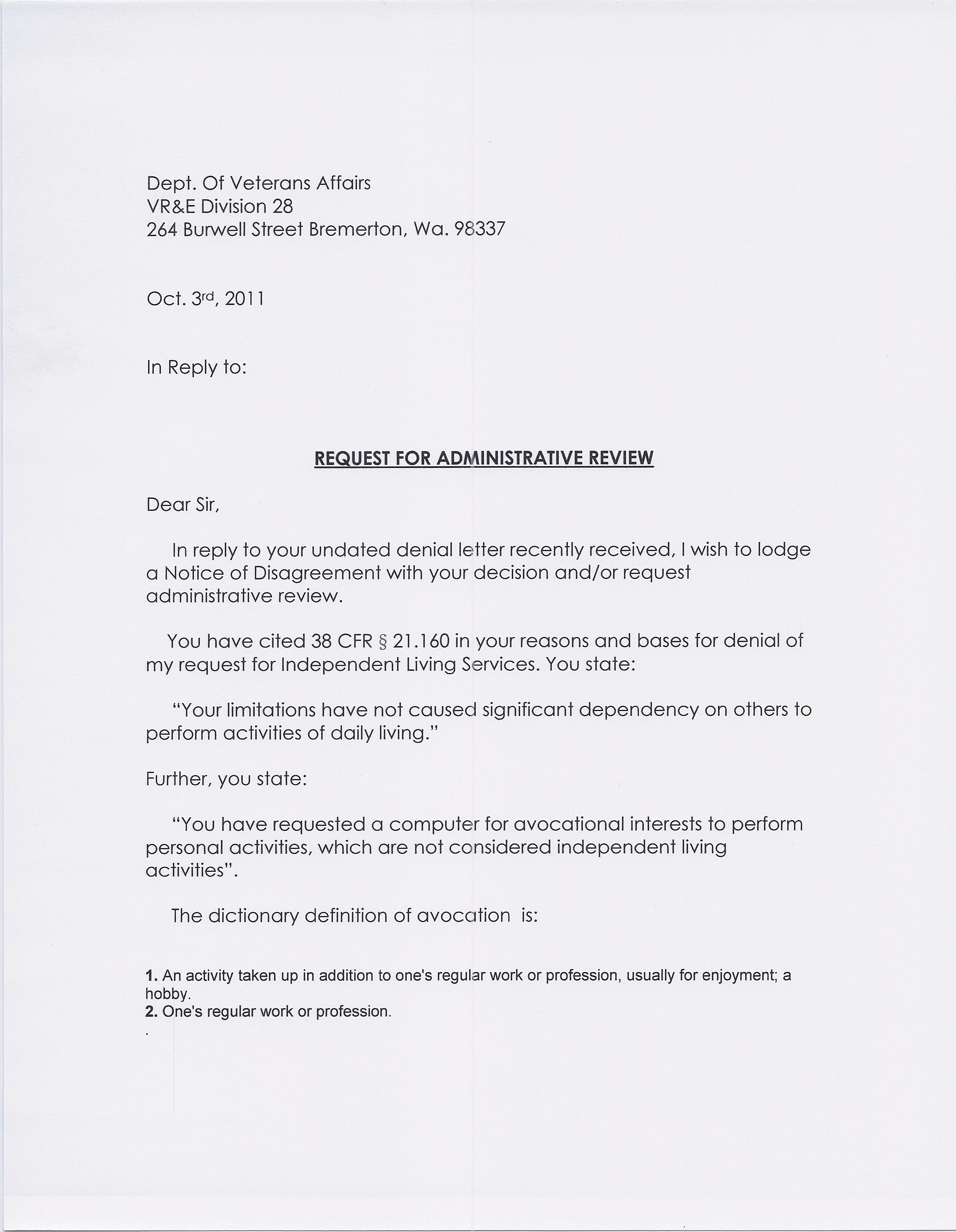
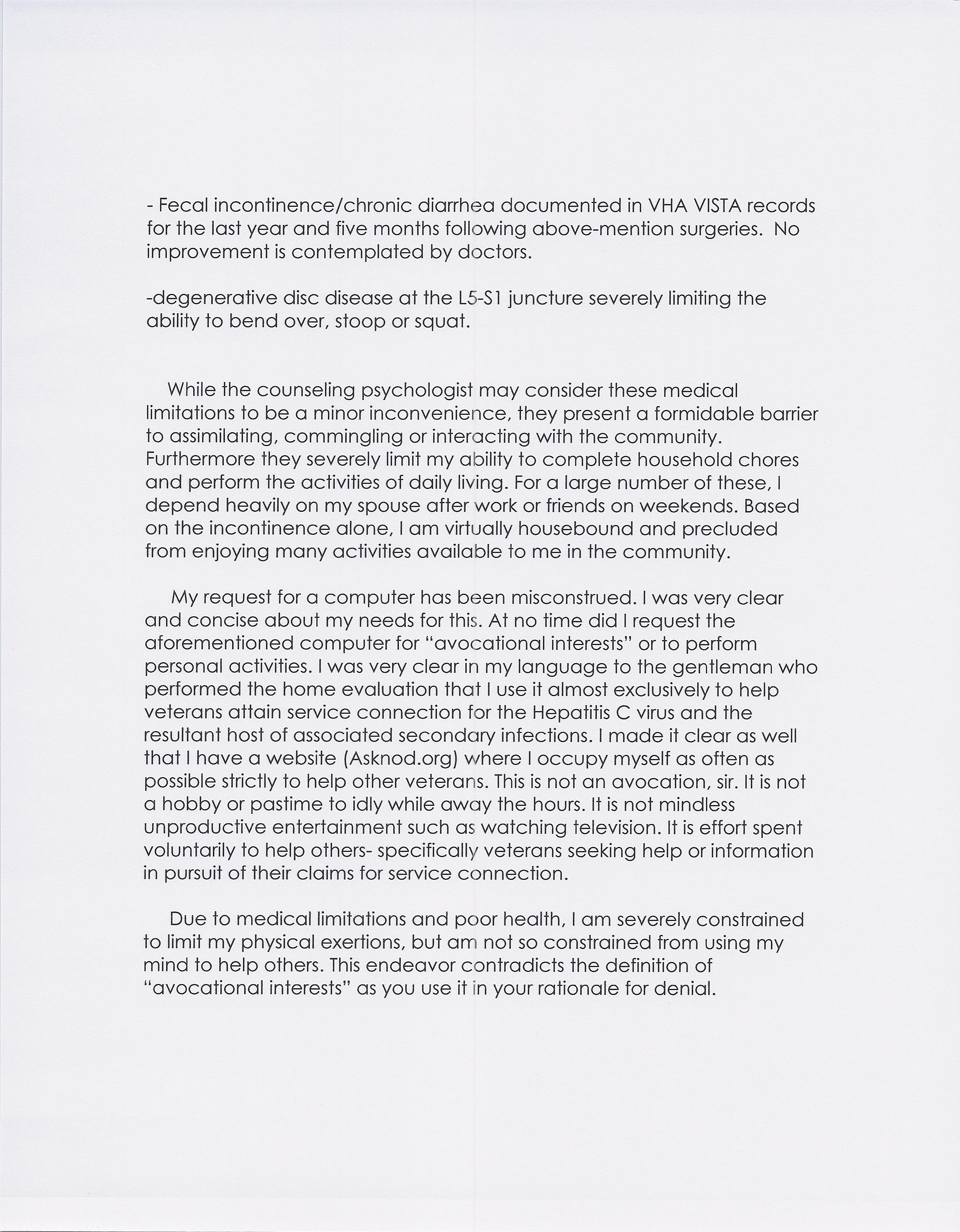
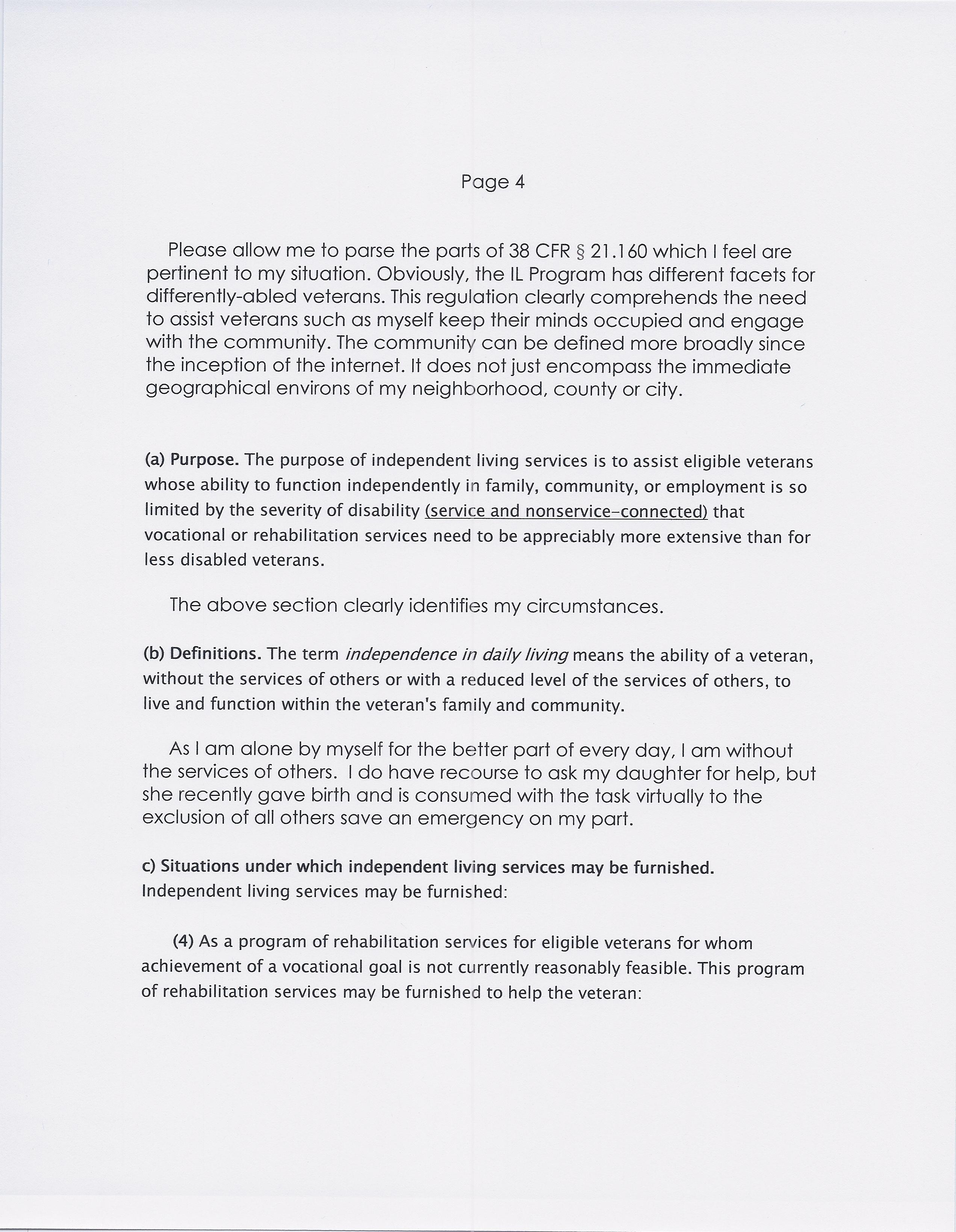
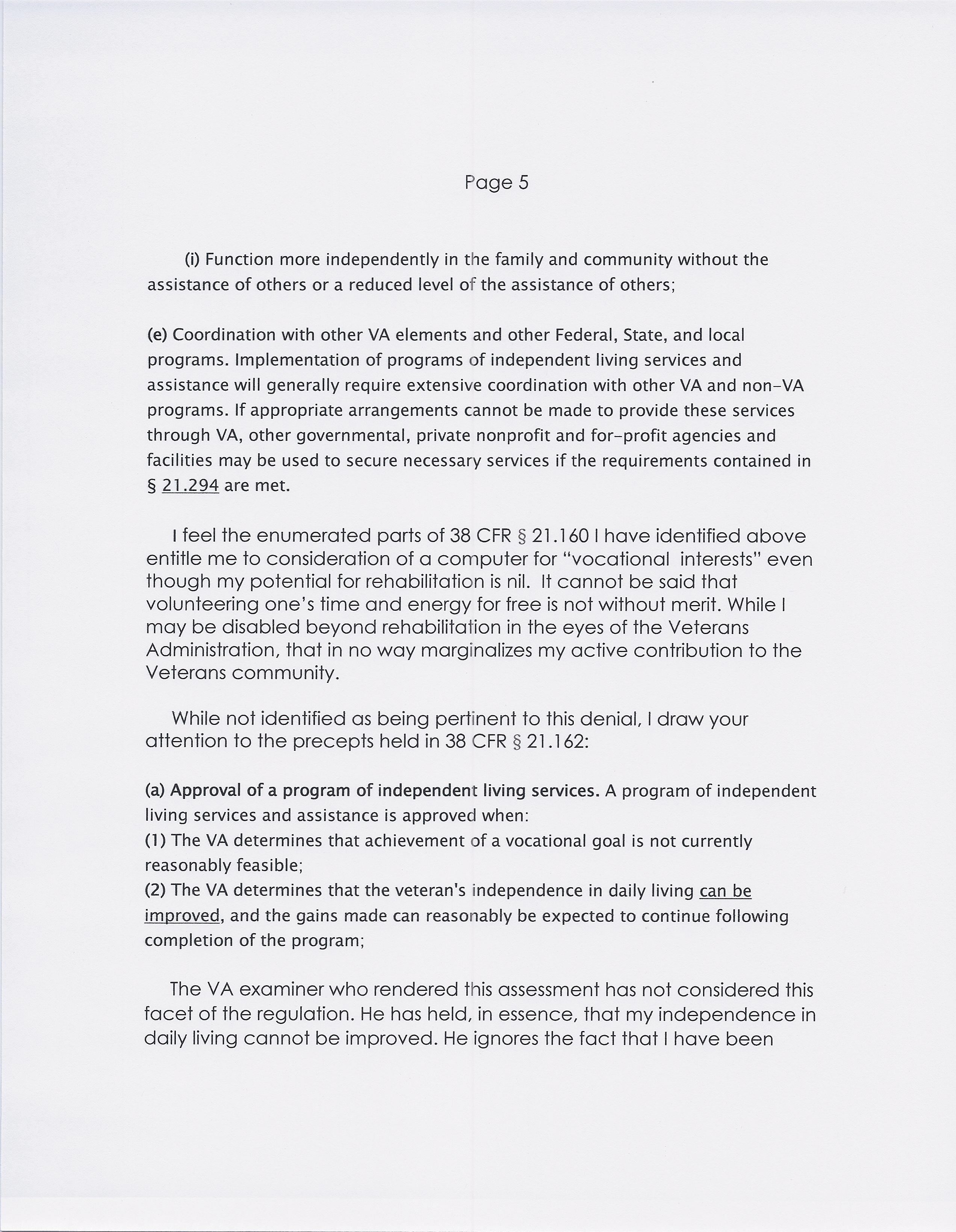
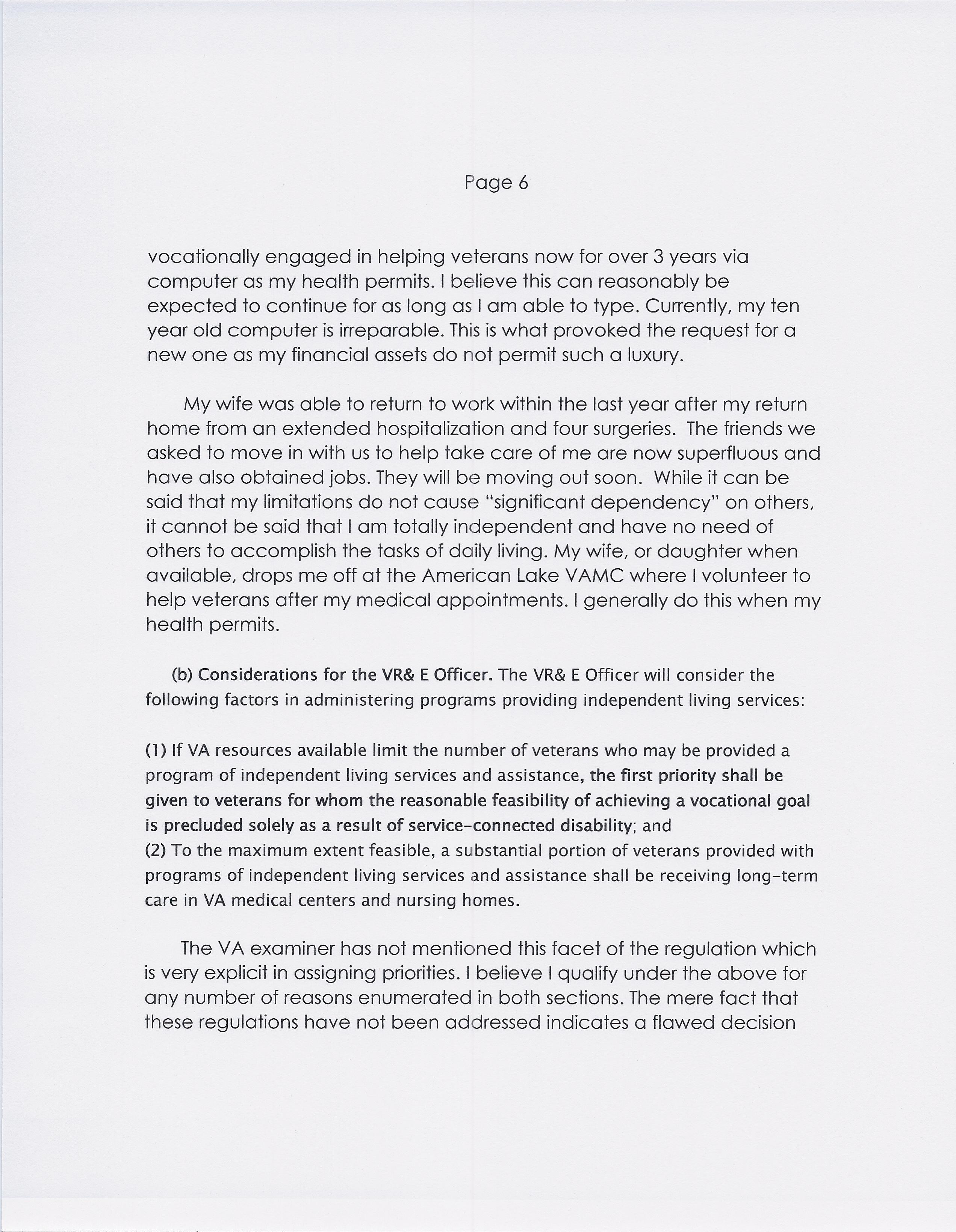
As you may know, the VA granted my ILP request for a computer and the peripherals. As rarely as this may happen, and from what I can gather, it’s becoming increasingly so. Oddly, the VA did not put any strictures on the amount of funds or machinery I can purchase. This may have been an oversight on their part.

I read up on this during the course of the claim and saw many cases from a decade or more ago when it was more lenient. Almost all demanded specific parameters to the request and concrete ideas on what was needed. For instance, if you wanted a John Deere Tractor, so be it. If you didn’t ask for the snow plow and rototiller at the same time,  you were out of luck. In other words, if the request was granted, you got what you asked for and no more. As we know now in 2012, if you ask for a Deere, you get grab bars, ADA approved toilet tissue dispensers and a tub/shower make over by Bathroom Crashers. You don’t need a snow plow. If you run out of food in winter and starve, dial 911. The medics will find a way to get in. They have plenty of snow plows so there’s no need to buy more.

This is why I was a little nonplussed when I put this request in. Being a computer novitiate, and when asked what I wanted, I was at a loss for words. I made no specific choices and even asked if I should provide specifics and the approximate costs. VA told me nothing and never answered my queries. They apparently had made a decision to deny and didn’t need any more information.  As the king of the NODs, I took my case worker by surprise by being polite and asking him to hurry up with the denial so I could begin my appeals process.

The ILP as a benefits grab bag is falling into disuse. I’m sure if vA could find a way to rescind Congress’ statute on this, they would. In the interim, they are doing what they always do which is to pay lip service to the theory and deny or ameliorate the requests. Hence grab bars in lieu of a photography studio with all the bells and whistles. Another bait and switch was a cordless phone in lieu of ham radio gear. How’s that for “independence in every-day living”? It gives more resonance to the jingle “Reach out and touch someone”.

In sum, fifteen months from request to fruition. Result: a complete computer with all in one printer/scanner/ fax. Software includes all the usuals including Dragon Naturally Speaking 11.5, Adobe Acrobat and Photoshop. web camera, vertical mouse and a headset for the Dragon.

I was never actually required to divulge the name of this site and the ILP IT technician who came out to ascertain my needs never wrote it up in the supporting paperwork or final report. I inadvertently included it in my NOD, though. It may be that I’ll continue in splendid isolation and be able to harass and harangue as before with no worries of vA’s gestapo trying to find something in my past to disqualify me. The government rarely needs provocation to silence its citizens.  If they wanted to make my life miserable, they know where to find me.

I hope this emboldens each and every one of you with extensive disabilities to file for ILP. The program is falling into disuse because they keep moving the goalposts. Their recent history of denials is not news to Vets. I have had many a query about this and the consensus is “Why bother?”  Vets need to file and then pursue the denial until they relent as they did with me. A new wave of these claims will eventually draw attention to them and the underlying program. Face it. vA hates to spend good money on things that might help you while away the sunset hours of your life. This money is desperately needed for bonuses for deserving VA examiners who toil tirelessly trying to approve vA claims. They are the real workhorse here and deserve the lion’s share. Given a proper financial incentive, they might even start doing it correctly!

One thing that concerns me is the plethora of Afghan/Iraqi Vets with PTSD returning to the community. Many are inclined to keep to themselves as virtual recluses. Large numbers will not survive this self-imposed isolation if the Vets from Vietnam are any indicator. More severe mental disorders, suicide and homelessness will be the fallout. vA needs to become VA soon and head off this impending storm. How they handle this will show either their resolve to become a valuable resource or just the desire to be another alphabet organization consumed with increasing their already bloated budget. The ILP is a valuable tool for Vets of this stripe. The independence it can engender is untapped because vA is so dead set on burying it.

As with any entitlement,  the operable term is use it or lose it.  Employ the Chicago style of ILP-file early and often. If you cannot impress them with your needs, baffle them with your bullshit. They never cease to remind us that we are full of it.

Accordingly, attached below is a sample guideline of what to use when denied. It worked for me. Remember, they live by regulations. They are at somewhat of a loss for words when you actually read them back what they wrote.

How’s this for a finale. vA still hasn’t  mailed me a letter confirming my grant. It’s all verbal to date. This just doesn’t sound like the vA we’ve all come to know and love.

Posted in General Messages, Independent Living Program, vA news, VR&E | Tagged , , , , , , , | 7 Comments

VA–A NEW CULTURE OF TRANSPARENCY

I always get a bang out of vA press releases. In this instance, it sounds so noble and altruistic. Always the the jerk who looks at the underbelly of the beast, I examine it from the pre-transparency era. In other words, if the President has directed that VA and other federal agencies write up policies that dictate all the below, does that mean they are going to model it on his campaign promises for a more transparent administration where everything is exposed to the light of day?  I only say this because in spite of what we were promised, it seems a lot of it is rather opaque. An example in my mind was the new Health Care Act that no one was allowed to read until after it was passed.

In the same vein, does this admission imply that the vA was anything but forthcoming and transparent in the past?

vA Publishes Draft on Scientific Integrity for Public Comment

At the direction of the President, VA and other federal agencies have drafted policies to foster a culture of transparency, integrity, and ethical behavior and to protect researchers from inappropriate influence in the development and application of scientific and technological findings.
Read the draft policy and comment.

We look forward to a transparent ex parte process. Ideally, the vA will keep us abreast of our claims as they do them rather that summarily open the bomb bay doors and drop it on us after the fact several years after filing. Few Vets know that our judicial process is supposed to be interactive. The Court has lamented often that the veterans Administration is remarkably recalcitrant about engaging the Vet, choosing  instead to marginalize him, holding him and his representative at arm’s length until the adjudication is over and done with.

As an example, a VLJ and his/her staff are encouraged to contact Vets and clarify what they meant by certain testimony. Similarly, they or the RO should come back and ask you if you have your SMRs when they don’t. No one wants to read about it 20 months later. A case in point is mine. I informed the vA at my DRO hearing on July 11, 1990 that there were far more medical records than what they were basing their denial decision on. I informed the hearing officer , one D.L. Peterson, that they were located at a civilian hospital in Thailand and gave him everything but the street address. When they continued the denial in my SSOC, I voiced my displeasure again. In desperation, I wrote the hospital and obtained  part of the records and submitted them. The BvA decided they weren’t going to be bothered either, and denied without obtaining them.

In this day and age, that would be legal (Caffrey v. Brown 1994). The duty to assist is only violated if you complain before the fat lady sings. I did, but by not going up to the Court, I allowed an incomplete record to stand as an incorrect record. What they did to me was CUE in 1992, but subsequently made legal in 1994 via Caffrey.

What I found most risible was this:

 and to protect researchers from inappropriate influence in the development and application of scientific and technological findings.

Huh? Would that be the same researchers who refuse to investigate whether bugs can be transmitted via jetguns? Yes, I hear you say “Well, gee Nod dude, they don’t use these guns anymore so the research would be wasted effort.” Tell that to the 1,600 Vets whose claims came up before the BVA in 2011. They are still getting the bum’s rush with the “speculative and plausible” argument. Transparency seems to be in the eye of the beholder.  Research is as research does would sum it up in Forrest Gump’s vernacular.

The appearance of propriety will continue as before until the political nature of the vA is subsumed by a meaningful process. As a Veteran and accomplished armchair quarterback, it is my opinion that an independent vASEC be appointed who has no political bent. He should not be hand picked by the party in power, but run for it as an elective office. Veterans might at least have more say in the choosing of the Head Bozo In Charge that way. To make it even more above board, I’d insist that only Veterans be allowed to vote in this elective process. What a concept. I realize this is heresy and antithetical to the concept of a true democracy, but what we have now is a far cry from what President Lincoln envisaged when he inaugurated the vA.

We haven’t come a long way yet, baby.

Hopefully, if and when my grandson chooses to follow this avocation, he will find the aftermath easier to navigate and more “Veteran friendly”.

Posted in All about Veterans, General Messages, vA news | Tagged , , , , , | Leave a comment

VARO DETROIT–THE MARCH TOWARDS 2 MILLION CLAIMS

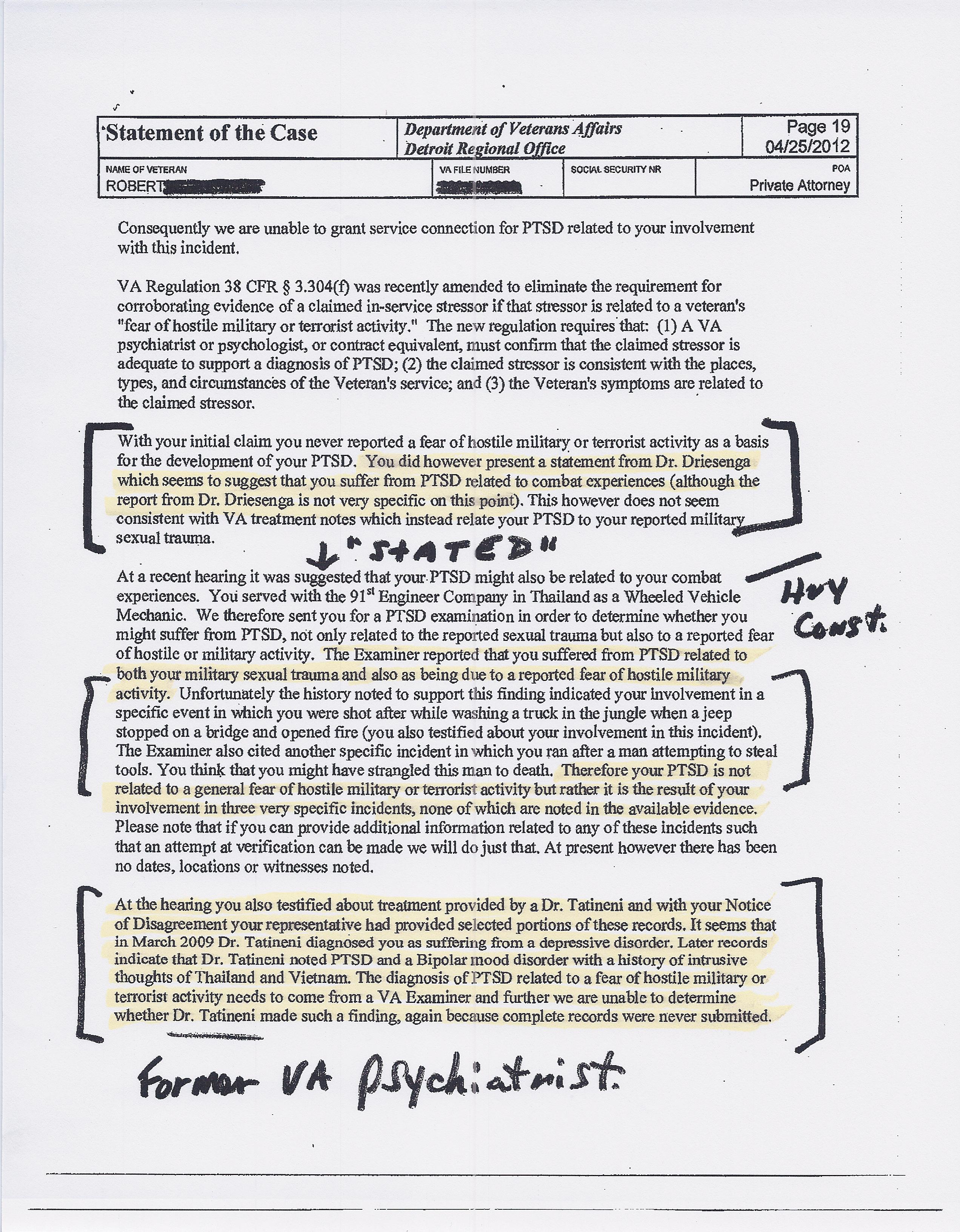
Member Bob sent us this from the city that manufactures  Binford Tools and motor vehicles. It is a classic example of what I call divide and conquer. The Veteran has been asked to be honest. This he does. VA immediately drags out the credibility Powerpoint Presentation and dissects his answers in such a way as to make it sound like he’s making it up as he goes along. This allows them to deny it for several years and then force him to head to D.C. By denigrating the perfectly good nexus information from not one, but two doctors, they are violating the whole process of VA jurisprudence (Colvin v. Derwinski 1991). Here a VA examiner-a  ratings “specialist” if you will- has donned the Ben Casey stethoscope and opined that the two doctors are wrong. What makes this delicious is that one of the two is a VA psychiatrist. Mix in a little mish mash about too many stressors  and not identifying them with proper documentation or timeliness, and you have what appears on its face to be Vincent Vet malingering and looking for a VA handout. Voila! Claim denied. Remember divide and conquer.

Remember the old movie sets with the crew called “continuity”? Everything had to remain in its place or be returned to where it was at the start of shooting a scene to prevent cars from jumping or silverware from disappearing. Likewise, your claim has to have continuity. Don’t allow it to be unstructured. Everything must occur the same way each time in the retelling. “My mental state is due to this: A)_____________; B)__________; and C)__________. It happened 2/3/1968. I was in Qui Nhon and they were shooting at me. I swear that the above is true and correct to the best of my knowledge and belief. Signed Vincent Vet. SSN 123-45-6789. ”

Like my pilot used to say: “If we’re shot down, give them your name, rank, airspeed and tail number. And pass the Scotch and be quick about it.”

If you’re blind like me, click on these jpegs and then click on them a second time to get good magnification.

This is why we are condemned to wait forever for a decision. These VA Examiners were imported from IOWA- Idiots Out Walking Around.

P.S. In deference to Gail from Iowa (the 29th State), I apologize for the slight. I tried to divorce it from yours by capitalizing all the letters. It appears I failed. No offense intended. Just my warped sense of humor. I’m sure Iowa is a beautiful state with many intelligent souls. I hear they grow corn there.

Posted in Nexus Information, PTSD, Tips and Tricks, vARO Decisions, Veterans Law, Vietnam Disease Issues | Tagged , , , , , , , , , , , | 2 Comments