Does anyone sense any urgency in about the VA’s response to the information given in study I posted about previously? They post one graphic showing an overall 20 year infection rate of 10.3 which is shocking enough. They offer one horrendous statistic:
Our mission and programs are carried out under the leadership of
Victoria J. Davey, Ph.D., M.P.H., R.N., Chief Officer.The Veterans Health Administration’s Office of Public Health-Population Health group, reports that baby boomer Veterans had a Hepatitis C infection rate more than five times higher than other Veterans.
Veterans born in 1954 had the highest infection rate at 18.4 percent.

But then they divert attention to the CDC’s recommendation for one-time testing of all boomers. Then they link to the study that involves a lengthy registration and only the study abstract!
September 9, 2013, Hepatitis C Virus Screening and Prevalence Among US Veterans in Department of Veterans Affairs Care
JAMAIntMed Backus HCV Screening Prevalence 2013 173 1549-52
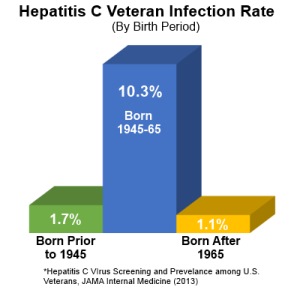
Twenty-year graphic
Victoria Davies, leader of VA’s Dept. of Public Health, why haven’t you set up a call bank to notify every veteran born in 1954 first, every black veteran in the boomer cohort, and then everyone else at risk? Why is there no outreach to veterans in private care and private physicians? This is an extraordinary situation and the VA’s response is lazy, unprofessional, and unethical. This is worse than Egypt’s HCV crisis that was caused by dirty injections years ago.
Bernie Sanders, please call an investigative hearing on this deplorable lack of action soon! Victoria Davies has some explaining to do to the Black, Hispanic and overall boomer veteran communities.


 asknod
 Bethanie Spangenberg
 kcraveiro
 robinhoodesqvetsatty
 Wesley McCauley
 Veterans Claims Help
Is it about the boomers or is it the Veterans of boomer age? That paints the target on the back of the VA for Vietnam and post-Vietnam Era Veterans. If it was about civilian baby boomers me thinks the CDC would have an explanation as to why.
My hunch about the CDC’s reluctance to deal with HCV in the general population is because of the mass campaigns in many parts of the country in the civilian population in the 60s and onwards.
It’s likely that many veterans entered service with HCV having contracted it from jet injections during these campaigns when they were young for polio.
Then they spread it to others in military service innocently via medical interventions etc.
A perfectly horrible storm.
Here’s a link to a CDC produced movie from 1961 in Georgia:
https://archive.org/details/0647_Babies_and_Breadwinners_1961_Polio_Vaccine_campaign_01_38_28_00
We should probably embed this movie because it shows everyone lining up for the dirty shots. Polio was defeated but at a cost we only recognized decades later.
Small pox campaigns are the other big events.
Or did we bring it back with us when we got back to CONUS and then spread it around?
————————————————————————————————————-
Viral Hepatitis
Viral hepatitis is a significant health risk for US troops, coalition peacekeepers, and humanitarian workers deployed to Afghanistan and neighboring countries. Historically, hepatitis A and B have been major infectious disease threats for military forces [121, 122]. More recently, there has been concern about hepatitis C because a high prevalence of hepatitis C virus (HCV) infection has been found in some populations of US military veterans [123, 124].
Importantly, viral hepatitis was a serious problem for Russian troops during the Soviet Union’s incursion into Afghanistan in the 1980s [4, 5, 125–127] and remains a major health threat to the local population. More than 115,000 cases of acute viral hepatitis were reported in a population of 620,000 Soviet troops who served in Afghanistan [4]. Morbidity rates were so high that viral hepatitis was thought to have directly compromised Soviet military operations. For instance, the 5th Motorized Rifle Division was reportedly rendered ineffective for combat by an outbreak of >3000 cases of acute hepatitis in late 1981 [4].
http://cid.oxfordjournals.org/content/34/Supplement_5/S171.full
————————————————————————————————————