I received this from Law Bob and/or Berta from Hadit.com, one of the more outstanding sister sites which looks out for the best interests of Veterans.
Veterans have been getting a raw deal for the last sixty years when they come home from wars, skirmishes, territorial “misunderstandings” and the like. The phenomenon began to occur during and after the Korean War when returning troops who had been mentally traumatized were miraculously discovered to be in much better mental health then even they knew. Instead of shell shock or battle fatigue, they were diagnosed with lesser diagnoses of obsessive compulsive disorder when they exhibited a desire to sleep under their bunk beds rather than on the mattress. Similarly, Vets like me who evinced a desire to sit in corners facing out, flinched when a car backfired and avoided crowds were found to be suffering from antisocial personality.
These diagnoses made the afflicted Vets much happier knowing they did not suffer life-threatening major mental disorders. In fact, many of us were able to venture out into society after living in the desert for years trying to heal ourselves. Sadly, many were not. Many became homeless or eventually took their own lives when left untreated.
The collateral damage from wars is only now becoming more known. Studies of PTSD-afflicted Vets reveal a plethora of psychoses in addition to the more obvious ones. One of my good friends, Bubba, was as happy go lucky as the next guy. He had burned through a few wives and lived alone. His life skills were scarce to none. He didn’t have a driver’s licence or insurance and saw no need to. His hygiene was a bit spotty and his clothes were always ready for a visit to the laundromat. He was perennially moving from apartment to apartment for failure to pay rent on time. Drugs, unfortunately were (and are) still a major part of his daily ritual. Nothing is going to fix Bubba after 42 years of no treatment. The military said he was good to go after he returned from Cu Chi and a year of tunnel hunting.
I came back after two years of this and that and the Air Force noticed I had unshined boots and my hair was unkempt. After losing a stripe in an Article 15, they graciously offered me a discharge if I’d just sign the page saying I was a homosexual. I just as graciously declined and offered to keep out of trouble for another 8 months to my expiration of enlistment. Like the proverbial rotten apple, I was not to be allowed to stay in the barrel. They discovered that all this time (three years and four months) I was actually suffering from the aforementioned antisocial personality compounded by passive aggressive tendencies. This entitled me to an immediate discharge under medical regulations and I even got a General Discharge under honorable conditions because this wasn’t my fault. Since the condition pre-existed service and did not become measurably worse while serving, I was not entitled to any compensation for my ills.
This is where matters have stood for the last forty or more years. Vet joins service. Vet goes to war. Vet comes home with bent brain syndrome. Vet is discharged with personality disorder unless he is certifiable and talks to flies on the wall. If he can be suitably drugged up long enough, he can be released and convinced he’s okay. Besides, tough guys like Rangers and Special Forces are not sissies. They don’t get these problems. Only the whiners and complainers who are too lazy to work ask for a PTSD rating.
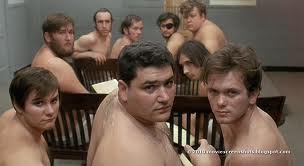
The Madigan phenomenon began to emerge as the Army realized three or four deployments to a combat theatre seemed to exponentially increase the number of Vets suffering this misdiagnosis. The VA sent out a flyer to the Military and said “Whoa, dudes. Lighten up. Our hospitals runneth over.” Something had to be done and soon. The Army opted to create a new method that would make a serviceman run the gauntlet before discharge. Anyone who chose to claim this was subjected to numerous tests. Think back on Arlo Guthries’s humorous Alice’s Restaurant and the Group W bench. Madigan’s Group W was intimidated, insulted, accused of malingering and much more. If you survived their gamut of psychiatric sleuthing and still passed muster, you got your diagnosis. If you faltered or tried to be Tough Guy, you were not Group W material but merely one who had slipped through the careful screening years ago.
The VA, with the implicit blessing of Congress, passed this get out of jail free card shortly after WW2. It has been modified and expanded upon over the years. As is most often the case, it provides an out for having to pay after the military has created a few new wrinkles in your gray matter.
§ 4.127
Mental retardation and personality disorders.
Mental retardation and personality disorders are not diseases or injuries for compensation purposes, and, except as provided in § 3.310(a) of this chapter, disability resulting from them may not be service-connected. However, disability resulting from a mental disorder that is superimposed upon mental retardation or a personality disorder may be service-connected.
(Authority: 38 U.S.C. 1155 )
§ 4.9
Congenital or developmental defects.
Mere congenital or developmental defects, absent, displaced or supernumerary parts, refractive error of the eye, personality disorder and mental deficiency are not diseases or injuries in the meaning of applicable legislation for disability compensation purposes.
[41 FR 11292, Mar. 18, 1976]
Last, but not least, 38 CFR 3.303(c) puts the fork in it.
personality disorders which are characterized by developmental defects or pathological trends in the personality structure manifested by a lifelong pattern of action or behavior, chronic psychoneurosis of long duration or other psychiatric symptomatology shown to have existed prior to service with the same manifestations during service, which were the basis of the service diagnosis, will be accepted as showing preservice origin. Congenital or developmental defects, refractive error of the eye, personality disorders and mental deficiency as such are not diseases or injuries within the meaning of applicable legislation.
Interestingly enough, the military’s doctors are the ones who make these determinations as to whether you had a “personality disorder” prior to entry. Since everyone diagnosed afterwards in service is found to have suffered this prior to entry, there really need not be any further discussion on the topic. Case closed. The exit is to your right, sir. Goodbye.
This is what happened at Madigan. The only problem was that Col. Homas got caught holding the bag. Fortunately he knows someone and got reinstated with no loss of rank or black marks on his otherwise stellar career. What is disturbing is that they still have not finished redacting the investigation report for public consumption.
In sum, we are gradually reaching the tipping point. As Berta so aptly put it..
I found myself repeating again at hadit that I think any member of the Armed Services being mustered out these days, needs a lawyer and a real doctor with them as they do that.
A sad assessment but only too true. Our citizens utilize the military experience to advance their potential in the civilian job market. Others seek a berth for a career. Both are admirable choices as they keep America strong and protect us from our enemies. Who would ever think that the enemy lies within? A Vet is precluded from having meaningful legal representation until he has lost at what is unarguably the most important adjudication of all ( the VARO). Everything henceforth is an appeal to attempt to overturn the injustice. I remember our training sergeant explaining that in the military we were guilty until proven innocent. The concept seemed alien at the time. Apparently that dispensation continues at the VA.


 asknod
 Bethanie Spangenberg
 kcraveiro
 robinhoodesqvetsatty
 Wesley McCauley
 Veterans Claims Help
Just wanted to update my husband’s C&P exam he had a couple weeks ago. I am not the best at describing emotions and such but what I can say is even if VA doesn’t grant his claim for PTSD it was well worth seeing this doc. This Doc invited me into the office with my husband which I was very surprised. The Doc asked Rick many questions regarding his childhood and parents, his Corpsman training, Vietnam and his return home. He then asked us both about Rick’s PTSD crash in the early 90’s and him seeing a private Doc for many years, he wanted to hear how those years affected our family. This Doc had actually been sent and read everything Rick sent with his claim, I was stunned. Rick had done a 45 minute computer questionnaire before we sat down with Doc and at the end the Doc pulled out a sheet of paper which he went over Rick’s responses and said just the talk and the test confirms his PTSD at a 75% rate, whatever that means. The Doc said “this I can tell is not about money” I was so proud of myself for keeping my mouth shut on that note. The Doc of course said he cannot say how VA will determine his claim but that he’d for sure confirm diagnoses. This was the first VA Doc visit that brought us both to tears on our way home. Rick said he felt for the first time that someone with VA acknowledged his existence in Vietnam and for serving his Country. Nearly 50 years late but who’s counting…. As Rick’s wife, I cannot tell you the deep hearted joy I felt just feeling and sensing the gratitude he had after talking with this Doc. Now, it’s a wait and see what VA comes up with and of course the next project trying to get a scooter that would allow Rick an outdoor life. Aw, the challenges are endless.
I jumped for joy in 2007 after VA finally acknowledged I was even in Vietnam. For 13 years they said I wasn’t…
Personality disorders are described as chronic maladaptive patterns of behavior, exhibited across many contexts and markedly different from those accepted by the individual’s culture. These patterns DEVELOP EARLY, are inflexible, and are associated with significant distress or disability.
So I think if you can prove that before military service there were no such patterns of behavior, that their life was pretty normal you should be able to disprove the “personality disorder” diagnosis.
Thank you SPrice. My husband went into the Service to serve his Country but also to prove to his life long Army Military Father. He did have stress trying to please his Father but as it turned out if it wasn’t Army he joined then he was no good. He joined the Navy and volunteered to become a Navy Corpsman with the Marines in Vietnam. He went through medical training in North Carolina, shipped to Hawaii and from there landed in Vietnam. Between all of that he never made his Father happy. And not one mention in his VA Psychological papers does it even mention his trauma experience in NC of two helicopters that crashed and he was a part of the rescued or the deaths. Not one word is mentioned regarding his time in Vietnam trying to save the lives of his fellow service men. It’s like each Psychologist carried over what the last Psychologist said, like they could read each others comments. Very odd if you ask me.
This is why Congress instituted 38 USC 1154(b). If you were in combat, everything you say is the truth automatically. No questions asked. Now all we have to do is teach the VSOs that one.
Funny you say that, I just replied back to asknod about that 1154(b). Does that mean if you have an ailment on their list and you were in combat it’s a presumption it came from there?
Jetguns=hep c. PTSD causes stress intolerance and the interferon used to treat the hep c makes the stress intolerance worse and that messes people’s lives. Perhaps I’ll make PTSD my next research project.
Oh my gosh this story just made me ill. My husband’s discharge papers say “Personality Disorder” However, he has early 1992/93 private medical documents which diagnosed him with “Delayed Onset PTSD” after his suicide attempt. At that time he reached out to VA but was tossed to the side after one visit with their Psychologist. Hmm, wondering if the effort to file PTSD claim is worth it?