My apologies to member Squidley for not getting this up on the board sooner. It is an important risk that was never before presented to us by him and one that bears examination.
As we all know, vA will have us believe that medical personnel stuck us with all manner of needles, jetguns, and other subcutaneous incursions with nary a risk one. On the other hand, were a Veteran to use his own syringe and needle to illegally inject drugs, it somehow became the focus of the etiology for his HCV to the exclusion of any other risk.
When doing a risk assessment, any engineering firm would look at all risks as to why a bridge fell down. They wouldn’t narrowly focus on whether the bridge workers were drinking beer on the job at lunchtime. In the same vein (no pun intended), the vA is taking a stand against Squidley over percutaneous piercing ( acupuncture, pierced ears, nipples, etc). No, Squidley is not one of those who has pierced everything that can be punctured. He was injured aboard ship off Japan and taken ashore in Yokosuka for an EMG test or two. Here we are thirty years later and Squidude has the bug-bad I might add.
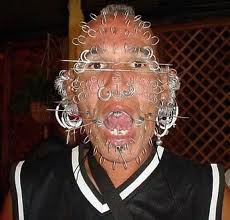
EMG (Electromyocariogram) tests using reusable, ostensibly sterilized needles to test for muscle or nerve disorders and injuries involve this percutaneous piercing. The needles are inserted in various afflicted parts of the body and a small current is sent in to stimulate the nerves and measure the results. This is Squid’s contention. If the gentleman or lady who was tested before him with those reusable needles had HCV, the odds of him picking this up go through the roof, statistically speaking. That would be the way I see it anyway.
Squid sent me a lovely dissertation on the subject of EMG and after careful perusal, I find an interesting note. The article, published in the prestigious Seminars in Neurology, Volume 23, Number 3, dated 2003 says this on page 338:
“Platinum single fiber electrodes are sterilized by gas or autoclave employing the same methods used for surgical instruments. In addition, special precautions, including the use of disposable NCS electrodes, are taken with patients known to be infected with agents such as Hepatitis, B virus, Hepatitis C virus, Creutzfeldt-Jakob disease, and human immunodeficiency virus”.
Now, stay with me here. Travel back in the mental DeLorean time machine and think about the early eighties. The autoclave was the only sterilization procedure in use then. EMG needles were reused until they were dull. According to the vA, HCV can be transmitted by needles. Hepatitis C virus, Genotype 2a was indigenous almost exclusively to the Japanese Archipelago and Okinawa in the early eighties. An IMO would only be able to conclude based on this, that it is at least as likely as not that if Squidley had an EMG done at a civilian hospital in Tokyo (Hell, even in Yokosuka for that matter), the odds of contracting HCV are excellent.
Now, based on the Court’s Layno holding in 1995, the Squidster can opine on all manner of subjects dear to his heart in his lay testimony. One of the things he is qualified to discuss is where he was geographically when he had this test. If everyone around you is speaking Japanese, you can generally assume that is where you are. If they were sticking EMG needles into you, you would notice because it hurts. Monsieur Squid might notice this too. If he were wearing one of those fancy Seiko® Day/Date chronographs on his wrist, he might even have ascertained the year it occurred. In addition, he had these same tests done when he returned to the States at the famous Balboa NAS Hospital in San Diego before his discharge. Another opportunity for infection in a new art little understood.
With the modern inception (after 1992) of what we consider the modicum of sterile procedures, disposable needles for EMGs are the norm as we can see in cases of nefarious germs. Any medical professional who could come down on the side of less likely than more likely that an infection could occur via this path prior to the aforementioned 1992 epiphany is in denial mode. Squidley is about to see if justice is truly blind or if the vA is going to blow soap bubbles and swear he got it from an unclean toilet seat. There is also the untested theory of immaculate conception which I had not considered before this morning . What the hey? The Virgin Mary claimed it. Why can’t the vA?
Here’s the PDF on the subject. I hope this helps someone because, although Squidley is the first, I doubt he will be the last.



 asknod
 Bethanie Spangenberg
 kcraveiro
 robinhoodesqvetsatty
 Wesley McCauley
 Veterans Claims Help
“The article says “In addition, special precautions, including use of disposable NCS electrodes, are taken with patients KNOWN TO BE INFECTED with agents such as hepatitis B virus, hepatitis C virus, Creutzfeldt-Jakob disease, and human immunodeficiency virus.” Since most people that are infectected with Hepatitis C are not aware they have it, then it makes no sense to only use precautions on the few that have been diagnosed.
Excellent point, Sylvia. If they are not using sterile protocols on all patients yet then they must not get out much. In this day and age, the medical world should be on high alert for any anomaly. Look at the bozo lab tech spreading HCV up in New Hampshire at Exeter. This is the perfect riposte to VA’s staid responses on the Presumption of Regularity in the delivery of medicine. Kwiatkowski puts a fork into that theory.
Thank you for your astute observations! 🙂
I submitted this medical journal as attached evidence when I submitted the F-9. This article was listed on the SSOC as “various internet articles” and given no specific reference what-so-ever. I circled and put an asterisk in the side columns for the following:
“detected by a needle electrode inserted into skeletal muscle.”
“Regarding complications of EMG, it is common for the patient to experience transient minor soreness at
one or two puncture sites—the typical study including 5 to 20 sites.”
“A few individuals sustain a small hematoma, usually at one site, from inadvertent puncture of a nearby blood vessel; this can be minimized by a detailed knowledge of vascular anatomy and by palpating arterial pulses in the region of intended puncture sites in order to avoid large vessels.”
“The risk of bleeding is greater in patients taking anticoagulants, those who have a coagulopathy of other causes, and those with marked thrombocytopenia. Many laboratories have guidelines concerning what degree of anticoagulation and what platelet count range are acceptable to perform EMG. Another concern in patients with bleeding tendencies is compartment syndromes caused by vessel puncture during EMG.”
“In addition, special precautions, including use of disposable NCS electrodes, are taken with patients known to be infected with agents such as hepatitis B virus, hepatitis C virus, Creutzfeldt-Jakob disease, and human immunodeficiency virus.”
Now if you could find a period set of instructions on the care and feeding of EMG needles from 1982, you could show the danger associated with these percutaneous puncturing devices. What’s the difference between them and a tattoo needle except for the ink? Ink by itself has no HCV in it.
“The commonly used concentric needle electrode,
introduced by Adrian and Bronkin the 1920s, has a
single insulated wire inside the cannula of a hypodermic
needle, fixed in place by epoxy glue and cut
flush with the needle tip (Adrian and Bronk, 1929).
This recording wire, with a recording surface of 150
by 600 _m at the tip, is referenced to the cannula.
Figure 18–1. Four common types of needle EMG electrodes. 1,
Concentric needle electrode. The recording wire is represented
by the stippled area, running the length of a hypodermic needle.
A full view of the recording surface is shown on the right. 2, A
monopolar needle electrode that is simply a wire insulated all
around except at the tip. 3, Single-fiber electrode. 4, Macro-EMG
electrode. The setup on the right side (4B) is identical to that of
the single-fiber electrode. At the tip of the needle is a very large
recording surface (the area in blackmeasuring 1.5 cm in length)
for detecting the action potentials generated by all the constituent
muscle fibers within the motor unit territory (A). A full
description of these electrodes is in the text. (Adapted by permission
from Stalberg E: Single fiber EMG, macro EMG, and scanning
EMG: New ways of looking at the motor unit. CRC Crit Rev Clin
Neurobiol 1986;2:127.)
On the other hand, the small pickup area of the
electrode does not provide any information on the
electrical size of the whole motor unit. Although this
information may be obtained with the use of surface
electrodes for superficial muscles, a macro-EMG needle
electrode is needed for deeper muscles (Stalberg,
1966; Barkhaus and Nandedkar, 1994).”
Click to access 9780721689227.pdf
———————————————————————————————————————
The following article talks about when EMG precautions for blood borne diseases were taken and how hepatitis is transmitted by way of EMG tests:
Click to access Putnam92.pdf