I found this while roaming around. The fellow who posted it feels that VSOs are the way to go. He pointed out that the 39.9% of pro se claimants lost. Statistics are everything. Let’s look:
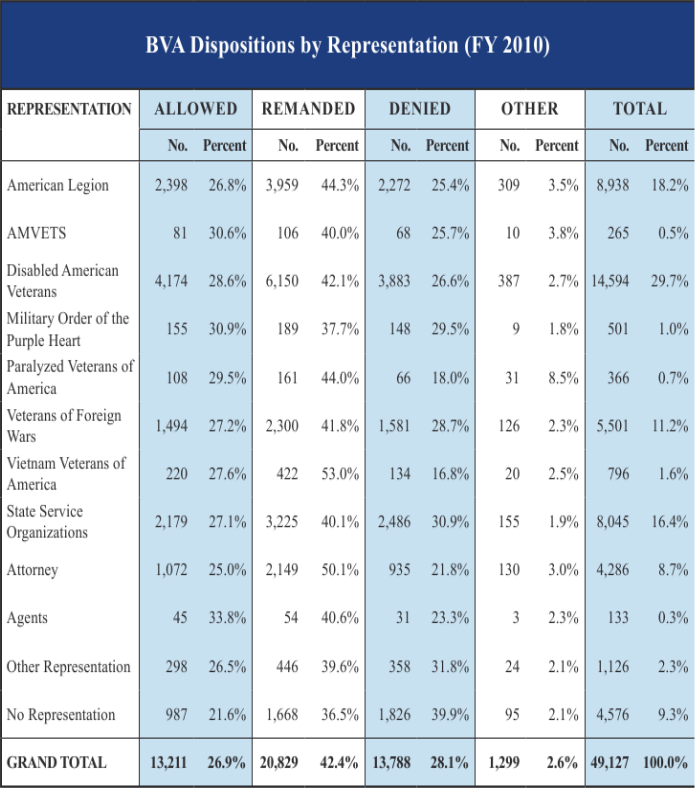
We have 4,576 Vets who have chosen to represent themselves. Without digging too deeply, I will wager some are as bright as I was in 1989 and 94. I would do this differently and will explain. A remand is a “win” in that it is another chance at winning, so I will combine wins with remands. This yields 2,655 of 4,586 claims filed (58.1%). The impressive figure is that only 9.3% of us attempt this. There is no magic in numbers. Numbers reveal things they often are not asked to.
AmVets claims 81 successes but they only filed 265 claims. DAV, with 14,594 filed, claims a whopping 4,174 wins and even larger 6,150 in remands. VVA is the clear winner, but only sallied forth 796 times with 220 wins (remands 422). Statistically, I’d prefer to have an attorney, but the thought of giving him 20% of a big settlement sticks in my craw.
These stats would have us believe that numerically, it is advantageous to hire a VSO. I don’t read it like that. I see a win column that insinuates 25-30% of Vets win their appealed claims in their entirety. I see only 49,127 appeals of what is usually about 1,000,000+ claims filed each year (based on 2009). These are appeals only. If we look at the RO statistics, we’d be stupefied at the win/loss ratios. I’d love to see those figures.
Check this out for brainwashing. VA calls it a Strategic Plan. I call it a Defensive plan with a lot of polysyllabic words designed to confuse the reader and deflect blame away from their door..
http://www.va.gov/op3/Docs/StrategicPlanning/VA_2010_2014_Strategic_Plan.pdf
There’s 4 million of us disabled Vets out there now. The report says our numbers are shrinking! Have any of you a) been to a VAMC lately and looked for a place to park and b) tried to get an appt. with your PCP in less than a month? The only thing shrinking is their ability to deliver the promises they are tasked with providing. If our numbers are shrinking it’s due to death from lack of proper medical treatment.
My take (and I’m not a good number cruncher) is that a lot of unrepresented Vets appeal their denials and need serious help with them. That’s all I can take away from it. Having a VSO doesn’t seem to be a big help unless you go to a smaller VSO or find an exceptionally good SO. The truth is out there. One thing is certain. No one will worry about your claim as much as you. It stands to reason you will be your own best advocate with some guidance. It’s not for the weak of heart, though.


 asknod
 Bethanie Spangenberg
 kcraveiro
 robinhoodesqvetsatty
 Wesley McCauley
 Veterans Claims Help
Okay, here’s the acid test. I went down to VAMC American Lake for a blood draw lab. Monday. While there, I wandered over to the “VSO building” where they are all housed. I went into the first office that had a representative available. I said I needed to ask a question about claims in general and if their organization could answer it. The AMLEG rep. spun her seat around 180 degrees and reached for a Form 21-22. She turned back around, faced the form towards me and asked me to fill it out. I explained that the question I wished to pose was generic in nature. She explained to me in no uncertain terms that she wasn’t going to say boo-squat unless, and until, I signed the POA. I stood up and thanked her for her time and turned to go. At that point she jumped up, interposed herself between me and the door and wanted to know what was so important that I was willing to forego representation at the drop of a hat. I broached the subject of how VSOs are funded and the room temperature dropped 20 degrees. She retreated to her desk and brusquely replied that I would have to contact the National Organization to obtain that. She then summarily dismissed me with a “You’ll excuse me. I have work to do.” T’would appear I had hit a raw nerve or that she did not have “the need to know” or a high enough security clearance. I’ll try this again at VFW when I go back in December.
Does anyone out there know of any attorneys that “successfully sued” a VSO for mal-practice? How long must veterans suffer at the hand’s of these incompetent representatives? We already know the VA System is broke and rife with corruption and double standards. Who can we as the twice injured party cry out for help? Since my denial for SC in 2001 I have developed cancer and a host of other ailments related to HCV and INF treatments. My quality of life and health is precarious day to day. Othe than GOD who will listen to a veteran with care and understanding? I will never rest until “justice” is rendered in my situation. Maybe this is what is keeping me alive but very bitter. Any replys to this post will be greatly appreciated. I hope all will have a good Thanksgiving Holiday.
Robert…….. hurtin4certin
It sounds like NoD, Robert and I are largely in agreement, with all 3 of us having a VSO that was less than “Veteran Friendly”. VSO’s largely echo the VARO agenda which is in conflict with the Veterans interests. While the Veteran seeks to obtain his or her benefits as quickly as possible, the VARO/VSO want the Veteran to be patient and tolerant of a typical 4.4 year delay on our benefits, which VCS says is the average wait time for a Veteran at the BVA level. Nod further pointed out that the average Veteran receiving benefits would need to go through at least one appeal, as less than 1 Veteran in 5 gets their benefits on the first VARO decision.
There is a disparity, however, that has gone by many unnoticed. Of the $111 million dollars paid out to bonuses to VA execs this year, I wonder how many of these execs experienced “paperwork glitches” that caused their exec compensation to be delayed by 4.4 years? Can someone explain why the VA seems to be able to flawlessly and timely administer $111 million per year of executive bonuses to VA employees, while the typical Veteran takes 4.4 years to receive his or her benefit check? I would venture a guess that execs being awarded a retention bonus receive their cash within 2 weeks, all while Veterans are waiting in a million man line for their compensation. This can only happen because VA employees “take care of their own” while putting Vets compensation applications at the bottom of the pile. In this scenario, VSO’s must “look the other way” while this happens.
Realizing that Veterans are actually approving VSO’s salary when they sign the POA form, perhaps we should be more careful about signing away our POA.
“Other Result” implied to me that death of claimant was definitely included. I also figured in Motions For Reconsiderations (which BVA has discretion to approve or deny) as well as CUE adjudications. But why, pray tell isn’t it a Spread Sheet with a breakdown of initial claims, claims for increase and “other” as in dependency, A/A, DIC, etc. I say that numbers are our friends, but deliberate obfuscation and/or creating dissension among Vets over which VSO is more successful serves no earthly purpose- or does it? Vets fruitlessly running from one VSO to the next shopping for the best rep. would truly delay justice even more. I’m sure the VA would love to help us and grant us every benefit we are entitled to, but publishing this drivel just allows minds to wander away from the task at hand.
It’s the ole “hurry up and wait” process with the veteran getting the shake down. WHY can’t these VSO’s get the “right decision” the first time around? These so called “representatives” are supposed to be trained by the VA and local states money for no cost representation to the veteran. I learned the hard way that if it doesn’t “cost” something than veteran beware. I was hung out to dry by the California Department of Veterans Affairs RO , Los Angeles, CA. My claims for service connection disability was denied summarily and illegaly by the board. My incompetent representative, Alberto Alpersan, sat quietly by and let the board run rough shot over my claim and ignored VA Law and procedure. This denial was August 2002. Later after review of the SOC “blatant CUE errors were made by the rating board” in denying my claim for SC. My moron representative claimed the CDVA did the “best” they could to represent me but lost. I immediately fired them and filed NOD with CUE errors to RO to reopen decision. YES I know how difficult this is. Yes I have my ducks all in a row. I have 4 CUE errors that could be close to bullet proof. So why do I opine here? Getting screwed is not what a veteran signs on for. The VSO system must be held accountable for any and all mal-practice against their clients. The years that go by to correct these mistakes is what kills us and doesn’t change a broken system. I have no power to sue the VSO that imposed my misery and learned hatred of injustices in my Government. Currently I am waiting for my letter/time for the traveling judge hearing at the RO in Los Angeles. I cannot apologize for my hatred and how I was treated in this process. 10 years out of a person’s life is worth something. I would of prayed for better thoughts but my story is still pending. I have no faith in any VSO. I consider them a ‘rubber stamp” for the VA because they want their fee for poor representation. I greatly appreciate this site and the time and effort of NOD to listen to our stories.
THANK YOU FOR YOUR SERVICE——GOD BLESS OUR MILITARY
I agree that it is best to combine the “Remand” and “Allowed” statistics, for the best analysis, but one would have to wonder what other result is included in “other”? Would “other” include the times when the Veteran died waiting on a VA decision, perhaps with no substitution of claimant? PVA’s rather ginormous 8.5% of “other” results would suggest this, as one could surmise that, a paralyzed Veteran would be less likely to survive the long wait for a decision, than a Veteran with less severe injuries. Based on this assumption, the VA has a kind of “reverse discrimination” to the severely handicapped built into its system. In other words, the long waits on a decision for disability compensation benefits favor those less disabled, as the severely disabled often die before the VA can make a benefit decision.
It would not be a surprise that the VA would want to hide such a statistic, conveniently covering it up in a cloak of “other results “