Saturday morning arrived with sunshine. The barking dogs signaled the arrival of the lady with the dog biscuits and the mail. As expected, my big brown envelope from the BVA arrived as well. What I least expected was what was contained therein.
I was prepared for a possible denial of the CUE because the Board is big on writing long tomes like their brethren above. What they are short on is logic or, more particularly, logic that defends their argument. When facts impede the orderly path to said denial, the proper method is to ignore them and talk loudly about the other failures to prove the case. As often as BVA cites to precedental cases to defend their position, they are loathe to employ the stance of Devil’s advocate. Hence, one reads of all the reasons why one hasn’t made his case for CUE and nothing about two Colvin violations where the Board made medical decisions. Judges, like you and me, are not doctors. When they opt to play Ben Casey, they run afoul of Veterans law. They know this. They hope we don’t.
Similarly, the Board was hasty in glossing over the fact that the AF doctors were unable to find anything wrong with my back physically although they acknowledged there was something amiss. This is called the Wilson doctrine. The mere noting of a medical issue in service is sufficient to document what might be a problem later. The phrase is “Symptoms, not treatment are the essence of any evidence of continuity of symptomatology”. I have an unbroken medical record with a small hiatus shortly after service, of back and hip pain. The Board has tried to employ the Maxson ruling to overcome that. Unfortunately, that concept of vA law did not surface until 1999.
The final error that the Board cannot overcome was the presumption of soundness. This is called the Bagby presumption. You were examined from head to toe by doctors before you entered to prevent what I am trying to do now. If there was something wrong with me in 1969, it would have shown up. They found me healthy and happy then and not so much when I departed. The trick to that is to state that it was “acute and transitory” and resolved before separation. One small defect in the argument pops up when they have to explain why an ortho consult was on the books for March 1973 on my back/hips. I separated in February 1973. Their post hoc rationalization is that God healed me the day before my discharge.
The Board bifurcated my claims into two separate ones. Thus I have one for the CUE on my back/hips and one for Hepatitis/PCT/Tinnitus.
As to the Hepatitis claim, it’s simple. They insist I never mailed in any New and Material Evidence after the SOC. They are right. I mailed it in with my NOD. That is within the one year window of my denial. Semantics are the vA’s greatest weapon against you. They make a grand statement that is unarguably true but distorts the fabric of the claim. Read these highlighted portions:
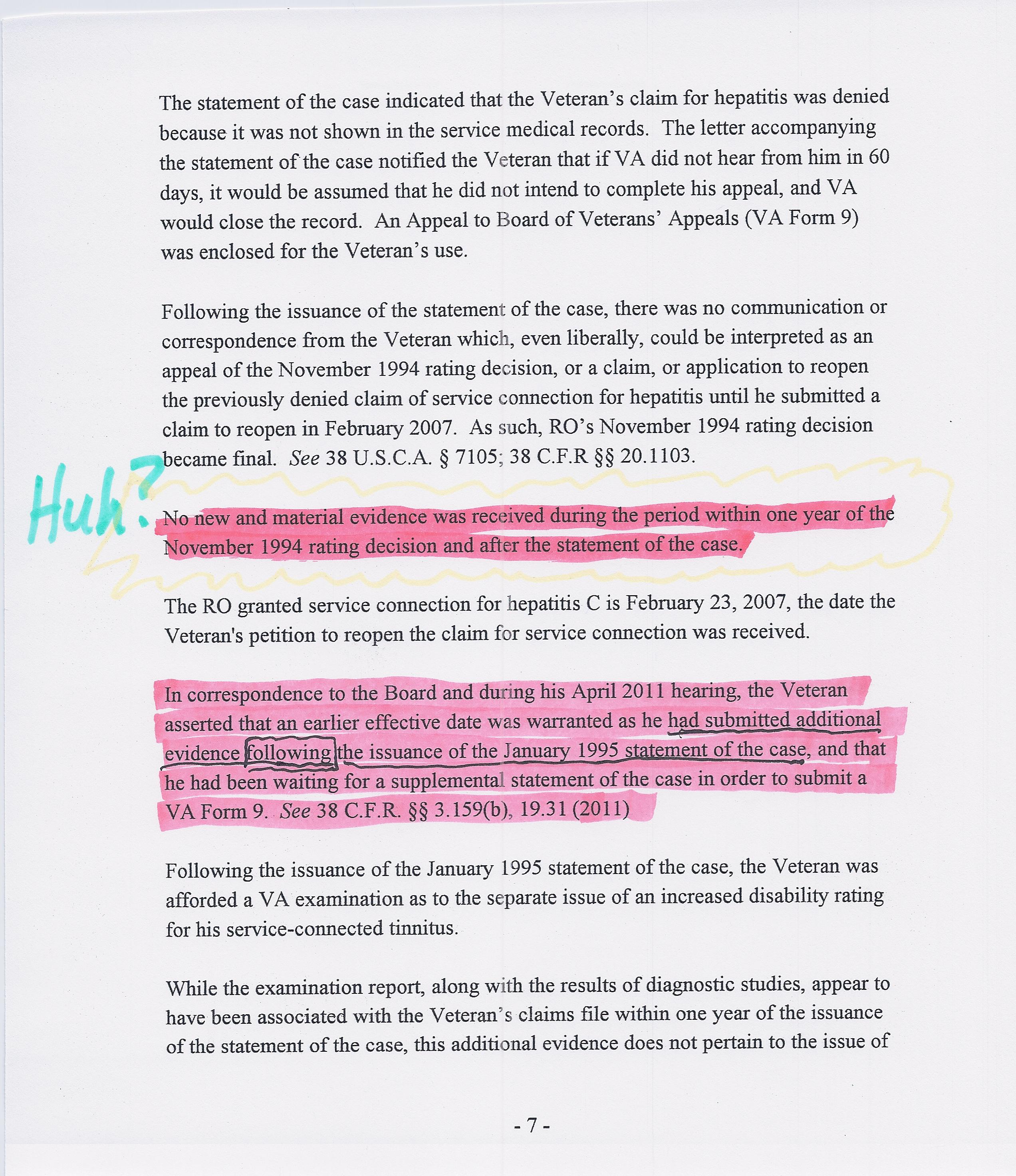
If you are blind, click on it twice and it will magnify. Now, they had all my records and the C-file shows it all. I know because I have a copy of it. Semantically, the Judge is correct in the second highlighted paragraph. I submitted nothing after the SOC. However, look at the NOD filed December 2nd, 1994:
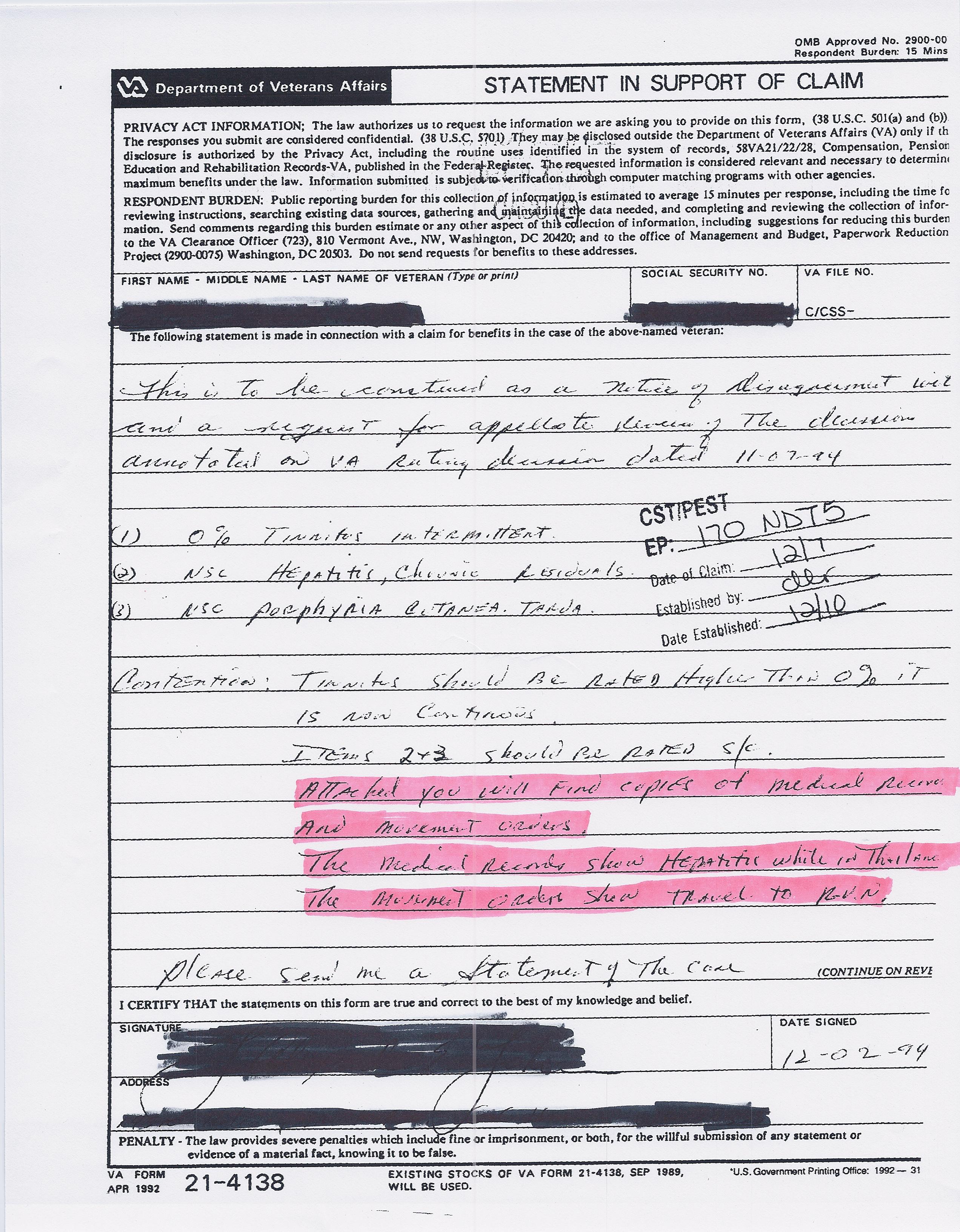
If I submitted nothing, then why would they tell me they had received my new and material evidence and were promulgating a new decision? Here’s the SOC on Jan. 5th, 1995:
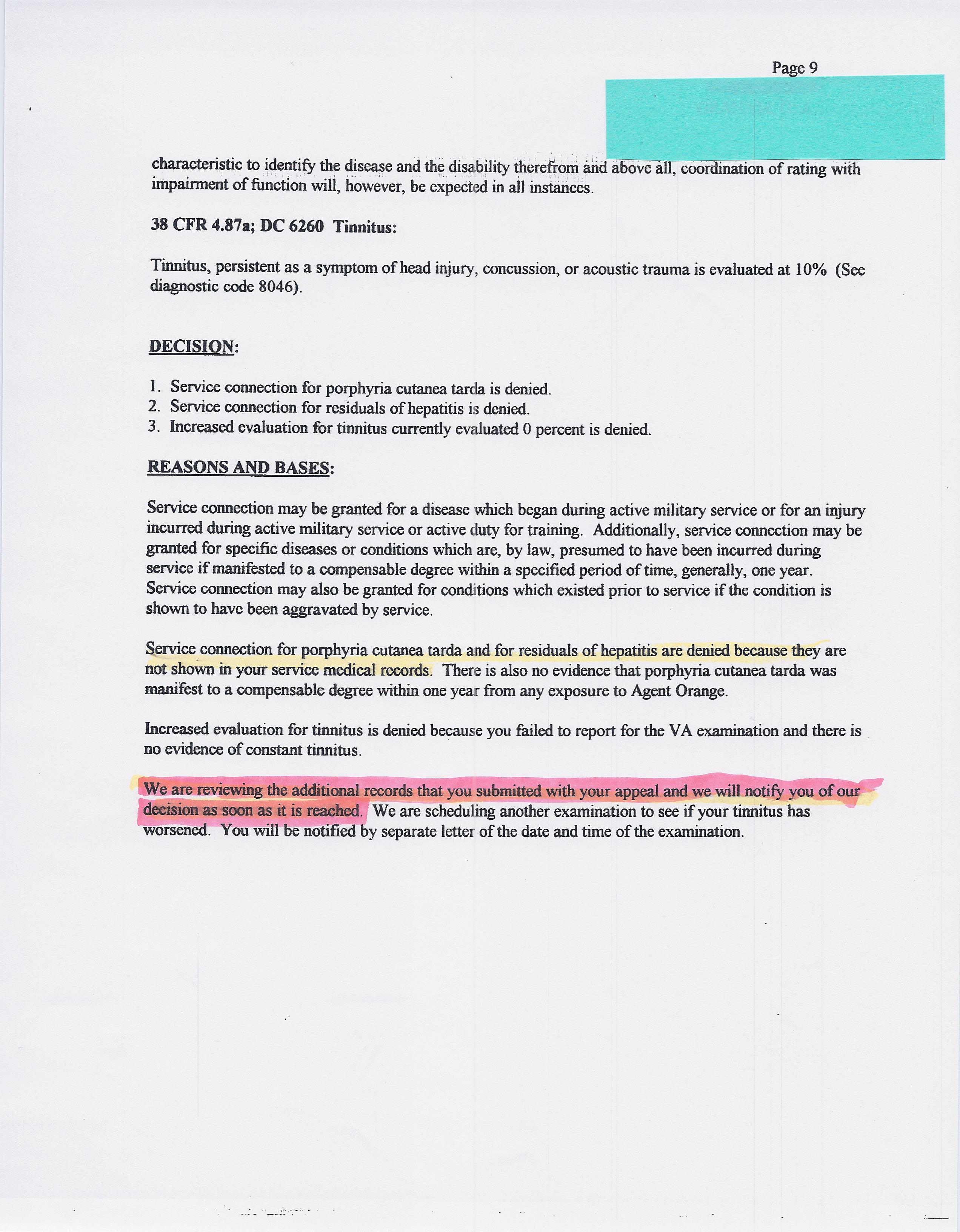
The new decision states quite clearly that I “asserted that an earlier effective date was warranted as he had submitted additional evidence following the issuance of the January 1995 statement of the case”. Now how can anyone screw that up so badly? The records clearly show I submitted the new evidence with the NOD, the SOC said they had it and here is a page from my Form 9 appeal that basically reiterates the same thing:
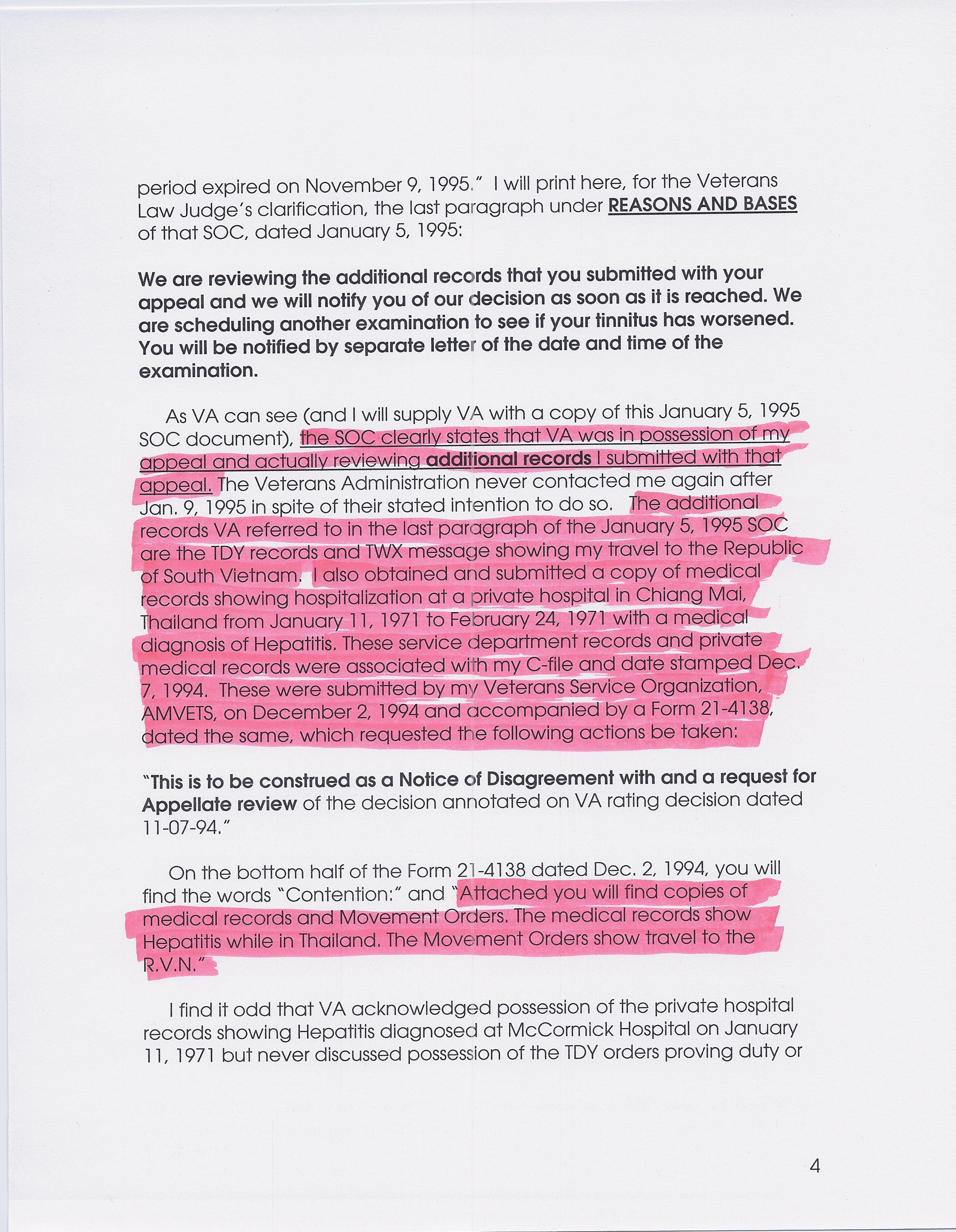
I often ask myself and others here how the RO and the Board can consistently make errors of this magnitude when they are in possession of all the evidence. The documented error rate is 60+% but no one can fathom why. Prior to this I would have conjectured that it was simply inattention to detail. Here the evidence leads to only one conclusion and it certainly isn’t what they arrived at. Where did they come up with this tortured interpretation? The answer is obvious.
I have written about one Leroy Macklem and his travails with the RO and the BVA. Granted, his claim had no legs but he was disenfranchised by a little know claim buster dreamed up by the wunderkind at the Head Office. I refer to the Extraordinary Awards Program or EAP as it was know during its brief lifespan. The EAP came to life in a back room without benefit of Congressional approval and said that any decision granting more than $25,000.00 dollars had to be “reviewed” again for errors. That’s vAspeak for revised downward to denial or 0%. It was declared illegal. I submit it is alive and well in an unwritten format. This decision alone, had it been granted, would have set the vA back over $150,000.00 samoles. Add in the CUE on the back and it would have inevitably gone over $200 K.
This means I’m off to see the Wizard on Monday. Filing a Notice of Appeal promptly will get me a docket date sooner. I foresee another year of waiting-interest free of course. I feel this is a gross deviation from the norm for the BVA. Most of these types are approved as it’s easy to see the paper trail and prove it. Here’s the case law as expressed in BVA decisions. It’s buttressed by VAOPGCPREC 9-97:
http://www.va.gov/vetapp98/files3/9826124.txt Read the introduction
http://www4.va.gov/vetapp99/files3/9927507.txt
http://www.va.gov/vetapp99/files3/9927507.txt
http://www.va.gov/vetapp99/files3/9923709.txt This one occurred in the same time frame as mine.
http://www.va.gov/vetapp99/files3/9926971.txt
The CAVC had this to say recently on the subject:
Section 3.156(b) is intended to be a veteran-friendly provision that allows for the assignment of an effective date of the date of the original claim when certain requirements are met. 72 Fed. Reg. 28,778 (May22, 2007) (explaining that §§ 3.156(b) and 3.400 “provide a claimant-friendly effective date rule for awards based on evidence received while a claim is on appeal or before the appeal period expires”). To accept the Secretary’s position that the Board correctly determined that the September 1996 RO decision was final would be to allow VA to ignore this claimant-friendly provision. It would also create the possibility that VA, by not considering evidence submitted during the one-year appeal period following the RO decision and simply waiting for the RO decision to become final, deprived the appellant of the earlier effective date associated with his December 1995 claim. This would be antithetical to the nonadversarial, claimant-friendly nature of VA proceedings. See Sanders v. Nicholson, 487 F.3d 881, 889 (Fed. Cir. 2007) (noting “VA’s uniquely pro-claimant benefits system”); Young v. Shinseki (2009)
Why the Judge and his munchkins failed in their due diligence can only be seen as a desire to avoid the inevitable. Were I not to appeal up to the Big House, they would be Scot free.
I refuse to fall for the ploy of a Motion for Reconsideration or a plea to vacate the decision. This would be akin to a DRO review. They have dug their heels in and are not going to change their minds soon. Any new motion in that venue will simply get more egg on my face. I’m pretty naive. I honestly thought I was dealing with a Veteran-friendly VLJ. In retrospect, it’s fairly obvious who writes his paycheck. We know what that fellow was ordering him to do.
This claim will be decided on one precept-equitable estoppel. I print the definition of it here:
Under the doctrine of equitable estoppel, “he who by his language or
conduct leads another to do what he would not otherwise have done, shall
not subject such person to loss or injury by disappointing the
expectations upon which he acted.” Dickerson v. Colgrove, 100 U.S. 578,
580 (1880). “An essential element of any estoppel is detrimental reliance
on the adverse party’s misrepresentations.” Lyng v. Payne, 476 U.S. 926,
932 (1986).
I relied on the RO to readjudicate my claim based on the submission of new evidence. This they did not accomplish. The list of regulations mandating them to do so are numerous. To wit: 38 CFR §§ 3.156(b), 3.160(c), 19.26, 19.31, 19.32, 19.37(a), 20.302(b)(1994),20.800 and 20.1304(c). Too bad I’m too old to go to law school.


 asknod
 Bethanie Spangenberg
 kcraveiro
 robinhoodesqvetsatty
 Wesley McCauley
 Veterans Claims Help
Quick responses:
–Decision stinks.
–Law school. Interesting idea. Any online or free possibilities that the VA will fund or state-funded for seniors?
–Timeline software might be really useful for the bleary-eyed case readers understand sequences of events. Visual information is great when data/issues are complex.
Online: 3 Free. http://timeglider.com/
In Word: http://www.microsoft.com/education/en-us/teachers/how-to/Pages/creating-timeline.aspx
Probably can find some free opensource timeline software online to tell one’s story.