Hmmm, that’s a mouthful. Allow me to explain. As many know, I drive down the road on autopilot going to my appointments to keep me alive. I leave surreptitiously when Cupcake isn’t watching because she doesn’t like me to inflict myself on other drivers. My theory is that scaring the shit out of other drivers keeps them on their toes-ergo alive longer.
While going to yet another blood letting at the VAMC, I had this epiphany about VA claims. I cannot be in the minority when I observe that the Administration has managed to misinterpret, misconstrue and basically mis-everything they get from me. Another member wrote me about this and wondered if it was just him or if this was endemic to the system. Sadly, I believe it is. Whether it’s a ploy to delay the inevitable or a genuine defect in logic assimilation is what I analyze today.
If you went to the dentist for a nagging pain in the right upper quadrant and the dentist said you had decay in the bottom left, you would question your sanity. Or would you? You trust the dentist to be knowledgeable. That is his forte, not yours. But when you are handed this misinformation, and it clearly is such, you question his ability to do that which you employ him for.
Similarly, when you finally engage in the distasteful job of bringing the VA to the table to settle old debts, you would expect them to be able at that which they accomplish everyday. Silly Vets. What were you thinking?
If every other Vet comes to me for help with their claim and shows me documented proof that the VA, purposefully or otherwise, managed to make a hash of their claim, I would assume they do it religiously for a living. This should be cause for alarm, but it is so prevalent that it passes for normal. How can that be?
The art form of collating evidence is old science. Assemble the contemporary evidence “for” in one pile and “against” in another. Determine who’s been naughty and who’s been nice in the interim and put it in the correct pile. Next, assemble current information and lay testimony and file it in one of these two mounting piles. Finally, weigh the evidence for and against based on judicial canons and if the evidence is in equipoise, give the benefit of the doubt to the Vet. Right? Seems pretty straight forward on its face, doesn’t it?
Now, let’s examine the fractious, disingenuous VA system and see where the two methods of decision-making part company. VA accomplishes, for the most part, all the above actions by requesting your files from the NPRC in St. Louis. The NPRC are water-challenged or eternal optimists, so they don’t own or possess normal fire suppression devices like overhead sprinklers and fire extinguishers. Other people’s paper burns-not theirs. And on the off chance that they do have another fire-what the hey? That means less filing and fewer requests for files from their brethren over at the VA. A win-win situation all around.
If the files managed to make it to St. Louis after you separated (and they don’t always do so), then they are sent to the VARO. This doesn’t mean they’re safe there. I don’t know how many Vets who have told me they filed and got 40% in San Diego and then refiled last year in Sioux Falls only to have VA tell them return to sender, no such number, no such zone. If they had the medrecs in 86, where’d they go? VA can look you right in the face and pull their collective pants pockets out and say “Search me.”
If they do manage to keep the files intact, the battle has just begun. VA looks at all your files including you military service files. If you had a run-in with them over some hashish or a love affair with Johnnie Walker, they know this. Bingo. You smoked hash, shared the pipe with someone who was HCV-positive, and therefore you are not entitled to SC. Same for the JW bottle. If you claim you wiped it off before smoking/drinking? Well, that can’t be corroborated and is mighty self-serving testimony, isn’t it? In a word, drugs or alcohol are the death knell for any HCV claim.
In the event that your milrecs are spotless, then the medrecs come under focus. Absence of any complaint of hepatic malfunction is positive evidence against SC in spite of the cryptogenic nature of HCV and further substantiates their theory. If you did have a hepatic misadventure in service it will be discounted as HAV, HBV or even mononucleosis if they didn’t test you for it. Absent a viable HCV test before 1988, this fact is overlooked by VA examiners or simply buried under the CAVC’s Maxson decision that so much time has passed that they can’t in good conscience attribute this to service.
With the advent of PCR testing, they can look into the past now and see whether you had HAV or HBV back in 1970. What they still can’t do is say you didn’t have HCV then and this is what VA continues to do. Medical evidence aside, your nexus letter is going to be suspect without contemporaneous medrecs from the service viewed by the doctor. Your risks were unique to you alone. The mere recitation of these events to your doctor from your perspective is not considered probative evidence. Lay testimony is supposed to be admissible and credible absent you changing your story every two years. If you give the doc everything you recall verbally, unsubstantiated by medrecs, the VA calls that inventing history and will not recognize it as evidence. Of course, a VA examiner and his cronies are allowed to opine all day long inventing history as they imagine it to support their decision.
In a nutshell, you have a mighty tall order to fill and you’re dealing with a deck that has less than 52 cards in it. Vets who win are few and far between because they do not comprehend what the rules of the card game are. This is what calls into question what the qualifications of the people hired to examine the evidence possess. What school of discovery do they attend to become approved VA sleuths? I submit that the diplomas come from Crackerjack boxes or south of the border from Diploma mills.
VA examiners as the BVA is fond of referring to them, can take a set of facts and come to the exact opposite conclusion you or a logical thinking person might because that is how they are trained. The VARO adage of “Grant if you can and deny if you must” is for PR publication only. The facts speak differently judging from the appeals process. This means that the assimilators and triers of fact have a predilection for leaning towards guilty until proven innocent. As there is no accountability for errors, an examiner can blunder through claim after claim and get absolutely none right. He will, however , get a bonus if he can do several of these a day and keep his in-basket empty.
Imagine the scales of justice-the normal scales. Then picture VA’s interpretation of how the fulcrum is positioned. I conceive of it as looking something like this:
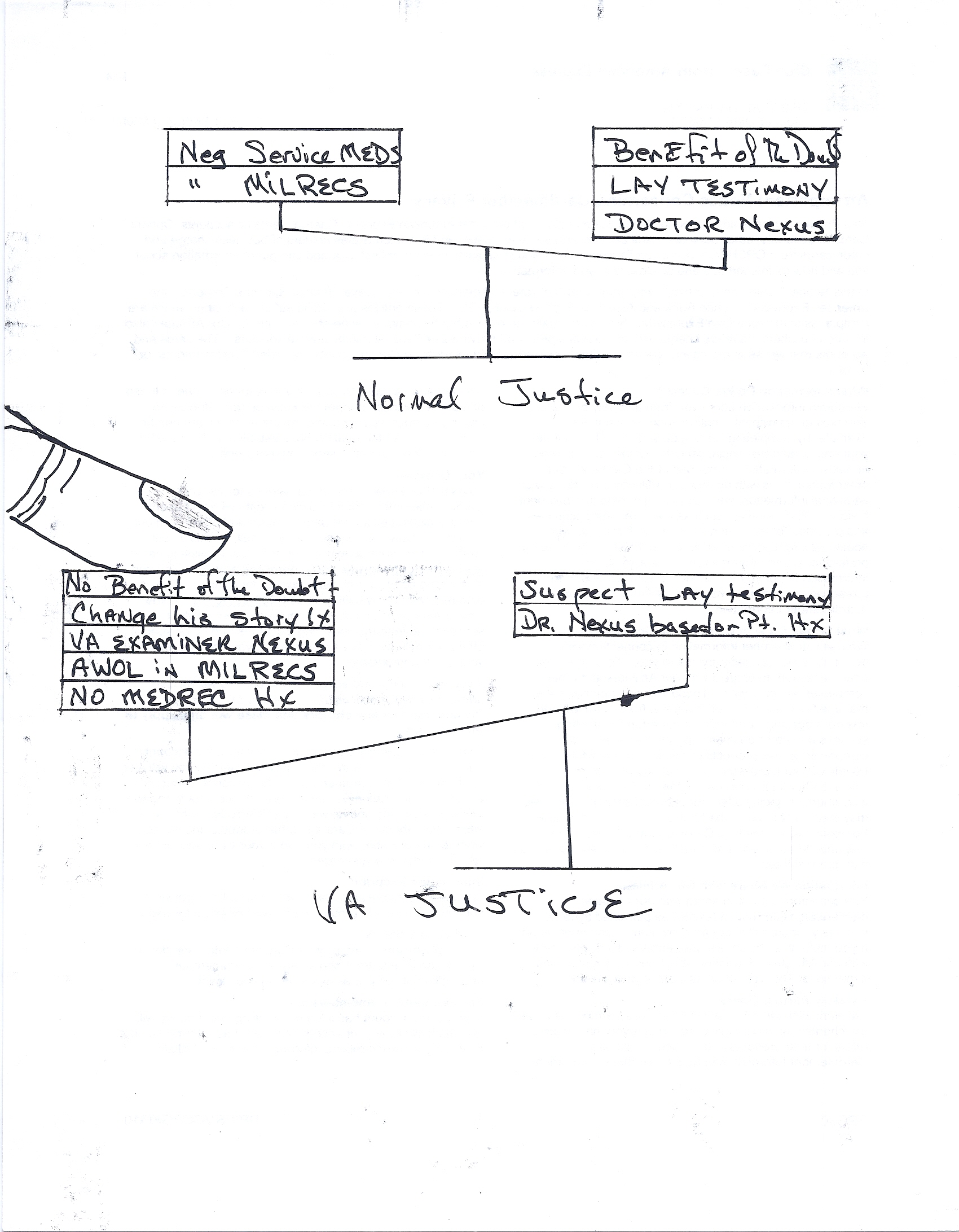
To win at this, your pile has to beat their pile just to get a benefit of the doubt. There is no magic to this. If you are taught by VA instructors that you start with the assumption that the claim is bogus and start filling it in with supportable fact, then you can cease looking for support before you reach the tipping point on the scale. This is one common ploy. Say you had tattoos in service. The entrance and the exit exam says no tattoos because you didn’t think to show them to the pecker checker on the way out. You lose absent several buddy statements. But let’s say you also had VD in service and they fail to look at that as positive evidence of HCV risk. That in itself would win your case but VA ignored it. Do you honestly think that is an accident? These guys look at everything. If you did time at the Graybar Hotel, they know about it even if you neglect to mention it to them.
We had a recent case when member WGM’s rater said “No sir. Wasn’t them jetguns. No way. That ol’ boy got it from patronizing prostitutes. Lookee here in his medrecs. 6, count ’em-6 cases of the clap in service. Willful misconduct! No money for you.” The service officer had to tell them that VD is not willful misconduct. With egg on their faces they admitted it was CUE. What they were also forced to admit was that they had made a finding of fact that it was clap. Now, they couldn’t change their story in mid-stream, so they gave him SC for hep. based on the STDs. VA doesn’t make many errors so this was an aberration. Usually, they have the story line established 15 minutes after they get all the facts. Claim denied due to … oh, yeah, here it is, no medrecs evidence and let’s throw in the failed urine test as proof of willful misconduct. Good deal. Send it down to steno and let’s look at the next one.
With an error rate approaching 70%, one would think it was time to reinvent the process. There must not be suggestion boxes in the coffee break rooms of VAROs. Think how much money they could save doing it right the first time. They might have to lay some of the raters off or let them go.


 asknod
 Bethanie Spangenberg
 kcraveiro
 robinhoodesqvetsatty
 Wesley McCauley
 Veterans Claims Help