When filing a claim for benefits, there are certain things that can unduly influence your success. These may seem mundane and of no import, but they will have an impact larger than you can imagine. First time filers fill out a Form 21-526 that records as much information as can be amassed in order to find your records and enter you into this gargantuan system. Subsequent filings will be done on the venerable Form 21-4138. Of course, if you’re a maverick like me, you shun the bridle and do it yourself on the Standard Form 8 ½ X 11 (white). Nowhere is it cast in stone that you use their paper.
Regardless of which method employed, one thing will stand you in good stead. A brief, concise summary of what you are filing for and why you think it is related to your military service is axiomatic. Where most Vets overlook a golden opportunity is to interject the most primordial reason for the disease that can be ascertained medically. Most initial filings with the VA are a peremptory affair with the majority of the claims documentation following later. This reason is twofold. First, the VSO or the VA stands a better than even chance of losing it and secondly, that is how it has been done for aeons. The VA motto, shared by their VSO lackeys is “If it’s broke don’t fix it”.
Under this scenario, you file and a month or more later VA will send you the standard intro with a “send us what you have and tell us if we need to go fishing for more.” This is all well and fine but there is one small detail many overlook. Much further down the road when the claims file reaches the ratings personnel, the first piece of paper on top will be the original filing document that set this process in motion. As such, it will be read and reread more times than any other document in your entire file. It will have more French fry fingerprint grease and catsup stains on it than any other document.
VA examiners, as they are referred to in BVA decisions, have just so much attention span. This is true for all of us, but when you do this for a living, your eyes tend to glaze over after about 3 or four pages and good comprehension of important evidence is often missed or simply misinterpreted. I have looked at successful claims I have helped with and see one commonality. The rationale in the great majority of them was plagiarized almost verbatim from what the Vet filed and the phrase or rationale was derived from that first document.
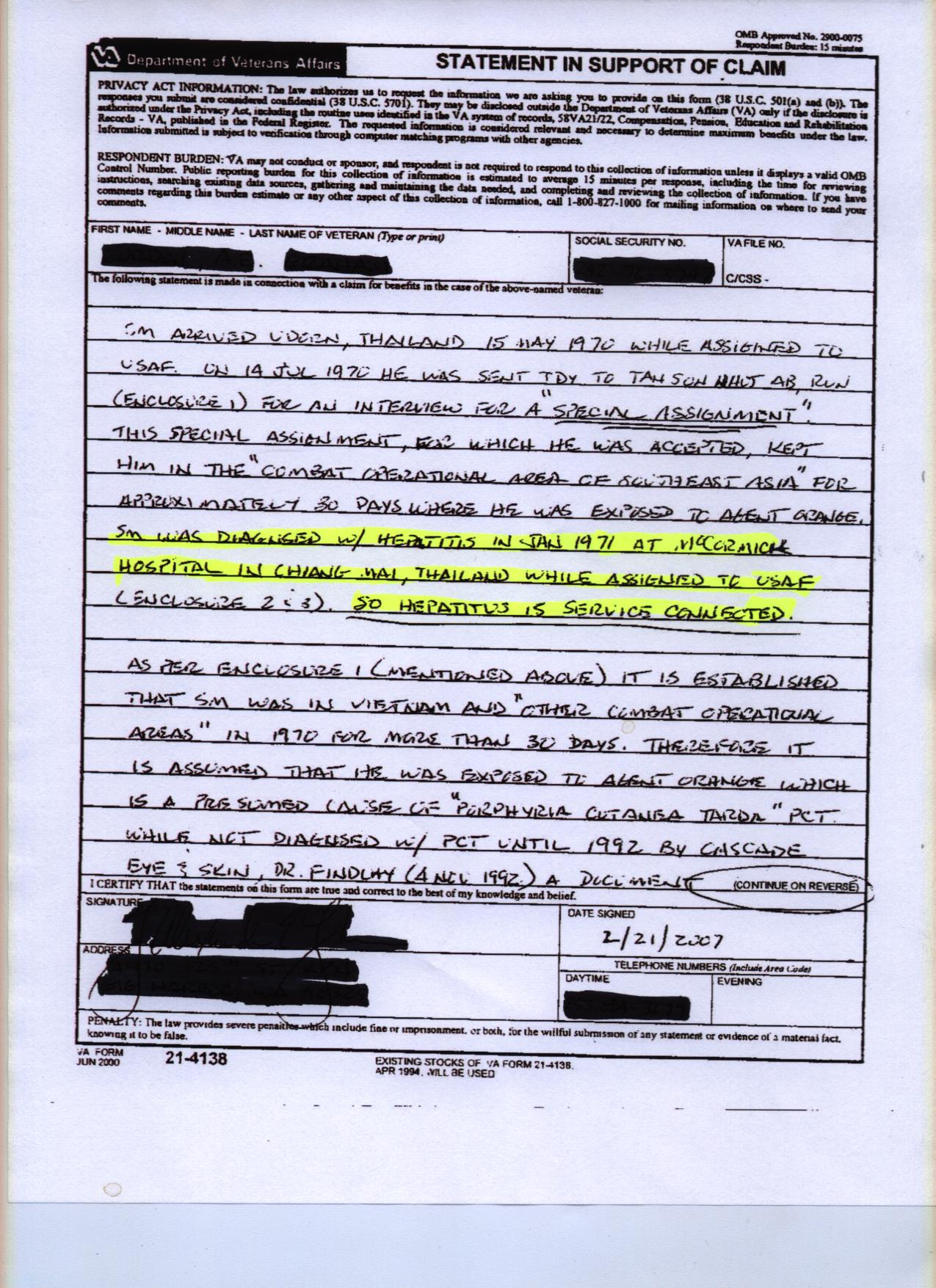
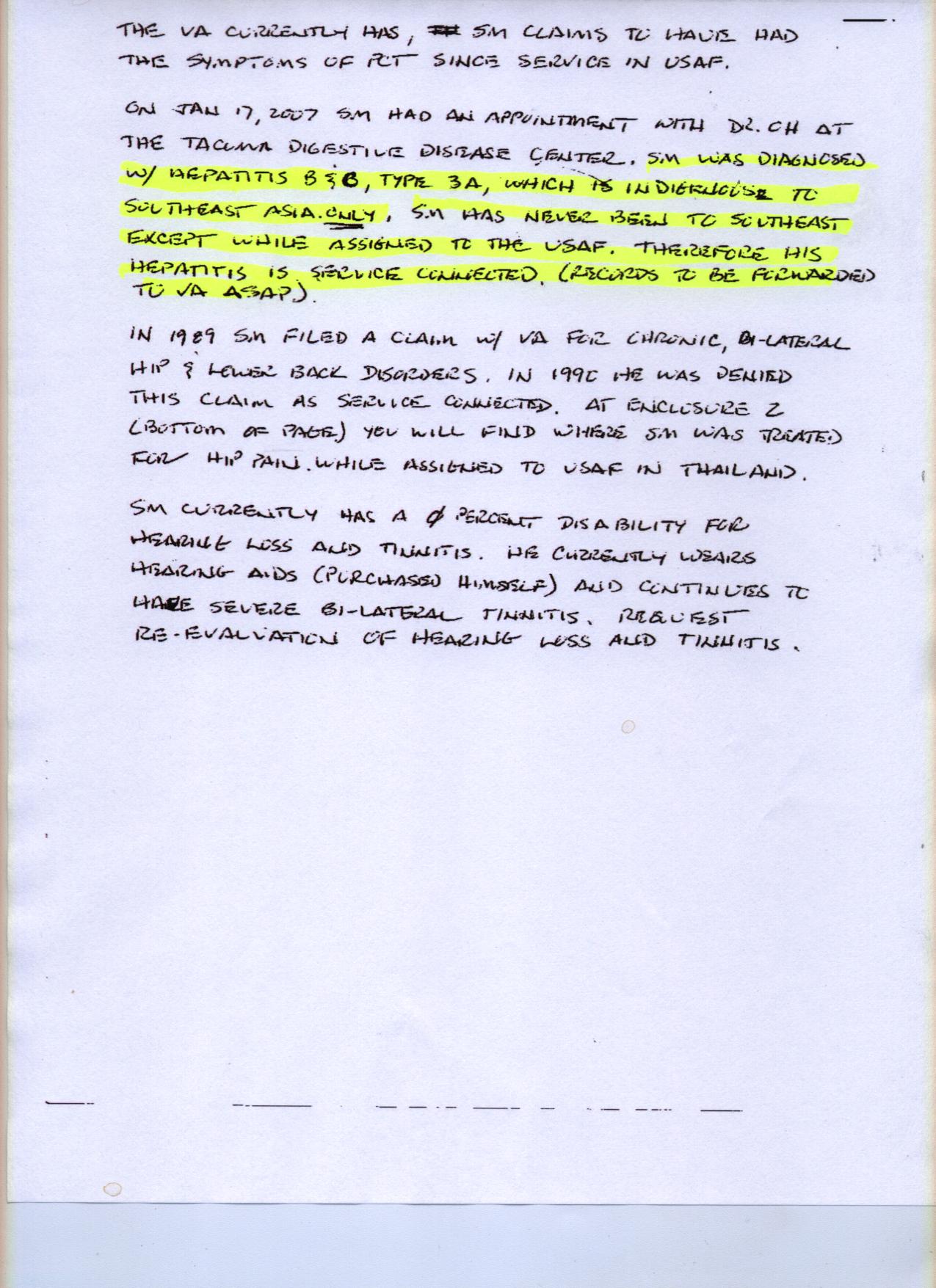
Case in point. I filed, or should say, technically refiled to reopen my HCV/PCT in 2007. Still ignorant of the ways of VSOs, I was doing this with the MOPH representing me. On my initial 21-4138, the rep. and I laid out all the reasons why I felt this was SC. One thing I insisted he enter on my sheet was the fact that my HCV genotype was 3A, dominant only in SEA at the time of my service there. Granted, I had hepatitis in service, but no one ever determined what flavor it was. I honestly believed it was HAV back then. It kicked my ass and I was sicker than a dog for months. Nevertheless, I survived and went on to recuperate after 6 weeks as an inpatient and several months of light duty. When I was diagnosed with PCT in 1992, the doctor ran the tests and determined I had been infected with HBV. He didn’t test me for HCV because it was still relatively unknown.
During the run up to what I figured would be a denial, the rater called me at home and asked for more information about my risks and whether I could document my transfusion from the GSW. It took me several days to remember the name of the pilot I was flying with. Believe me when I say it tasked my brain. I could see the gentleman in my mind’s eye, but couldn’t put a name to him to save my life. While driving to a job site to check on my crew (I was still working a few hours a day), I turned onto Englewood Drive and bingo-Charles “Chuck” Engle, Slats (slang for a 1st. Lieutenant) jumped up and it all came back to me. Forty years of admittedly repressed memories. Being a newbie to the computer, I asked my wife how to find him or show me how. Fifteen keystrokes and a google search later up popped the link that would guarantee my claim’s success…
http://www.virtualwall.org/de/EngleCE01a.htm
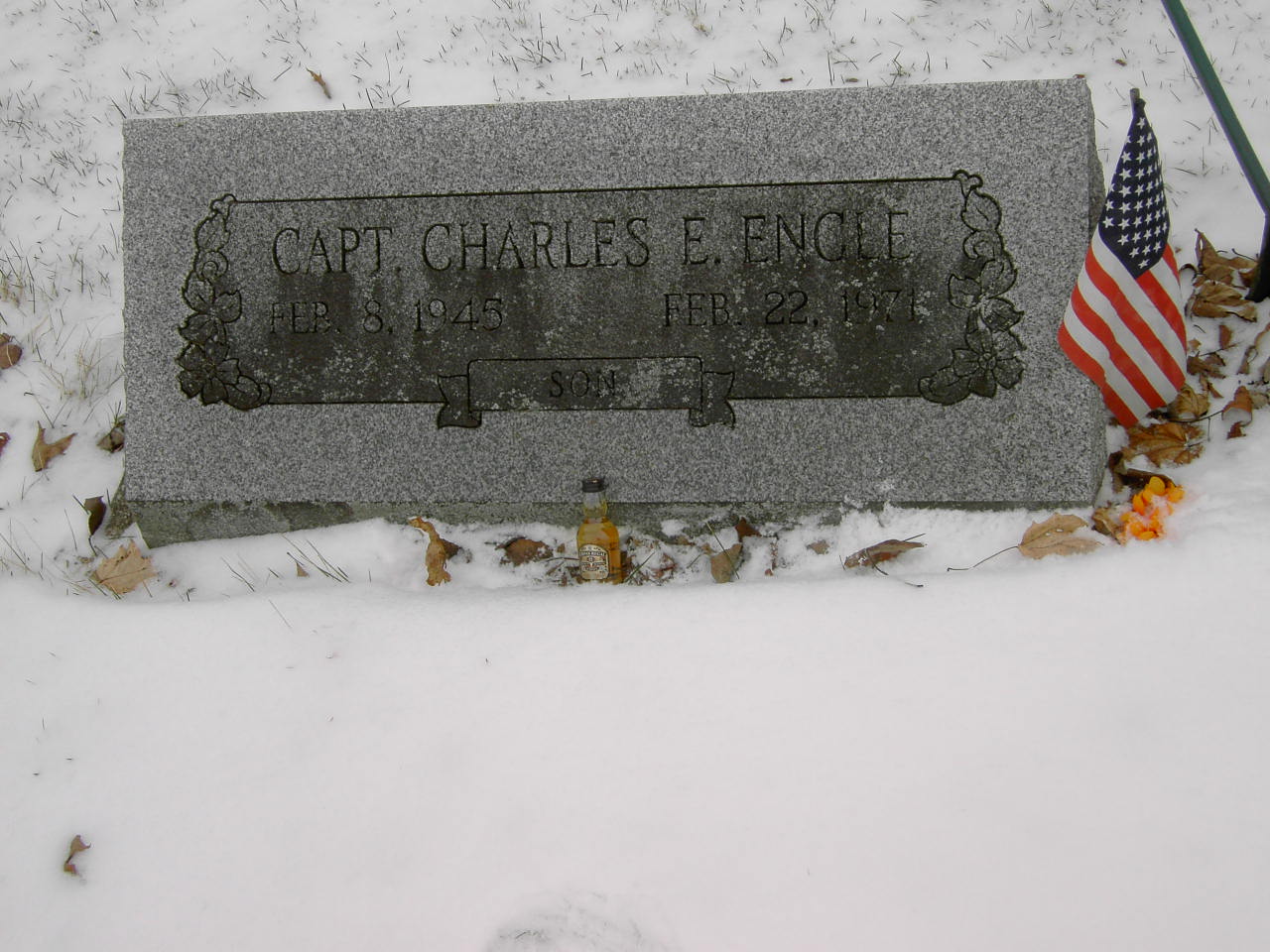
I was still in the hospital when Chuck augured in on the 22nd of February, 1971. I never returned to that assignment and thus never knew he caught the golden BB. This really put a fork in any potential buddy letters as you can imagine. Try as I might I couldn’t put a last name to our crew chief Randy. No one wore uniforms up country so that name tag over one’s right pocket was absent from my memory’s chords.
All I had for evidence was some civilian medical records that documented my hep. 89 days after being wounded, a faded scar where the bullet transversed my upper thigh and a raging case of HCV out of control. Things looked pretty dim. VA wasn’t going to buy my version of events without some tall evidence. The hep records were useful, but VA was still in the “HBV isn’t the same as HCV” mode then. If you didn’t have evidence of HCV in 1970 in your records, then you were screwed. Trying to point out that HCV hadn’t been “invented” until 1989 falls on deaf ears-especially when they aren’t medical ears. VA ignored my nexus letter from my doctor and sent me to a QTC exam. I suppose that would have happened anyway as it’s SOP. The doctor who performed the C&P was an old Chinawoman. I couldn’t understand a word she said so she had her assistant translate. She listened to everything I said and finally asked me to drop my trousers. She carefully measured the GSW and photographed it extensively. That was January of 2008- almost a year from filing.
VA called again in March and asked if there was anything I could think of that might help prove this and also asked when I was going to send in any private medical records in my possession(???). I couldn’t add any more new, but did send in all the ones I submitted to my VSO a year earlier which were promptly lost. I was stumped and so were they. This is when they sent out for an IMO and also where the story returns to why I won.
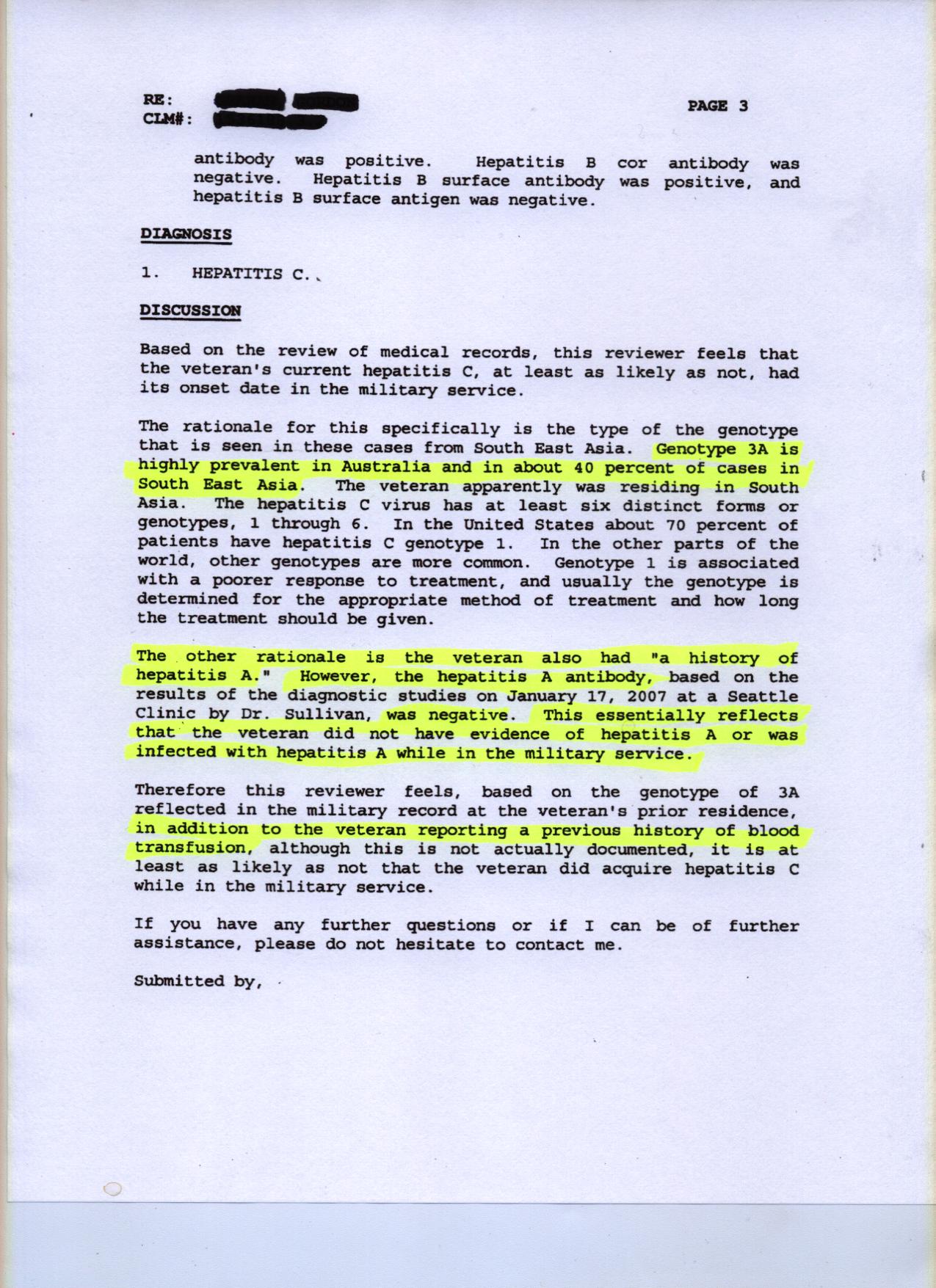
The QTC doctor doing the IMO looked over the whole pile of evidence which was pretty skinny. He correctly pointed out that while I claimed a transfusion, there was nothing to document it other than an obvious GSW scar. However, he seized on two things that were right on the top of the pile in the 4138. Hepatitis in service (documented now) and the genotype. Like all Dick Tracy types, he simply abrogated this evidence for himself and acted as though he had just cut the Gordian knot. Yea, verily, Genotype 3a is of Southeast Asian origin and the hepatitis in service wasn’t HAV, but HBV. Since it was HBV which is blood borne, it was as least as likely as not that I had contracted the C at the same time from the transfusion that was undocumented. I’m sure at that point he felt he had just solved the most complex medical quandary of all time. My private doctor had opined as much in his nexus a year earlier.
The moral of this is simple. You can put the evidence in front of VA examiners but you cannot make them digest it. They live in the M-21 world which demands clear, easy to decipher evidence contained in military medical records. Nexus letters mean nothing unless penned by their own personnel. Doctors, like lawyers, have a keener mind and invoke inductive as well as deductive thought processes to arrive at diagnoses. While I am fond of making fun of the mental midgets who work at the VAROs across the country, I understand their limitations. They are a product of what they are taught and permitted to do. Hillary Clinton wrote a charming novel about how it takes a village to change a light bulb or some such drivel. Similarly, it takes a VARO to arrive at a decision on your claim. The fact that it is in error 70% of the time is immaterial in their mind. They have done their job and it is up to others to sweep up the broken glass if they erred. One small, insignificant entry in and of itself at the very beginning of my claim is what made the difference in my case. Keep this in mind when you file. Condense the initial filing into something short so as not to lose the attention of the examiner. Keep it simple enough that a person of sub par intelligence can assimilate it. And most importantly, enshrine it at the beginning of the process on your initial filing where even a dolt can stumble over it- thus repeatedly stubbing his mental toe in the process. Where, as here, if they still manage to ignore it, your chances are not completely dashed. Should it require a substantive appeal, rest assured that someone with a three-digit IQ will eventually recognize it for its significance. My abiding hope for all of you is to avoid that by utilizing some of these ploys.
If you are filing based on a jetgun risk theory, enunciate the fact that just because there are no documented cases of HCV transmission via the guns, that is not definitive evidence that it has never occurred. Absence of evidence is never incontrovertible proof that something doesn’t happen. Explaining this to the VA is much like discussing the shape of the Earth with a devoted member of the Flat Earth Society. Keep that in mind.
Below are the 2/23/07 refile for Hep./PCT and the QTC IMO that put this in the bag.


 asknod
 Bethanie Spangenberg
 kcraveiro
 robinhoodesqvetsatty
 Wesley McCauley
 Veterans Claims Help