Once again, using literary license, we take pen to paper to illustrate the VA Secretary’s attempts to make an elephant disappear up its own asshole. He rarely succeeds when he gets to the Court and this is a fresh example. I rarely resort to scatalogical terms so I apologize. It is a literary term that best describes what has ensued here.
Mr. James I. Evans comes before the Court, with counsel, to object to what the VA has been doing for years and often getting away with. Occasionally a Veteran will call them on this and it arrives at Indiana Ave. NW for a fresh inspection that reveals this same, seminal defect. This time the Court cut down a few more trees and the decision runs to 18 pages, not including Mr. Evans’ attached Form 9 as evidence. This is a first for the Court as they never publish the documents involved. You will love the rich, controlled language that flows from the decision and the subtle jabs at the Secretary’s vain attempts at post hoc rationalizations (PHRs) for why they tried to railroad James’ claims. The term “post hoc rationalization” has been around for aeons, but has gained notoriety in print in recent years due to the VA’s attempts to employ it so frequently. It’s their latest default setting when explaining what transpired decades ago. Hell, the raters have retired and there are no notes on why they screwed the guy. VA is just attempting to reconstruct the rationale for denial. Absent anything else they bring in the designated apologist. The Court, just as eager to please, has been more than happy to keep telling the Secretary he cannot do this. Perhaps a wet, smoky fire with green Madrona wood and an equally wet blanket to send smoke signals down toVermont Ave. NW to that effect would be in order. Maybe a wet blanket alone? He just doesn’t get it. God can get away with this. He can say He created Eve to keep Adam company and we have to take that as Gospel. The Secretary cannot decide 3K years later that the reason God did this was that a) He was bored; b) had some extra clay lying around and c) was only a couple of ribs shy of a chick, so what the hey? Try this one on for size:
The Secretary further argues that the appellant “explicitly abandoned” the issues of asbestos exposure, hepatitis B, and hepatitis C during his January 2008 hearing before the Board. Secretary’s Br.at 13-14. However, it is the Board that is required to provide a complete statement of reasons or bases, and the Secretary cannot make up for its failure to do so. See Martin v. Occupational Safety & Health Review Comm’n, 499 U.S. 144, 156 (1991) (” ‘[L]itigating positions’ are not entitled to deference when they are merely appellant counsel’s ‘post hoc rationalizations’ for agency action, advanced for the first time in the reviewing court.”). The Board does not discuss the January 2008 hearing in its decision. There is simply no indication that any statements that the appellant or his representative made at that January 2008 hearing influenced the Board’s decision. The Secretary cannot support the Board’s determination by providing reasons for the Board’s decision that were not stated by the Board. Evans v. Shinseki (2011)
In years past, the term for this was “fabricating a new interpretation out of whole cloth”. Recent Presidents have been known to dissemble with meaningless phrases like “Well, shucks fellers. That all depends on what the meaning of ‘is’ is. Ya know?” Presidents can do this. Accountants do the elephant trick all the time. VA needs to take lessons as they haven’t quite got the hang of this yet.
Here, we have a Vet who appealed 6 claims but was verbally challenged and accidentally ended up only appealing three according to VA poohbahs. Instead of just sitting down and saying “Gee, Jimbo. Something’s wrong here. Did you mean to do this? Are you sure?”; true to form they took the path of least resistance, took out their magic 8-ball and construed what the poor man really meant. VA does this all the time. How many decisions have I read where the BVA says something along the lines of “It was felt that he was trying to… or- The claim was construed to be for…” or my favorite “The VA examiners extrapolated…”. Any time you see the word construe, interpreted or extrapolated, it usually spells disaster for the Vet’s claim. In ex parte justice this is all too common and unconscionable. The Vet finds out about 2 years later and goes postal. It certainly didn’t help James to have a VSO. His service officer glossed right over this and probably was sitting in his little VSO office telling the Jimster what to write. This is a small excerpt from the case, but it says it all:
As noted above, VA has a multitude of avenues available to clarify the issues on appeal that are consistent with pro-veteran, claimant-friendly claim development. The entire veterans claims adjudication process reflects the clear congressional intent to create an Agency environment in which VA is actually engaged in a continuing dialog with claimants in a paternalistic, collaborative effort to provide every benefit to which the claimant is entitled. In accordance with the Secretary’s asserted position, VA not only does not engage in such a dialog, but rather need not even communicate to a veteran that he has not perfected an appeal as to certain issues he might otherwise believe are on appeal to the Board until the veteran receives that message many years later in a final Board decision. Evans v. Shinseki supra.
The Evans case will offer us endless ammunition to counteract the proclivity of VA to deny and then years later come back and try to reconstruct the denial reason anew with their latest PHR technique. Even I have been the unwitting recipient of one of these expeditions into the past. And oddly enough, after much brow-beating and chest-pounding (not to mention a DRO review of all the evidence), it was determined that Mr. Nod had inadvertently failed to obey the rules and filed his F 9 incorrectly, thus depriving himself of the right to appeal within 60 days. What is apparent is that they can’t do it with a straight face and are forced to inform you in writing. Hence the ex parte justice. If they had to stand up in court and regurgitate this nonsense, everyone would look at them as if they were blaming it on alien abduction, or God forbid, George Bush.
At any rate, if you like a good Grimm’s faery tale, the Secretary’s version of how this went down is very entertaining. If he’d had a beer summit with the Vet, I’m sure this could have been ironed out and global warming would have been averted or reduced greatly. Once again, this is proof of a governmental agency run amok spending hundreds of thousands of dollars trying to defend the indefensible. It is also proof of why Congress felt the need to bridle the VA with the Veterans Judicial Reform Act (VJRA) of 1988. Perhaps the Secretary should get a bumper sticker that says “If you’re gonna ride my case, have the decency to saddle me first”. Granted, he would look silly wearing a saddle all the time.
Get out the popcorn and a cold IPA for this one. It’s a good read. At the end, Judge Moorman files his dissent and advocates for a much harsher remand than the mild-mannered response of his brethren. These gentlemen are becoming more than fed up with the Secretary and it’s starting to show.
http://www.uscourts.cavc.gov/documents/Evans_08-2133_published_opinion_4-4-2011.pdf
P.S. Below is a classic example of Post Hoc Rationalization. I hope it doesn’t have to go all the way up to the Court. It’s sitting in D.C. right now advanced on the docket because my shelf life sticker is expiring soon.
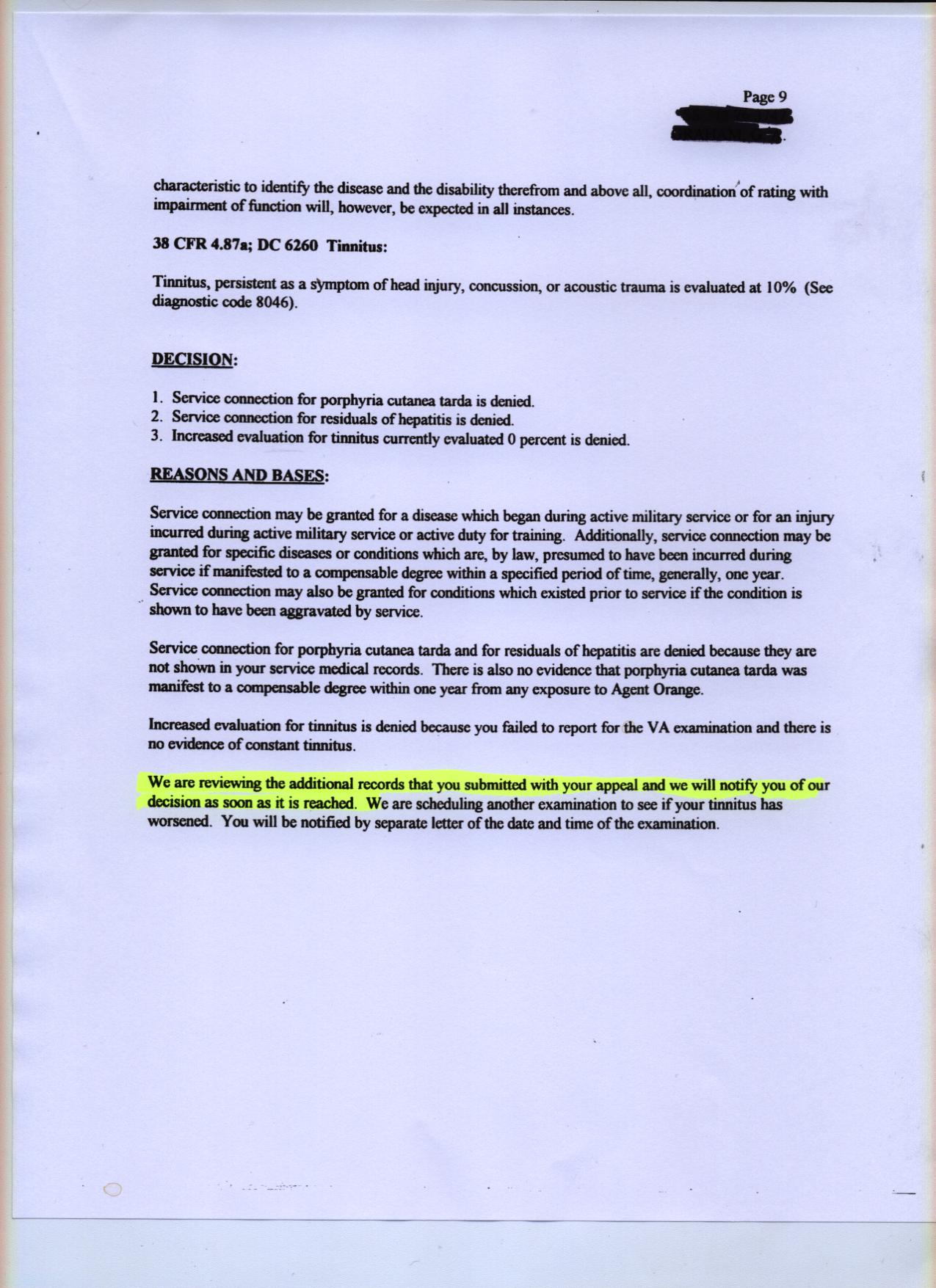
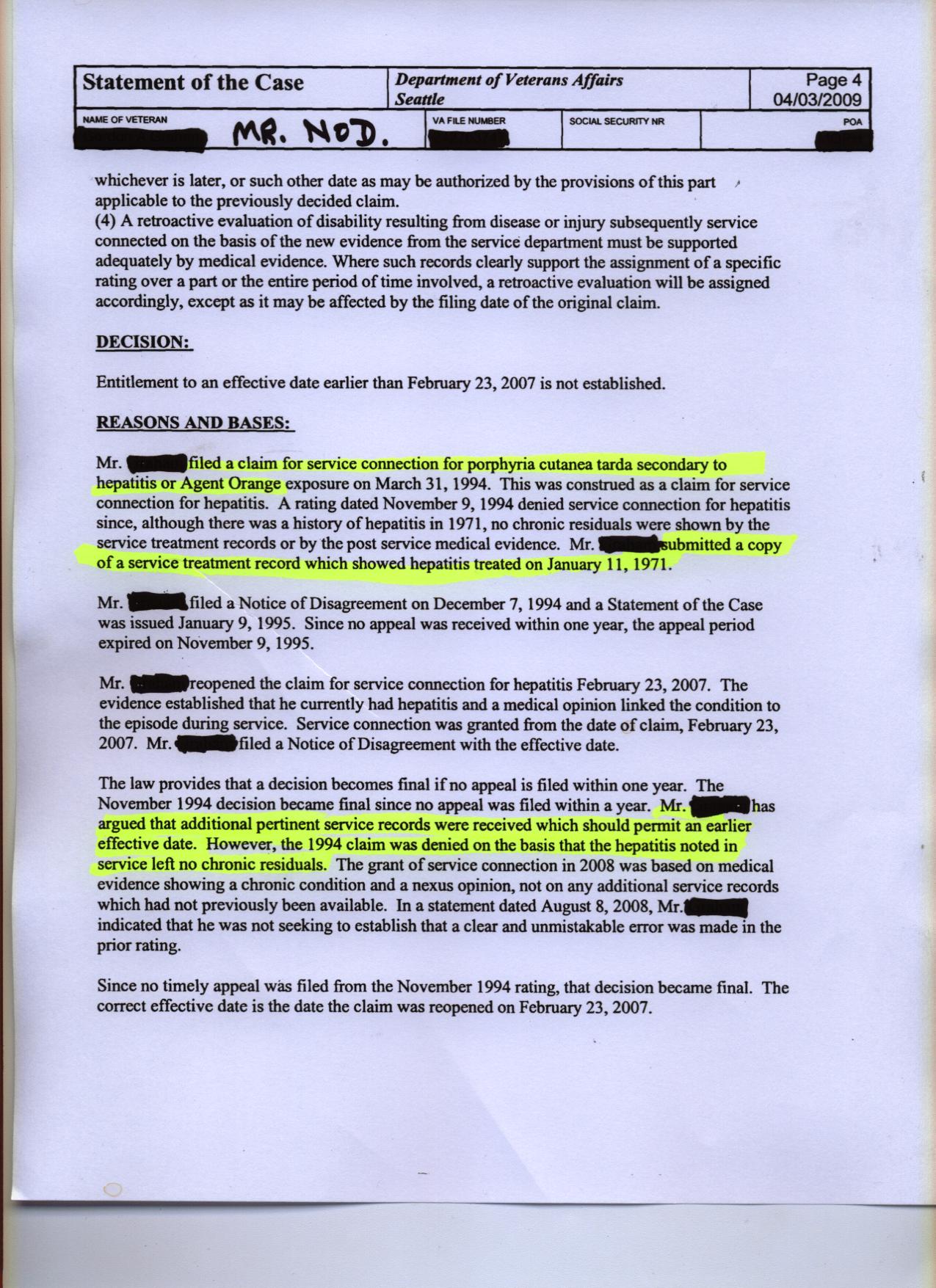
Attached is a post hoc rationalization made 14 years after a denial. On the blue-hoo sheet (#1) it states”The service record shows history of treatment for hepatitis in 1971 during his duty in Indochina.Treatment for hepatitis is not shown in the available service record.” This puzzled me for a while until I remembered some of my military career was spent working for AirAm. That was where I was when I came down with hep. My military SMRs have no record of it. I mentioned it in my separation exam and that is the “history of treatment” they mention. Since I had a copy of my off road medical records, I sent one in (#2). And since they said I wasn’t in Vietnam, I also sent them a copy of TDY orders showing I was. I got an SOC in January of 95 (3) that said “Roger on the records. We’ll get back to you.” Like a jilted lover, I waited, but that was the last I heard.
I refiled in 07 and won in 08. I filed for the 1994 date in my 2008 NOD and the 09 SOC (DRO review, no less) shows the revised post hoc rationalization (4). All of a sudden, records sent in with the 12/94 NOD are moved to appear to have been sent in with the 3/ 94 claim. Now the rationale for the 11/94 denial shifts to”However, the 1994 claim was denied on the basis that the hepatitis noted in service left no chronic residuals”. No mention of “history” or “treatment” now. The reader will notice that the PCT issue is no longer associated with the hepatitis as in “residuals of hepatitis”. It has been sidelined and thrown out as in “you were never in Vietnam, Mr. Nod.”. Bingo. No more residuals. As usual, my good buddy at the VSO never mentioned getting a nexus from the skin specialist who identified it (the PCT). Actually, that nexus requirement didn’t become mandatory until a year later in the Caluza v. Brown decision. All in all, VA did a bang up job of rearranging the furniture and moving the documents around to fit the picture. Police call this staging a crime scene. VA calls it a probative analysis of the available information. One little problem. When you submit new documents, they have to redo the decision from scratch [38 CFR 3.156(b)]. Absent a do over, the Vet cannot file his appeal (Form 9). That is why they said “we will notify you as soon as our decision is reached”. There’s no regulation that says you have to file the F-9 to get a do over. The DRO danced around the fact that they never called me back. That’s where it sat for 14 years. Now, ladies and gentlemen-watch closely. The typewriter is faster than the eye. Approximately a year later on the PCT DRO review, they finally address that pesky #4 document. This time VA opts for a novel PHR (#5) “The narrative portion also noted that the above TDY orders were received and that you would be further notified of a decision. This subsequent decision would have been a SSOC issued subsequent to your filing a timely VA Form 9.” No mention of the simultaneous submission of the off road hep. medrecs. Just a failure to submit the F-9 in order to receive my SSOC denial. VA eats 38 CFR for breakfast every morning and they damn sure don’t cotton to the idea of having to pay a shitton of bucks out for their screwup. It’s easier to employ the PHR technique and reconstruct history to comport with a “revised” version. Since the new PHR version reveals I never appealed, the claim is DOA. Pretty fancy footwork, huh? These guys would be naturals for Dancing with the Stars.





 asknod
 Bethanie Spangenberg
 kcraveiro
 robinhoodesqvetsatty
 Wesley McCauley
 Veterans Claims Help